China’s H-20 stealth bomber promises a leap in strategic capabilities but remains plagued by critical challenges delaying its operational debut.
The quest for air dominance in the 21st century has led China to develop its H-20 stealth bomber, a new-generation flying-wing designed to challenge U.S. supremacy in long-range strike platforms. Despite ambitious plans and high expectations, as 2026 unfolds, the aircraft faces significant technical hurdles. With the United States accelerating their B-21 Raider program, Beijing is caught in a race against time to transform the H-20 from concept to a credible global strategic asset.
Delving into the advanced design features of the H-20 stealth bomber
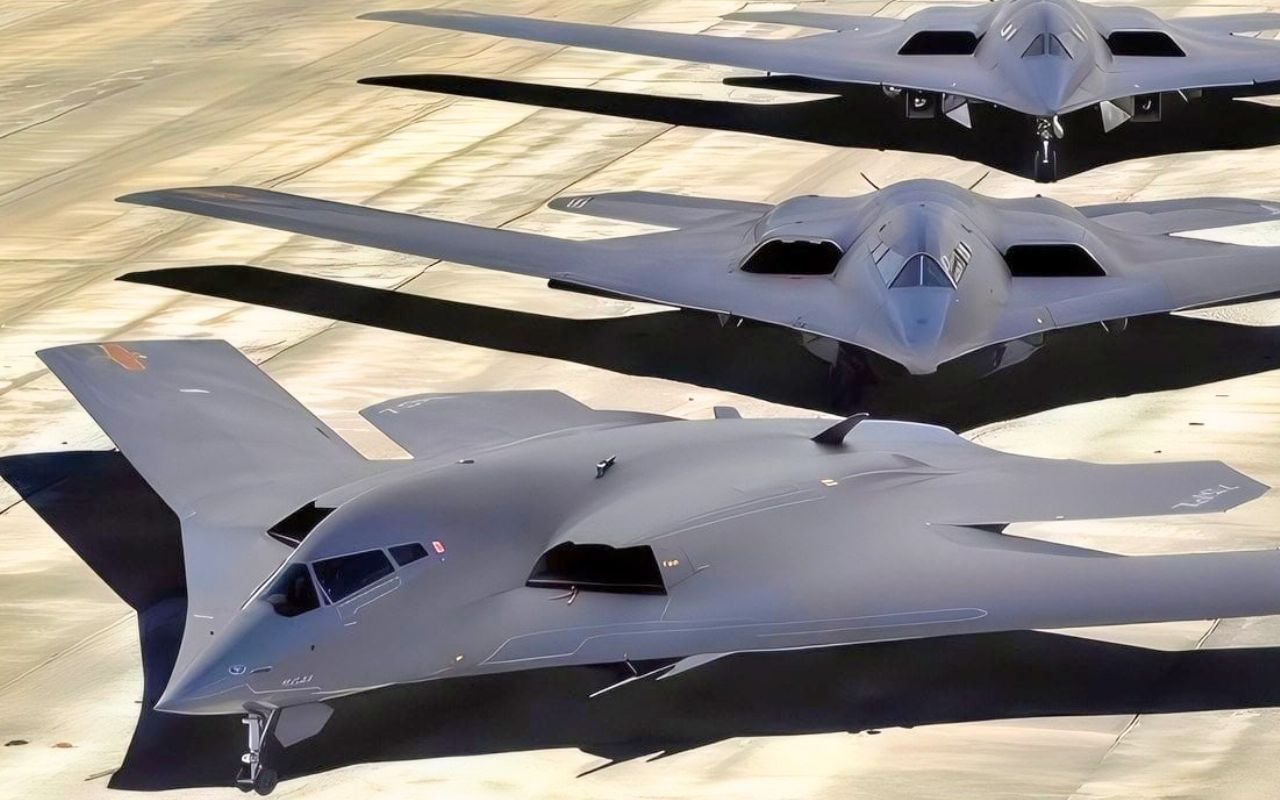
The H-20 represents a major technological upgrade over China’s legacy bomber fleet, embracing stealth technology and long-range strike capabilities that aim to close the gap with American bombers like the B-2 Spirit. Its flying-wing design is significant; this configuration is renowned for minimizing radar cross-section, offering superior low-observable features compared to traditional bombers. The H-20’s smooth fuselage and absence of vertical stabilizers mirror the characteristics that have made the B-2 a benchmark in stealth aviation. This bomber is designed with multiple internal weapons bays capable of housing a variety of payloads, including nuclear and conventional munitions. Reports suggest these internal bays can hold several tons of armaments, enhancing mission flexibility while maintaining stealth integrity. Unlike older Chinese bombers, which rely heavily on external payloads that increase radar visibility, the H-20’s internal carriage reflects a conscious effort to balance capacity and stealth. One of the critical components of the H-20’s advanced design is its range capability. Estimates place its unrefueled flight radius between 8,500 and over 10,000 kilometers, making it a platform capable of reaching targets deep within the Indo-Pacific region and potentially beyond without mid-air refueling. This range is strategic, enabling the People’s Liberation Army Air Force (PLAAF) to operate past the Second Island Chain — a key defensive perimeter for the United States and its allies. Thermal management and engine cooling systems are areas where the H-20 aims to integrate cutting-edge solutions to keep its infrared signature low. Maintaining stealth is not solely about deflecting radar but also evading thermal detection, especially as adversaries deploy increasingly sophisticated infrared sensors. However, these areas have contributed to significant development challenges, indicating the complexity of achieving the aircraft’s stealth and performance goals simultaneously. In summary, the H-20’s advanced design incorporates lessons from Western stealth bombers while introducing indigenous innovations tailored to China’s strategic needs. Its flying-wing architecture, extensive internal payload capacity, and ambitious range targets embody China’s goal to leapfrog into the upper echelon of strategic aviation.
Engineering struggles and delays: why the H-20 program remains frozen in time
Despite its promise, the H-20 program has not proceeded as swiftly as Chinese officials and military strategists would desire. Reports from early 2026 reveal that the bomber remains “frozen in time,” grappling with persistent engineering challenges that have delayed its operational entry indefinitely. This stagnation stands in stark contrast to the accelerated development and deployment of the United States’ B-21 Raider bomber. One of the pivotal issues hindering progress is thermal management. Efficiently cooling the aircraft’s engines and onboard systems without compromising its stealth profile remains a demanding technical obstacle. The challenge arises because conventional cooling systems often produce detectable heat signatures, undermining low observability. Engineers at Xian Aircraft Industrial Corporation have struggled to perfect these systems, which has slowed final testing phases. Another setback involves integrating next-generation avionics and weapon systems. Modern stealth bombers rely heavily on sophisticated electronics that enhance situational awareness, targeting precision, and survivability in contested airspace. However, the H-20’s development has revealed compatibility issues and software complexities that have required redesign efforts, adding months if not years to the timeline. Furthermore, the lack of extensive operational testing prolongs uncertainty about the bomber’s real-world capabilities. Unlike the B-2, which has accumulated decades of flight hours and combat experience, the H-20 prototypes have yet to reach a stage where they can undergo rigorous trials under realistic conditions. Without these trials, China misses critical data to refine and certify the aircraft for frontline deployment. These engineering hurdles have forced a shift in China’s timeline, with official statements now projecting the H-20’s public unveiling and operational readiness into the 2030s. While the delay is frustrating, it underscores how building a stealth bomber of this caliber demands immense resources, research, and patience — especially for a country still scaling this technology.
Comparing China’s H-20 with the U.S. B-21 Raider: strengths and weaknesses
The quest to match or surpass U.S. stealth bomber technology places the H-20 in direct competition with the B-21 Raider, the Pentagon’s next-generation stealth bomber platform. Despite similarities in flying-wing design and strategic role, the two aircraft diverge significantly in maturity, integration, and expected operational impact. The B-21 Raider has already entered advanced testing and limited deployment, benefiting from decades of cumulative experience from predecessor bombers like the B-2 and B-1B. Its stealth features are state-of-the-art, combining radar-absorbent materials and advanced electronic warfare systems. It is also equipped with a digital backbone that enhances connectivity, enabling seamless integration into joint force networks worldwide. In contrast, the H-20 remains a prototype, laden with developmental uncertainties. U.S. defense officials emphasize that China has yet to overcome fundamental engineering limits to produce a bomber comparable in stealth, range, and payload versatility to the B-21. Thermal management failures, avionics integration, and lack of operational testing are cited as critical deficits. Nonetheless, the H-20’s potential should not be dismissed outright. Even a partially successful platform would bolster China’s regional power projection dramatically, providing a persistent threat in contested maritime and air spaces like the South China Sea and Taiwan Strait. The H-20’s expected range allows it to target U.S. bases such as Guam, extending China’s anti-access/area denial (A2/AD) strategies.
The divergence between the two bombers is captured in this comparative overview:
| Aspect | China’s H-20 | U.S. B-21 Raider |
|---|---|---|
| Design type | Flying-wing stealth platform | Flying-wing stealth platform |
| Operational status | Prototype stage; expected operational in 2030s | Advanced testing; nearing limited operational deployment |
| Range (unrefueled) | 8,500–10,000 km (est.) | 10,000+ km |
| Stealth features | Advanced but with thermal management challenges | State-of-the-art, proven radar and IR stealth |
| Weapon payload | Multi-ton internal bays; nuclear and conventional | Multi-ton internal bays; nuclear and conventional |
| Electronic warfare and avionics | Under development; facing integration issues | Highly advanced and integrated network-centric systems |
This contrast highlights that while China is catching up technologically, it still lags behind the U.S. in producing a fully mature, operational stealth bomber capable of global reach and high survivability.
The strategic implications of the H-20 for Asian-Pacific power dynamics
The introduction of a credible stealth bomber with intercontinental range will reshape military calculations across the Asia-Pacific region. For years, China’s strategic bombing capabilities relied primarily on older platforms like the H-6 series, with limited stealth and relatively short range. The H-20 aims to change that by enabling China to threaten critical U.S. military installations and allies far from its coast. Should the H-20 enter service as envisioned, it would extend China’s anti-access/area denial (A2/AD) defenses well beyond current limits. This new reach increases pressure on U.S. Pacific bases such as Guam, a linchpin in American military presence. It also challenges regional powers’ defense postures, forcing Japan, South Korea, Australia, and others to reconsider force deployments and missile defense investments. Additionally, the bomber’s capability would mark the first time China possesses a dedicated strategic platform capable of delivering nuclear and conventional payloads at global ranges, cementing a true nuclear triad. This development escalates the strategic competition, particularly given ongoing tensions surrounding Taiwan and disputed maritime territories. China’s pursuit of the H-20 also carries diplomatic weight. It signals Beijing’s commitment to asserting power projection and deterrence in the face of U.S. efforts to maintain military superiority. The bomber’s existence puts pressure on the U.S. and NATO allies to augment their own capabilities and reinforces the need for multilateral security frameworks in the region.
Below is a summary of key strategic shifts anticipated with the H-20 deployment:
- Extended strike reach beyond traditional boundaries into the western Pacific
- Enhanced nuclear triad capability for China
- Expanded A2/AD zones threatening U.S. forward operating bases and allied nations
- Increased defense spending among regional actors responding to perceived threat
- Heightened geopolitical tensions forcing diplomatic and military recalibrations
Looking ahead: challenges and prospects for the H-20’s future operational deployment
China faces numerous hurdles before the H-20 can join its active fleet, but the program’s strategic importance ensures continued investment and prioritization by Beijing. Over the next decade, advancements in stealth technology, engine design, and avionics are critical milestones toward realizing the bomber’s potential. Improvement of China’s aerial refueling fleet is also essential. The H-20’s theoretical extended range can be substantially increased through in-flight refueling, allowing truly intercontinental missions. Yet, China’s current tanker aircraft capabilities lag behind those of the United States, hampering full operational flexibility. Further testing and incremental upgrades will determine how effectively China can resolve thermal management and avionics integration issues. Any failure to address these could limit the H-20 to regional roles rather than transforming it into a global strategic bomber. Meanwhile, the bomber’s potential role as a “campaign-shaping platform” remains an attractive prospect for the PLAAF. Deployment of the H-20 could compel adversaries to alter their force postures, redistribute assets, and engage in costly countermeasures, thereby providing a strategic advantage for China even before the bomber takes active part in conflict. Looking to the future, the H-20 embodies both ambitions and challenges intrinsic to China’s technological rise. Success would position Beijing as a dominant strategic airpower contender, but failure to overcome complex development issues will reinforce America’s existing aerial supremacy for years to come. The above video provides a detailed analysis of the H-20’s design innovations and ongoing development hurdles, offering a closer look at how China plans to close the stealth bomber gap with the United States.
When is China’s H-20 expected to enter operational service?
Current projections estimate the H-20 may become operational sometime in the 2030s, as technical challenges continue to delay earlier timelines.
What are the main technical challenges facing the H-20 program?
Key challenges include managing the aircraft’s thermal signature to maintain stealth, integrating advanced avionics, and ensuring reliable engine cooling systems.
How does the H-20’s range compare to that of the U.S. B-21 Raider?
Estimates suggest the H-20’s unrefueled range is around 8,500 to over 10,000 km, while the B-21 Raider likely exceeds 10,000 km, allowing for more extensive global reach.
What strategic impact will the H-20 have on Asia-Pacific security?
Once operational, the H-20 could extend China’s strike capabilities deep into the Pacific, enhancing A2/AD zones and posing serious challenges to U.S. and allied defense operations.
Does the H-20 enhance China’s nuclear deterrence capabilities?
Yes, the H-20 is expected to play a key role in China’s nuclear triad by providing a long-range, stealthy platform capable of delivering nuclear weaponry.
