
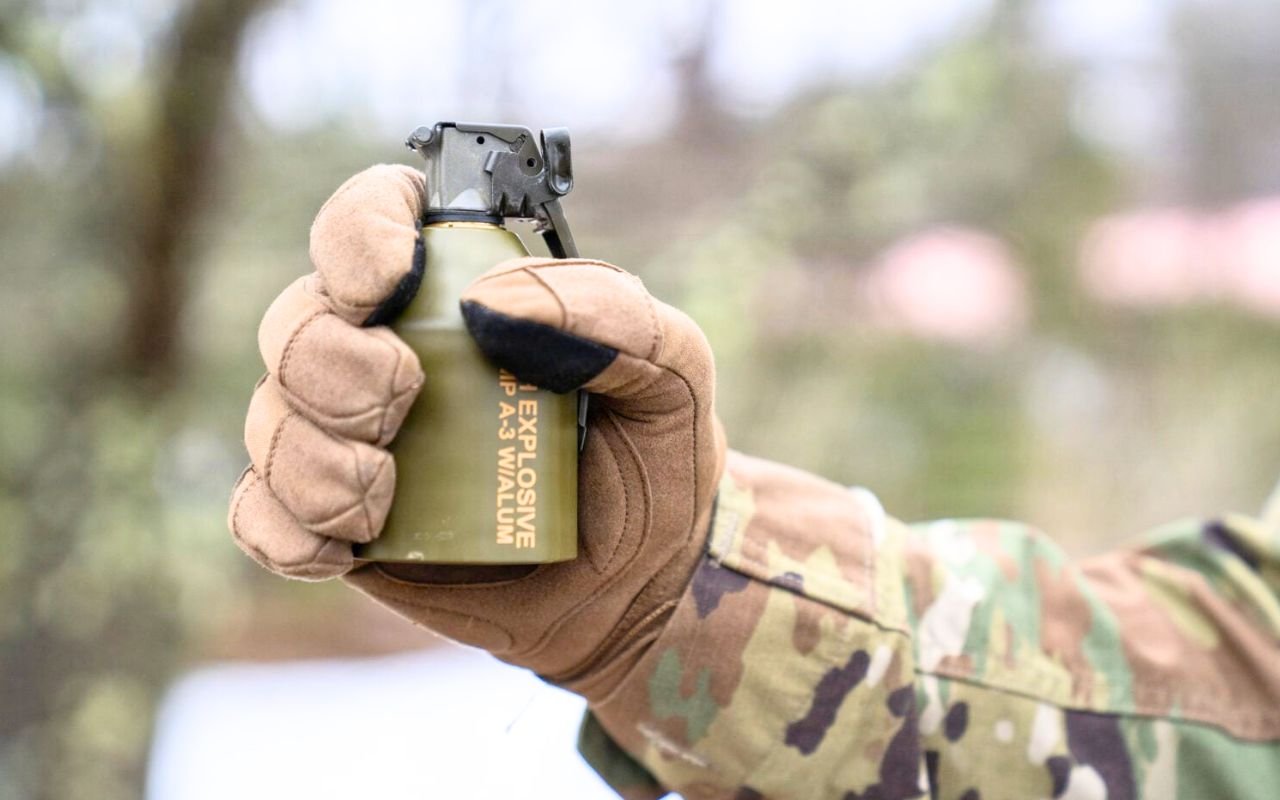
The U.S. Army has unveiled a game-changing offensive hand grenade, its first new lethal model introduced since the late 1960s, promising enhanced battlefield versatility and soldier safety.
After more than fifty years without a significant update, the U.S. Army’s latest innovation in hand grenades marks a milestone in military ammunition technology. The new grenade intends to blend superior lethality with adaptable operational use, aiming to empower warfighters with greater precision and flexibility in close combat. This advancement arrives amid evolving warfare demands and increasing emphasis on soldier survivability and effectiveness.
The evolution of hand grenades in modern warfare: a 50-year gap finally bridged
The gap of over five decades since the last major hand grenade revision reflects a period where many military tools saw incremental tweaks rather than wholesale redesigns. The M111 Offensive Hand Grenade, developed at the Picatinny Arsenal, is the product of modern engineering responding to the complex needs of contemporary combat scenarios. Hand grenades have historically been indispensable tools for infantry, effectively clearing trenches, bunkers, and urban environments. However, legacy models like the M67 have long been criticized for limitations in blast control and fragmentation patterns, sometimes posing risks to fellow soldiers in confined spaces. The breakthrough with the M111 lies in its multi-purpose design. It integrates both enhanced fragmentation and controlled blast overpressure, a dual action that offers a tactical edge invisible in prior models. This means that soldiers can achieve greater neutralization of threats with reduced risk of unintended collateral damage or self-injury. This approach reflects broader shifts in military technology favoring scalability and adaptability. Soldiers on the frontline face diverse terrains and unpredictable enemy behaviors, so ammunition that can adjust or deliver different effects without needing multiple variants is a major tactical advancement. Moreover, the modernization of grenades aligns with the Army’s strategic pivot to near-peer conflicts, where precision and survivability become even more critical. The M111 promises soldiers more confidence when operating in tight quarters or amidst civilian populations, where careful application of lethal force is essential. This new grenade was not developed in isolation but emerged from extensive research, testing, and soldier feedback over several years, underscoring the military’s commitment to user-centric enhancement.
Design breakthroughs powering the M111 offensive hand grenade’s capabilities
The innovation behind the M111 isn’t just in its lethality; it’s about its smart design that answers multiple combat challenges. The new grenade is engineered to provide a balance between powerful blast effects and fragmentation control, which historically has been a trade-off in grenade design. Blast overpressure refers to the intense pressure wave produced by the explosion, capable of incapacitating enemy combatants without relying solely on shrapnel. The M111’s enhanced overpressure can neutralize threats with greater efficiency in enclosed areas. At the same time, fragmentation remains a critical lethality factor. The M111’s casing is optimized to produce controlled shards, increasing effectiveness while minimizing unintended casualties. This design results from careful metallurgical studies and blast physics simulations. Another impressive feature is the grenade’s safety and handling improvements. The M111 follows a familiar five-step arming sequence that mirrors legacy grenades like the M67, easing soldier transition without new training hurdles. This design choice reduces misfires and handling accidents, directly contributing to troop safety. The grenade’s adaptability also suits multiple mission profiles—from offensive offensives clearing enemy bunkers to defensive operations in urban warfare. Importantly, soldiers will have better options when deciding whether to leverage shock blast or maximum fragmentation effects. This versatile approach highlights the Army engineers’ commitment to developing a grenade that is not only lethal but tactical, aligning with the increasing complexity of modern military operations where precision under stress is paramount. By combining lethality, safety, and versatility in one package, the M111 sets new standards in how infantry units can approach the battlefield with confidence.
Training and integration: ensuring soldiers maximize new grenade effectiveness
Introducing cutting-edge weapons into the field requires comprehensive training to ensure soldiers can safely and effectively employ them. The M111 offensive grenade rollout is no exception, emphasizing seamless integration with existing soldier doctrine and skills. Training versions like the M112 replicate the M111’s weight, handling, and arming procedures but without live explosives. This lets troops practice realistic deployment techniques while minimizing risk during exercises. Using a consistent five-step arming sequence simplifies the learning curve. Soldiers familiar with older grenades can transition rapidly to the M111 without needing to relearn fundamental handling behaviors, which is crucial during deployments where rapid adaptability matters most. The Army has incorporated simulation and live-fire training modules designed to showcase the grenade’s varied effects, preparing soldiers to select the right tactical response based on situational demands. For instance, knowing when to emphasize blast overpressure over fragmentation can mean the difference between neutralizing a target effectively and avoiding excessive danger to others nearby. A detailed feedback loop during this training phase has already provided insights into user preferences and minor tweaks needed for optimal performance, fueling continuous improvement from design to field deployment. The comprehensive preparation ensures the M111 will truly empower the warfighter, enhancing combat readiness without compromising safety or familiarity. Alongside hands-on training, digital learning tools and immersive virtual reality scenarios help soldiers internalize new grenade tactics, aligning with the Army’s broader modernization efforts.
What this grenade means for infantry tactics and future ordnance development
The M111 offensive grenade represents more than just a new tool; it signals a shift in infantry tactics and future explosives development philosophy. Ready availability of a multi-purpose, adaptable hand grenade can reshape combat strategies, particularly in close quarters battles and urban warfare. Infantry units now have more nuanced options for engaging enemies, avoiding the “one-size-fits-all” approach of traditional grenades. Commanders can plan missions that leverage precise effects to reduce collateral damage and improve soldier survivability simultaneously. Moreover, the M111 is a stepping stone towards more intelligent ordnance. Research into scalable blast yields and fragmentation patterns hints at future grenades equipped with electronic controls or selectable detonation intensities, tailored to specific mission profiles. These advancements align with the military’s broader goals to increase lethality while managing operational risk and ethical engagement standards. The M111’s introduction may influence allied militaries too, encouraging international arms development competition and collaboration. The success of this grenade could spark a wider reevaluation of infantry ammunition, potentially extending to other areas like mines, rockets, and specialty explosives, all geared towards adaptability and soldier-centric design.
This turning point underscores the evolving role of infantry in hybrid and asymmetric warfare environments where precision, flexibility, and rapid response are valued over sheer brute force alone.
List: key features of the M111 offensive hand grenade
- Dual action: blast overpressure combined with controlled fragmentation
- Enhanced safety: familiar five-step arming sequence to minimize mishandling
- Versatile usage: suited for both offensive assaults and defensive clearing operations
- Training compatibility: uses M112 training grenade mirroring real combat conditions
- Reduced collateral risk: optimized fragmentation pattern for tighter blast zones
- Designed for modern warfare: aligns with soldier-centric, adaptable tactical needs
Timeline of the M111 grenade’s development and deployment phases
| Phase | Year | Milestone |
|---|---|---|
| Conceptual design | 2018 | Initial specifications and user feedback gathered |
| Prototype development | 2020 | First physical models created and tested |
| Testing & Evaluation | 2022 | Live-fire and user testing complete |
| Full material release approval | 2024 | Official Army clearance for field deployment |
| Initial fielding | 2025 | Deployment began with frontline infantry units |
What makes the M111 grenade different from previous models?
Unlike earlier grenades, the M111 offers a combination of blast overpressure and controlled fragmentation, enhancing lethality while reducing risks to friendly forces.
When did the U.S. Army officially approve the M111 grenade for use?
The M111 Offensive Hand Grenade received Full Material Release approval in 2024 after extensive testing phases.
How does training with the M112 aid soldiers?
The M112 training grenade mimics the M111’s weight and arming steps without live explosives, allowing safe and realistic practice.
What tactical advantages does the M111 provide infantry units?
It allows infantry to select blast or fragmentation effects based on the combat situation, improving effectiveness and minimizing unintended harm.
Could this grenade influence future military weapon development?
Yes, it signals a trend toward adaptable, scalable ordnance and may inspire more intelligent explosive designs in coming years.
