
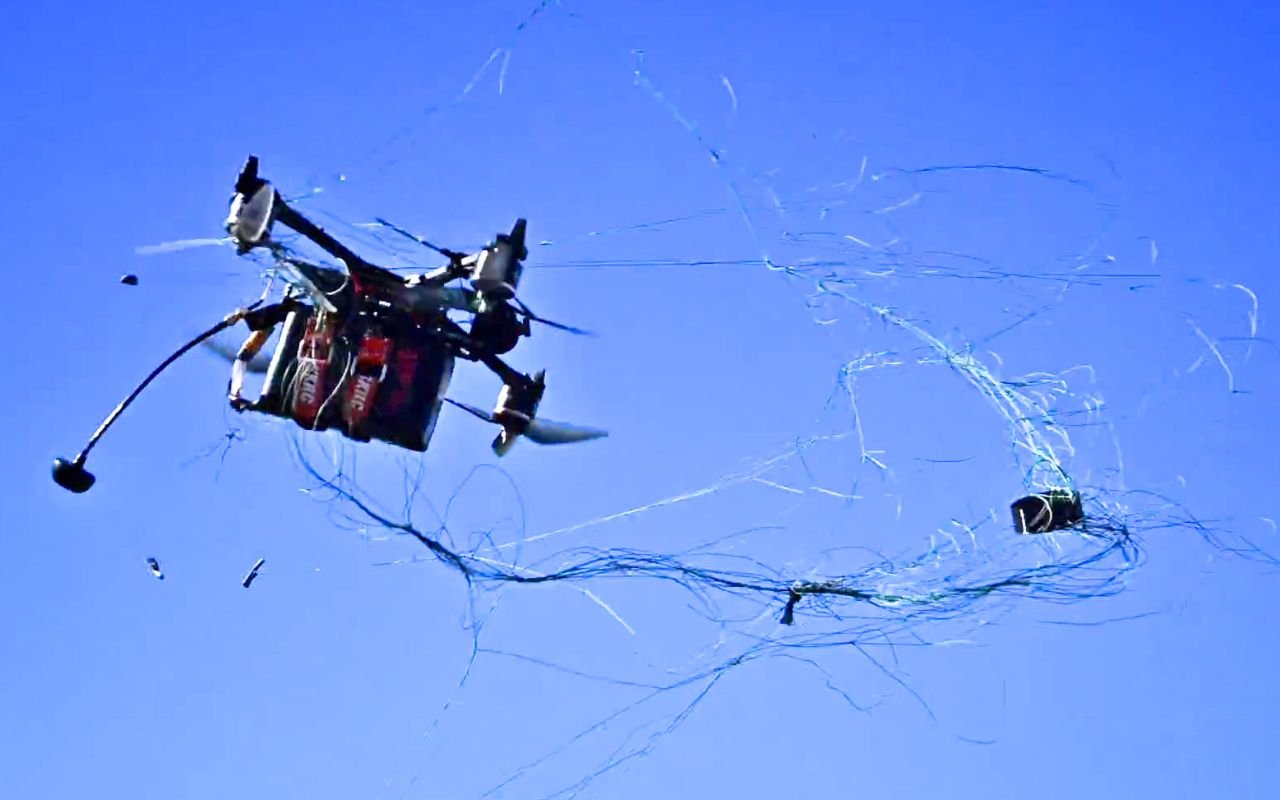
The rise of FPV drones has prompted groundbreaking countermeasures, and a Ukrainian company’s innovative ‘Chipa’ net gun is reshaping aerial defense tactics.
In the evolving battle against unmanned aerial threats, particularly FPV (first-person view) drones, Ukraine has taken a significant leap forward with the development of a new interception device. The Ukrainian firm BlueBird Tech introduced the ‘Chipa,’ a compact, pistol-style net launcher designed to incapacitate drones at close range. As drone technology becomes more accessible and poses increasing risks on modern battlefields and urban environments, this innovation offers a timely and effective way to counter these threats with precision and mobility. The Chipa net launcher exemplifies how simple mechanics, paired with clever design, can deliver a potent tool against complex aerial threats.
The mechanics behind the Chipa net gun and why it’s a game changer in drone defense
At its core, the Chipa net launcher employs a pyrotechnic cartridge to rapidly deploy a tightly folded net in mid-air. Upon firing, the net unfolds to a size of approximately 3×3 meters, a footprint large enough to entangle the propellers of many commonly used FPV drones. This physical entrapment disrupts drone flight instantaneously, forcing the craft to crash or be grounded. This approach differs fundamentally from traditional electronic jamming or signal interference strategies because it physically disables the drone rather than relying on electronic countermeasures. This makes the device effective even against drones employing sophisticated anti-jamming technologies. The simplicity of the mechanism ensures reliability, as the net does not depend on environmental conditions like radio frequencies, which can be highly variable in combat zones. Moreover, Chipa’s design embodies portability and ease of use. Weighing only a few kilograms, it resembles a pistol in form, allowing operators to quickly aim and fire. Its single-use cartridge design lends itself to rapid deployment in high-pressure situations without the need for complex reload systems or power sources. Examples from field tests demonstrate that Chipa proves especially effective in urban conflict scenarios, where drone threats are both frequent and unpredictable. Unlike heavier anti-drone systems that require stationary positioning or large crews, the Chipa can be wielded by a single soldier or security personnel, enhancing tactical flexibility.

Advantages of physical net capture over electronic disruption
Physical nets do not depend on interrupting signals or hacking drone control protocols. This means that even drones equipped with encrypted communication links or autonomous flight patterns can be stopped. Additionally, net capture minimizes collateral damage. Instead of causing an explosion or destructive impact, the drone is simply immobilized, reducing the risk to civilians and surroundings, a crucial factor in peacetime security or urban defense operations. Finally, the modular design of the net launcher means it can be adapted or scaled to different drone sizes and operational requirements, reflecting versatility rare among drone countermeasure arsenals.
Contextual rise of FPV drone threats and implications for modern warfare
The surge in FPV drone usage across global conflicts marks a new era in aerial threats. FPV drones, favored for their maneuverability and real-time video feed, empower operators to scout, target, and attack with remarkable precision. In recent years, these drones have been deployed extensively in Ukraine, mainly by both defense forces and hostile groups attempting reconnaissance or direct offensive strikes. The key vulnerabilities reflected by FPV drones include their low cost but high impact potential. For under a few hundred euros, adversaries can field drones that deliver explosive payloads or surveillance equipment. This democratization of aerial capability has challenged conventional air defense networks which prioritize high-value aircraft rather than small unmanned vehicles. To counter these low-profile, agile devices, defenders require equally nimble responses. The Chipa device fits perfectly within this tactical niche, offering: rapid deployment, portable size, and immediate drone neutralization. Its emergence signals a paradigm shift in battlefield defense towards affordable, decentralized anti-drone solutions. Other countries have followed suit with similar interceptors; however, the Ukrainian innovation stands out due to its unique cartridge system and net size. The device enhances force protection of critical infrastructure such as power plants, government buildings, and urban centers, where drone assaults have become a growing menace.
The psychological impact of drone countermeasures
Beyond physical destruction, the capability to neutralize drones also carries a psychological dimension. It disrupts the enemy’s risk calculus by imposing new barriers in airspace control. When operators know their drones are vulnerable to immediate capture, they may reduce sorties or adopt less aggressive missions, effectively curbing drone warfare aggressiveness.
Comparing Ukraine’s ‘Chipa’ to other anti-drone technologies on the market
The current anti-drone technology landscape spans electronic countermeasures (ECM), directed energy weapons, and kinetic interceptors. Ukraine’s Chipa stakes a claim within kinetic solutions but distinguishes itself with cost-efficiency and field versatility. Electronic jammers and signal disruptors, though effective in some cases, lose advantage in contested electromagnetic environments and against drones with autonomous capabilities. Directed energy weapons, such as lasers, promise instant neutralization but remain expensive, bulky, and mostly limited to stationary installations.
In contrast, Chipa offers:
- Affordability: Single-use cartridges and simple mechanics make it cost-effective for widespread deployment.
- Portability: The pistol-weight device can be carried by infantry without heavy equipment vehicles.
- Operational independence: Requires no power sources or complex batteries, enhancing reliability in field conditions.
- Safe neutralization: Physical nets reduce risk to bystanders, limiting unintended damage.
For many field commanders, Chipa effectively bridges the gap between sophisticated, high-cost systems and low-tech, unreliable methods. Its deployment dashes reliance on centralized anti-drone batteries, empowering soldiers on the frontlines.
Deployment challenges and user training for efficient Chipa utilization
Despite its innovative design, the effective use of Chipa requires a blend of training and tactical awareness. Operators must learn to calculate drone speed, estimate range, and time net deployment accurately because proximity is crucial — the device works best within close range where the net can successfully envelop fast-moving drones. Training programs emphasize target tracking and rapid reload tactics, equipping users with skills to respond swiftly in dynamic environments. Additionally, units conduct drills simulating varied drone approaches to hone reflexes and improve interception success rate. Beyond user skill, logistical considerations influence deployment. Since each Chipa device is single-use, forces must ensure steady supply chains to maintain defense readiness during prolonged engagements. Units also develop tactics to combine Chipa with electronic warfare tools, maximizing overall aerial defense synergy. Examples from frontline Ukrainian defense illustrate successful coordination between Chipa operators and drone surveillance teams, allowing anticipation of drone incursions and prepared responses. This integration fortifies defense depth and limits drone operational space.
Producing cost-effective, scalable counter-drone solutions for global markets
As drone threats proliferate worldwide, the Chipa has garnered international interest for its simplicity and effectiveness. The ability to manufacture a low-cost, disposable net launcher on a large scale provides an attractive alternative to expensive, maintenance-heavy counter-drone platforms. Ukraine’s defense industry leverages domestic expertise in pyrotechnic technology and small arms manufacturing to produce the Chipa efficiently. This streamlined production contrasts with high-tech solutions requiring exotic materials or lengthy development cycles.
The modularity of the launcher also opens up customization potential — nets with different sizes, weights, or materials can be adapted for a wide range of drone threats, from small hobbyist quads to larger commercial UAVs. This adaptability suits export markets where drone threats vary widely across regions.
| Specification | Chipa net launcher | Comparable systems |
|---|---|---|
| Weight | 3 kg | 5-12 kg |
| Range | Close-range, up to 30 meters | Varies, typically 50-200 meters |
| Portability | Handheld pistol-style | Stationary or mounted systems |
| Cost per unit | Approximately €150 | From €1000 upwards |
| Reload | Single-use disposable cartridge | Often requires extensive reload or maintenance |
| Neutralization method | Physical net entanglement | Electronic jamming, kinetic interceptors, lasers |
This table highlights the Chipa’s standout advantages in terms of cost, weight, and tactical use, supporting its growing adoption by forces seeking tactical agility in drone defense.
What types of drones can the Chipa net launcher intercept?
The Chipa is specifically designed to capture FPV and small reconnaissance drones. Its 3×3 meter net is effective against lightweight quadcopters commonly used in urban and battlefield environments.
How portable and user-friendly is the Chipa device?
Chipa is compact and resembles a pistol in form, weighs around 3 kilograms, and can be operated by a single person with minimal training, making it highly portable and user-friendly.
Is Chipa effective against drones with autonomous flight systems?
Yes. Since the Chipa uses a physical net to incapacitate drones, it works regardless of whether the drone operates autonomously or under remote control, bypassing typical electronic countermeasures.
What are the operational limits in using the Chipa net gun?
The primary limitation is its effective range, approximately 30 meters. Operators must be trained to intercept drones within this close proximity, balancing speed and precision.
Can the Chipa contribute to civilian drone security?
Absolutely. Due to its minimal collateral damage risk and portability, Chipa could be employed at sensitive public events or critical infrastructure to neutralize illegally flown drones safely.
