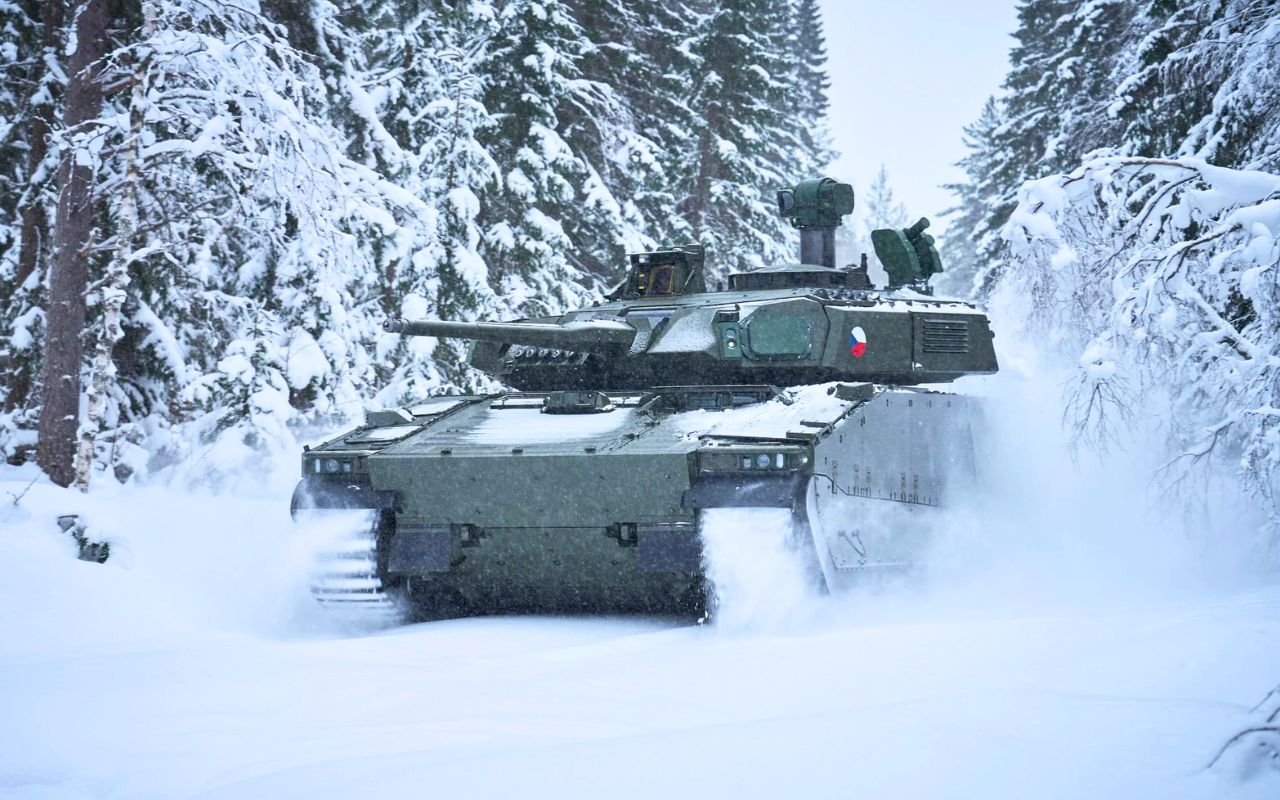
The Czech Army has embarked on a game-changing journey as it tests the very first CV90 MkIV infantry fighting vehicle on Swedish soil, marking a massive leap in military modernization and strategic capability.
In a prominent display of defense collaboration between the Czech Republic and Sweden, the arrival and trial of the CV90 MkIV infantry fighting vehicle stand as a clear testament to the Czech military’s push to upgrade its armored forces. This vehicle, tailored with the latest innovations in combat technology, signals a new era in the Czech Army’s operational strength. The trials underway in Sweden not only test the vehicle’s capabilities but also underline the broader European ambition of military modernization combined with strategic partnerships.
Key features powering the CV90 MkIV infantry fighting vehicle’s cutting-edge performance
The CV90 MkIV is more than just an armored vehicle; it represents a sophisticated fusion of firepower, protection, and mobility designed to meet the demands of modern warfare. One of the most notable enhancements in this latest model is the upgrade to the CV9030CZ version, equipped with a 30mm autocannon that offers enhanced targeting precision and destructive power. This upgrade ensures the Czech Army maintains superiority against armored threats on various battlefields. Advanced armor technology is a standout feature that boosts survivability against both ballistic and explosive threats. The MkIV variant integrates modular armor packages, allowing it to adapt quickly to mission-specific threats. This flexibility is crucial for the Czech mechanized infantry, particularly under NATO commitments where multi-environment deployment readiness is essential. Another critical aspect is the vehicle’s state-of-the-art sensors and communication systems. The CV90 MkIV boasts a suite of advanced thermal imaging and battlefield management systems that provide superior situational awareness for its crew. This technology enables rapid response to threats and facilitates seamless coordination with other units on the field. The integration of new digital interfaces empowers commanders with instantaneous tactical data, crucial for making life-saving decisions in combat. The CV90 MkIV also excels in mobility, thanks to its powerful engine delivering around 810 horsepower. This level of propulsion confers excellent speed and agility both on-road and off-road, allowing the Czech mechanized forces to operate effectively across varied terrains – from rugged forests to open plains. Its tracked chassis design provides rugged stability and contributes to its performance in challenging environments. Such advanced features are not just theoretical; their practical deployment will be witnessed during the current trials in Sweden, where the vehicle’s systems undergo rigorous testing to validate their effectiveness before joining the Czech Army’s fleet.

What the Czech Army trials in Sweden reveal about multinational military collaboration
The ongoing Czech Army trials of the CV90 MkIV on Swedish terrain go far beyond mere vehicle testing; they exemplify the growing importance of multinational collaboration in European defense modernization. Sweden, with its recognized expertise in armored vehicle production through BAE Systems Hägglunds, serves as the ideal partner in this effort. These trials facilitate a shared testing environment where soldiers from the Czech 7th Mechanized Brigade can operate alongside Swedish defense experts, exchanging operational knowledge and tactical insights. They create a space where not only the vehicle but also crews and support teams adapt to new combat doctrines linked to advanced infantry fighting vehicles, thereby enhancing interoperability within NATO. The transfer of technical knowledge during these trials is invaluable. Operational experience gained by Czech forces under Swedish guidance ensures the proper handling and maintenance of the CV90 MkIV’s complex systems. This hands-on learning process helps the Czech military prepare for the vehicle’s full integration into their existing fleet seamlessly and efficiently. Moreover, this collaborative testing supports the broader ambition of standardizing defense equipment among European allies, which optimizes supply chains, maintenance logistics, and joint mission effectiveness. The Czech Republic’s acquisition of 246 CV90 MkIV vehicles—partly manufactured in Sweden and partly assembled domestically—is a strategic decision to boost national defense capabilities while strengthening ties with European defense manufacturers. These trials underline a growing trend where European NATO members pool resources and expertise, enhancing their collective capacity to respond to emerging geopolitical threats with cutting-edge military technology.
Modernization of the Czech Army: replacing Soviet-era vehicles with next-generation technology
For decades, much of the Czech Army’s infantry fighting and armored vehicles were legacy systems dating back to the Soviet era, including the BMP-2 and older tracked vehicles ill-suited for today’s warfare challenges. The introduction of the CV90 MkIV ushers in a robust modernization phase designed to remedy these obsolescences and align the Czech forces with NATO’s high standards. The decision to procure 246 CV90 MkIV models involves not simply replacing old hardware but transforming operational tactics and defense postures. These new vehicles directly address vulnerabilities in firepower, protection, and network-centric warfare capabilities, offering soldiers the tools to meet modern asymmetric threats and high-intensity conflict scenarios efficiently. Transitioning to a modern platform affects not only combat units but also logistical and maintenance infrastructures throughout the Czech armed forces. Training programs are heavily revised to incorporate the CV90’s advanced systems, requiring new skills for crews, technicians, and commanders. This large-scale transition demands close cooperation with manufacturers and foreign military partners to ensure the vehicles perform reliably under operational pressures. The CV90 MkIV’s introduction is strategically timed to phase out older Soviet models by 2030 fully. This timeline enables the Czech military to gradually integrate the new vehicles, avoiding disruptions in defense readiness while upgrading its technological footprint. This modernization is also a clear message to regional actors, signaling that the Czech Republic is investing in a future-proof and interoperable defense force. In summary, the CV90 MkIV shapes a multifaceted renewal across technical, tactical, and strategic dimensions, offering a comprehensive leap forward for the Czech Army’s mechanized capabilities.
The strategic implications of the CV90 MkIV deployment within NATO’s eastern flank
The arrival of the CV90 MkIV vehicles in the Czech Army signals an important shift in the security dynamics of NATO’s eastern frontier. With rising tensions in Eastern Europe and persistent concerns about regional stability, the Czech Republic’s modernization serves as a crucial step in strengthening allied deterrence and defense postures. The CV90 MkIV’s advanced capabilities enhance the Czech Army’s ability to engage effectively in combined arms operations alongside other NATO members, particularly under Article 5 commitments. The vehicle’s robust protection and mobility allow faster response times to any external threat, securing borders and reinforcing regional defense chains. This boost in capability also impacts NATO’s overall force posture, with the Czech Republic becoming a key node in the eastern defense network. Modern IFVs like the CV90 MkIV provide versatile platforms suited for rapid deployment, surveillance, and offensive operations – essentials in modern hybrid warfare scenarios involving both conventional and irregular threats.
By embedding these next-generation vehicles into its mechanized brigades, the Czech military enhances collective defense readiness, promoting stability in a region where military modernization is both a deterrent and a reassurance to allies.
Key strategic benefits of the CV90 MkIV on NATO’s eastern flank:
- Enhanced mobility enabling quick maneuvering in varied terrains, critical for border defense and rapid reaction forces.
- Superior firepower ensuring the capacity to neutralize diverse threats effectively, from infantry to armored vehicles.
- Interoperability built into its design, allowing seamless coordination with allied forces during joint operations.
- Advanced communication systems facilitating real-time battlefield awareness and command control at multiple levels.
- Modular armor protection adaptable to evolving threat environments, increasing crew survivability.
The future of infantry fighting vehicles and lessons learned from the Czech-Swedish CV90 MkIV trials
The trials conducted by the Czech Army on Swedish soil offer a glimpse into the evolving role of infantry fighting vehicles in modern military engagements and underscore lessons critical for future defense planning. First, the trial emphasizes the value of collaborative testing environments where cross-national exchanges optimize both vehicle performance and crew proficiency. Such trials provide consistent feedback loops for manufacturers and armed forces to refine systems ahead of full deployment. For instance, adjusting sensor calibrations or modifying software responsiveness during these exercises ensures tactical effectiveness. Secondly, the trials highlight the increasing importance of digital integration and networking in armored warfare. The CV90 MkIV represents a step beyond traditional armored vehicles by embracing digital battlefield ecosystems, where vehicles communicate continuously with drones, command centers, and infantry units, crafting a multi-layered operational picture that multiplies combat efficiency. Furthermore, these trials expose the necessity of modular and adaptable designs. The ability to quickly reconfigure armor and armaments in response to specific mission profiles is set to become a standard in future platforms, directly inspired by feedback from users like the Czech mechanized brigade. The Czech-Swedish collaboration also demonstrates the strategic advantage of balanced defense spending. Instead of piecemeal upgrades, investing in a comprehensive fleet renewal with a single, future-proof platform like the CV90 MkIV ensures better long-term value and operational cohesion. Ultimately, the ongoing trials are more than just a singular event; they serve as a benchmark shaping the next generation of infantry fighting vehicles globally, informed by real-world experience and multinational cooperation.
Military observers and analysts widely view the ongoing Czech-Swedish trials as a beacon of how armored vehicle modernization should progress within NATO allies, melding advanced technology and operational training to protect Europe’s security in the years to come.
| Trial phase | Location | Duration | Focus area | Outcome |
|---|---|---|---|---|
| Initial operational testing | BAE Systems Hägglunds, Sweden | 6 months | Vehicle systems integration and firepower testing | Validated core combat capabilities |
| Environmental and terrain testing | Northern Sweden military ranges | 4 months | Mobility on rugged and varied terrain under multiple weather conditions | Confirmed vehicle reliability and adaptability |
| Joint training exercises | Swedish and Czech military ranges | 2 months | Interoperability and crew tactical proficiency | Enhanced multinational cooperation and readiness |
What makes the CV90 MkIV stand out among other infantry fighting vehicles?
The CV90 MkIV combines advanced firepower, modular armor, state-of-the-art sensors, and superior mobility, making it a versatile and resilient platform for modern warfare.
Why is the Czech Republic conducting vehicle trials in Sweden?
Sweden offers specialized testing facilities and expertise through BAE Systems Hägglunds, enabling rigorous evaluation and training before full operational integration.
How does the new vehicle improve NATO interoperability?
The CV90 MkIV is designed with integrated digital systems and communication tools that enable seamless coordination with other NATO forces during joint operations.
What is the timeline for the full deployment of the CV90 MkIV vehicles?
The Czech Republic aims to complete the delivery and integration of 246 CV90 MkIV IFVs by 2030, with phased production occurring both in Sweden and the Czech Republic.
How do these trials impact future infantry fighting vehicle development?
Lessons learned during these multinational trials influence design priorities such as modularity, digital networking capabilities, and crew interoperability, shaping future armored vehicle advancements.
