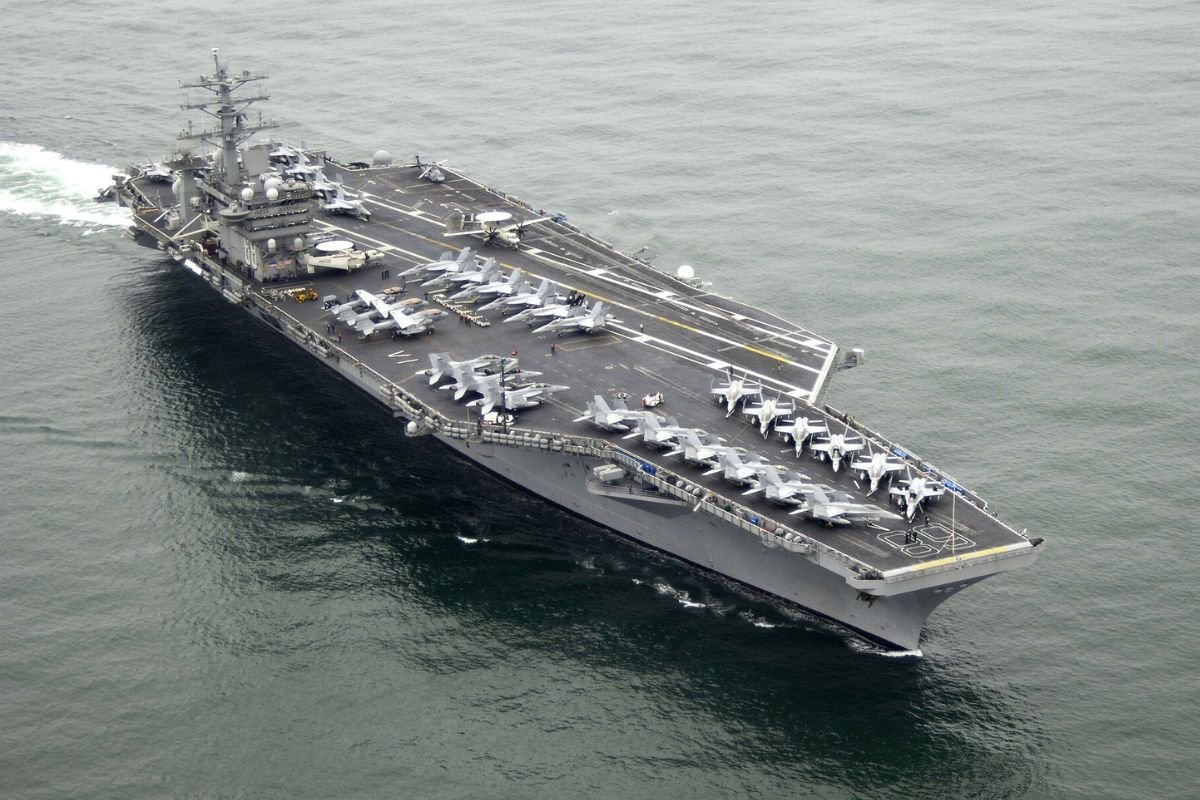
The USS Nimitz, a towering symbol of American naval power, is sailing into history as her era draws to a close.
For over five decades, the USS Nimitz has been the heartbeat of the U.S. Navy’s fleet, projecting strength, power, and unmatched capability across global waters. As the oldest active nuclear-powered aircraft carrier, its retirement in 2026 marks the end of an era not just for the Navy but for naval aviation worldwide. With a legacy shaped by critical operations and technological milestones, the Nimitz’s final voyage around South America en route to its new homeport in Norfolk signifies more than a logistical transition—it is a historic farewell to a true maritime giant.
USS Nimitz’s remarkable 50-year journey and historical impact on naval dominance
Commissioned in May 1975, USS Nimitz (CVN-68) stands as the lead ship of her class and the oldest nuclear-powered aircraft carrier in the world. Named after Fleet Admiral Chester W. Nimitz, the carrier has long been a cornerstone for United States naval operations, embodying the growth and evolution of American military power on the seas.
Her maiden deployment came shortly after the nation’s bicentennial, setting off on July 7, 1976. Immediately, the Nimitz showcased its role in pivotal global events, particularly during escalating tensions in the late 1970s. The carrier was dispatched to the Indian Ocean amid the Iran hostage crisis in 1979, participating indirectly in Operation Evening Light – an audacious attempt to rescue American hostages that, despite being aborted due to operational setbacks, demonstrated the Nimitz’s strategic importance.
Through the 1980s and 1990s, the Nimitz continued to be a flexible powerhouse. It played crucial roles in Operation Desert Storm during the Gulf War, helping to project air power that decisively reshaped military engagement in the region. The carrier also undertook a globe-circling cruise in 1997, a testament to its durability and worldwide reach. Returning to the U.S. west coast, specifically San Diego in 2001, the Nimitz was quickly redeployed following 9/11, to contribute to subsequent military efforts in the Middle East.
The 2000s saw the Nimitz blend power projection with coalition-building, as it participated in the Malabar exercises alongside the Indian Navy and operated extensively in the Indo-Pacific to bolster peace and stability. By 2012, the vessel found a new homeport in Everett, Washington, subsequently relocating to Bremerton in 2015, solidifying the Pacific Northwest’s reputation as the carrier’s bastion for 50 years. With over 8,500 combat sorties and 17,000 flight hours recorded during its last Pacific deployment, this carrier undeniably embodied the U.S. Navy’s enduring dominance on the oceans.
Technological marvel of the seas: nuclear propulsion and aviation capabilities
The USS Nimitz revolutionized naval aviation with its groundbreaking nuclear propulsion system, powered by two Westinghouse A4W reactors. This innovation allowed the carrier to operate at high speeds for months without refueling, a significant leap over conventionally powered carriers. The nuclear propulsion enabled not just endurance but also increased operational flexibility, projecting a permanent naval presence across the Pacific and beyond.
Its flight deck was a hive of activity, consistently deploying squadrons filled with F/A-18 Hornets and Super Hornets, EA-18G Growlers, and MH-60 Seahawk helicopters. These aircraft gave the Nimitz an unmatched ability to provide air superiority, precision strike capabilities, electronic warfare support, and anti-submarine roles. The complexity of daily flight operations on a ship the size of a floating city required expert coordination and contributed to the Navy’s growing expertise in carrier aviation logistics.
Throughout its career, the Nimitz underwent extensive upgrades to its radar, communication systems, and defensive capabilities, ensuring that it stayed ahead of evolving threats. The carrier’s strike group routinely conducted operations in multiple fleet areas, including the 5th, 6th, and 7th Fleet zones, with emphasis on the Indo-Pacific region—bolstering alliances and deterring aggression in some of the most contested waters on Earth.
The technical challenges involved in maintaining such a leviathan were enormous, culminating in complex contracts worth over €33.4 million awarded to Huntington Ingalls Industries for preparatory work on reactor defueling in anticipation of the decommissioning. This process underscores the unique difficulty in retiring the Nimitz, as it remains the only nuclear carrier apart from the now-retired USS Enterprise to undergo this procedure.
The final voyage: circumnavigating South America for historic Southern Seas deployment
In March 2026, the USS Nimitz embarked on its final deployment from Naval Base Kitsap in Washington State, departing on a poignant voyage that carries it all the way to its new—yet final—homeport at Naval Station Norfolk, Virginia. This deployment, part of the Southern Seas 2026 mission, will see the Nimitz navigating the waters around South America, circumventing the continent due to its sheer size being too vast for the Panama Canal.
During its circumnavigation, the carrier is expected to visit multiple partner nations, strengthening diplomatic ties across Latin America and the Caribbean. While specific details of stops and joint exercises remain under wraps, the mission reflects a final gesture of naval diplomacy and outreach. Such a journey highlights not only the ship’s physical scale but also its role as a movable emblem of U.S. presence and cooperation on the international stage.
Following years of primarily Indo-Pacific deployments, where the ship played a tactical role in maintaining regional peace and deterring potential adversaries, this deployment marks a symbolic transition for both the vessel and the Navy. It represents a passing of the torch as new Ford-class carriers assume the mantle of frontline nuclear-powered aviation at sea, yet the Nimitz will remain an icon and a touchstone for decades of service.
Decommissioning preparations: complex challenges of retiring a nuclear giant
Decommissioning the USS Nimitz involves far more than the simple removal of equipment. As the Navy’s oldest nuclear supercarrier, it requires a carefully orchestrated and legally stringent process to ensure safety and environmental compliance. The defueling and dismantling of its two massive Westinghouse A4W nuclear reactors is a rare and technically demanding operation that Huntington Ingalls Industries is contracted to carry out.
Beginning officially in late 2025, the process includes the Ship Terminal Off-load Program (STOP), during which useful parts, supplies, and equipment will be removed. This careful stripping down will be followed by over a year-long reactor defueling and decontamination phase, slated to continue through October 2027. With the Nimitz being only the second nuclear carrier ever to be fully decommissioned (after USS Enterprise), much of this effort will serve as a pioneering model of best practices.
An aerial and operational overview of the decommissioning stages:
| Phase | Description | Projected Timeline |
|---|---|---|
| STOP – Off-loading | Removal of equipment, supplies, and stores in preparation for decommissioning | Late 2025 to early 2026 |
| Reactor defueling | Safe removal and storage of nuclear reactors’ fuel cores | 2026 to October 2027 |
| Long-term dismantling | Disassembly of ship structure and recycling of materials | Post-2027 (not yet fully scheduled) |
Such a complex undertaking demands meticulous environmental controls, regulatory oversight, and community engagement to mitigate risks associated with nuclear materials and properly honor the carrier’s legacy.
List of key challenges during retirement
- Nuclear safety and waste management – Ensuring complete and safe removal of radioactive material without environmental contamination.
- Logistical complexity – Navigating the safe transportation and storage of parts and materials.
- Technical expertise – Employing highly specialized teams trained in nuclear decommissioning and dismantling.
- Regulatory compliance – Meeting federal, state, and local regulations during all phases.
- Legacy preservation – Conservation of significant historical components and naval heritage artifacts.
Transition and legacy: what the USS Nimitz’s retirement means for the Navy’s future
The retirement of the USS Nimitz is stirring reflections across naval circles on the future shape of American sea power. As the venerable Nimitz bows out, the Navy is focusing on modernizing its carrier fleet with the new Gerald R. Ford-class vessels, promising increased automation, reduced crew requirements, enhanced aircraft launch systems, and integrated network warfare capabilities.
This transition is part of a broader strategic pivot emphasizing naval agility, advanced technology, and sustainable operations—fitting for confronting 21st-century challenges. Despite the Ford-class carriers’ promising features, the Nimitz’s half-century record establishes an unmatched standard of service, resilience, and tactical effectiveness.
Moreover, the crew’s relocation to Norfolk symbolizes not just a geographic change but a cultural and institutional handoff. Thousands of sailors who served aboard the Nimitz will carry forward its traditions, stories, and ethos into the Navy’s future endeavors. The Nimitz will remain a symbol of American naval strength for decades to come, its iconography deeply embedded in naval history books and public memory.
Watching detailed footage of the USS Nimitz’s final missions and deployment highlights brings to life the full scope of its operational excellence and teamwork over the decades. This documentary-style video captures the ship’s legacy in sweeping visuals and firsthand accounts.
This video delves into the highly specialized and sensitive procedures entailed in decommissioning nuclear-powered carriers like the USS Nimitz, outlining the engineering challenges involved in reactor defueling and dismantling.
What makes the USS Nimitz unique among aircraft carriers?
The USS Nimitz is the oldest nuclear-powered aircraft carrier in the world and served over 50 years, establishing a record for endurance, versatility, and versatility in naval aviation operations.
Why is the retirement process for USS Nimitz especially complex?
Due to its two nuclear reactors, the decommissioning involves the delicate defueling and disposal of radioactive materials, making it a rare and highly technical operation.
How many miles did the USS Nimitz sail during its last deployment?
The carrier logged over 82,000 nautical miles (about 151,900 km) during its final Pacific deployment, underscoring its incredible endurance and operational tempo.
Where will the USS Nimitz’s final homeport be?
Following its circumnavigation of South America, the USS Nimitz will be decommissioned at Naval Station Norfolk, Virginia, marking the official end of its active service.
What will replace the USS Nimitz in the U.S. Navy fleet?
The Gerald R. Ford-class carriers represent the future, featuring new technologies like advanced automation, electromagnetic aircraft launch systems, and improved survivability.
Source: https://www.washingtontimes.com/news/2026/jan/21/saying-farewell-uss-nimitz-americas-oldest-aircraft-carrier
Image: Tests of the U.S. Navy electromagnetic railgun conducted at the Naval Surface Warfare Center in Dahlgren in 2017.
The system uses powerful electromagnetic pulses to launch projectiles at hypersonic speeds without chemical propellants.
