Finland debates a historic shift as it moves toward lifting its nuclear weapons ban, marking a seismic change in European security amid rising tensions with Russia and deepening NATO ties.
Finland, a country long known for its policy of nuclear-free security and military neutrality, is now considering a pivotal legal reform that would allow nuclear weapons on its soil. This bold pivot is a direct response to the upheavals in regional security dynamics, notably after joining NATO in 2023. The shift could reshape the strategic landscape of Northern Europe, intensifying the nuclear debate and stoking geopolitical tensions.
Finland’s four-decade nuclear weapons prohibition under scrutiny
For nearly forty years, Finland has upheld a stringent domestic ban on nuclear weapons, a policy embedded in its 1987 nuclear energy law. This legislation explicitly forbids the import, possession, manufacturing, and detonation of nuclear arms within Finnish territory, underscoring a long-standing commitment to nuclear disarmament and peace. The ban was a cornerstone of Finland’s security strategy during the Cold War and the post-Soviet era, reinforcing its image as a neutral actor in a tense global environment.
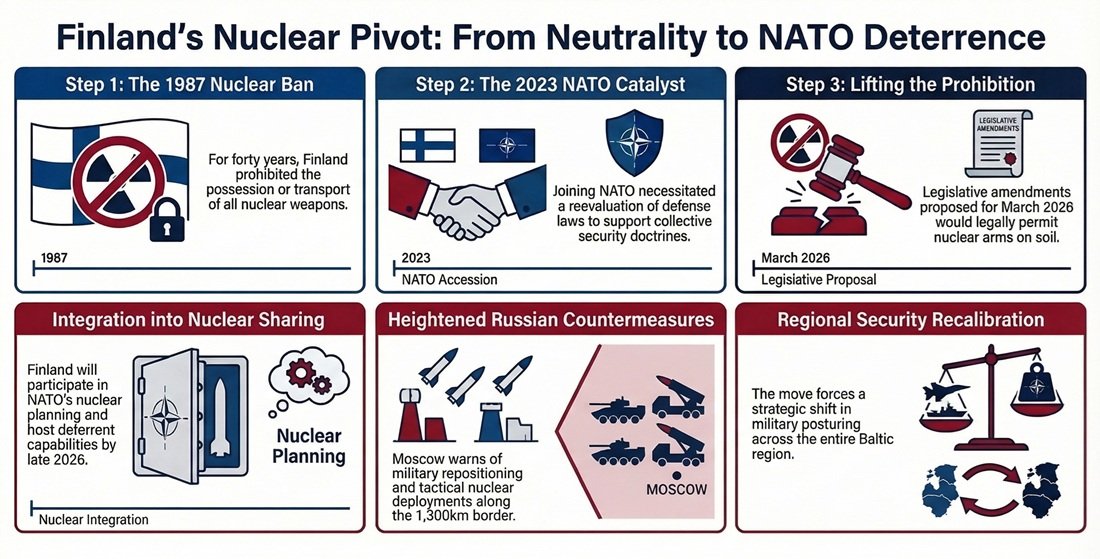
However, the geopolitical map of Europe has changed dramatically following Russia’s invasion of Ukraine and Finland’s consequential decision to join NATO in 2023. The incursion released shockwaves through Europe’s security architecture, forcing previously neutral nations to reconsider their defense postures. For Helsinki, the constraints of its existing laws impede full integration into NATO’s collective security umbrella, especially regarding the alliance’s nuclear deterrence capabilities.
The Finnish government, led by Defense Minister Antti Häkkänen, is drafting legislative amendments aimed at revoking the nuclear weapons ban. This adjustment would legally permit the presence or management of nuclear arms as part of both Finland’s national defense and NATO’s collective deterrence efforts. Häkkänen has articulated a crucial justification for this move, stating, “The amendment is essential for Finland to fully participate in NATO’s military defense and to leverage the alliance’s nuclear deterrence and collective security guarantees.”
This debate represents Finland’s delicate balancing act: preserving its historic values while adapting to a transformed strategic context. It also reflects Helsinki’s intention to align its laws with NATO’s evolving doctrines, potentially redefining its role in European security for decades to come.
NATO’s nuclear deterrence strategy and Finland’s integration challenges
Finland’s accession to NATO in 2023 marked the end of an era characterized by military non-alignment and codified neutrality. Since then, Helsinki has progressively positioned itself within the alliance’s broader strategic framework, including the controversial but pivotal nuclear deterrence doctrine. NATO’s deterrence hinges upon maintaining a credible and flexible nuclear arsenal as a means to dissuade nuclear and conventional aggression against member states.
Several European NATO members—such as Germany, Belgium, and the Netherlands—already participate in NATO’s nuclear sharing arrangements by hosting U.S. nuclear weapons and integrating into the alliance’s nuclear planning structures. Finland’s legal ban, however, currently precludes such participation, limiting its ability to fully engage in joint defense planning and deterrence strategies.
Supporters of lifting the ban argue that integration into NATO’s nuclear framework would enhance national security by providing a stronger deterrent shield against potential aggressors, especially neighboring Russia. Former Finnish Prime Minister Juha Sipilä has voiced support for this perspective, emphasizing, “NATO’s nuclear axis is the ultimate deterrent understood by all nuclear-armed states.” This remark highlights the grave security considerations motivating some Finnish leaders.
On the other hand, this policy shift faces internal political debate and public concern. Critics warn that permitting nuclear weapons on Finnish soil could escalate regional tensions and provoke retaliatory measures, potentially destabilizing the carefully maintained security balance in Northern Europe. The central question for Helsinki remains: does the security gained from aligning fully with NATO’s deterrence outweigh the risks of antagonizing Moscow?
Russia’s vehement opposition to Finland’s nuclear policy shift
The Kremlin reacted almost immediately and forcefully to Finland’s announcement of its intent to reconsider the nuclear weapons prohibition. Given the extensive 1,300 km shared border between Russia and Finland, Moscow perceives any potential introduction of nuclear arms as a direct and unacceptable threat to its national security interests.
Russian officials condemned the proposed policy change as a dangerous provocation likely to increase military tensions along their border. Dmitri Peskov, the Kremlin spokesperson, stated, “These declarations are feeding an escalation of tensions in Europe. By allowing nuclear weapons on its territory, Finland begins to threaten us.” His words underscore how nuclear policy decisions in Helsinki resonate far beyond its borders, influencing the strategic calculations of the Russian leadership.
In addition to rhetorical condemnation, Moscow has issued warnings that it could respond with countermeasures if nuclear weapons are deployed in Finland. Such responses could include enhanced military posturing, deployment of additional forces near the border, or even the repositioning of tactical nuclear weapons closer to the Finnish frontier.
This reaction illustrates how Finland’s reconsideration of its defense policies plays into the broader NATO-Russia rivalry, a complex web of military posturing and strategic signaling. While Finland aims to protect its sovereignty and align with Western allies, Moscow views these steps as steps toward encirclement, increasing the risk of a regional arms race.
Key implications of Finland lifting nuclear weapons restrictions
Should Finland proceed with lifting the nuclear weapons ban, this decision will have far-reaching impacts on both national and regional security frameworks. A few main implications emerge:
- Enhanced NATO integration: Finland would be able to actively participate in NATO’s nuclear sharing program, solidifying its defense ties and potentially receiving a nuclear deterrence umbrella.
- Strategic recalibration of Northern Europe: The move could prompt other nearby countries to reexamine their policies on nuclear weapons and collective defense, possibly reshaping the military posture of the entire Baltic and Nordic region.
- Heightened Russian countermeasures: Increased militarization along the Russian-Finnish border and deeper geopolitical tensions, with Moscow potentially expanding its nuclear and conventional capabilities in response.
- Domestic political debate intensification: Kicking off an intense national discussion on defense priorities, public safety, and Finland’s identity in a changing security landscape.
Below is a table summarizing the major milestones and projected outcomes related to this nuclear policy shift:
| Event | Date | Potential Impact |
|---|---|---|
| Finland joins NATO | 2023 | Ends decades of neutrality; aligns security with NATO collective defense |
| Proposal to lift nuclear weapons ban | March 5, 2026 | Legal framework change to allow nuclear arms on Finnish soil |
| Russian government response | Immediately following March 2026 announcement | Strong opposition warning; potential military countermeasures |
| Projected NATO nuclear sharing participation | Late 2026 or beyond | Finland fully integrates into NATO’s nuclear deterrence strategy |
Broader geopolitical consequences and future scenarios for Finland and Europe
Finland’s reconsideration of its nuclear policy reflects a significant trend across Europe: nations reevaluating their strategic postures in a world marked by growing uncertainty and renewed great-power competition. The move by Helsinki could ripple well beyond its borders, forcing the European Union and NATO to face complex questions about nuclear deterrence’s role in future security strategies.
Moreover, Finland’s decision highlights the tension between historical policies of restraint and the pressing need to adapt to new threats. This dilemma is especially acute for countries bordering Russia, where security calculations now involve not only conventional military threats but also the specter of nuclear escalation.
Potential future scenarios include:
- Stabilization through deterrence: Finland’s integration into NATO’s nuclear framework deters aggression and strengthens regional security, despite heightened tensions, preventing conflict escalation.
- Regional arms race: Moscow’s responses trigger increased nuclear deployments by multiple actors around the Baltic Sea, raising the risk of misjudgments or accidents.
- Negotiated security framework: Diplomatic efforts between NATO, Russia, and Nordic countries result in new arms control measures and confidence-building initiatives to limit nuclear risks.
The outcome will largely depend on diplomatic agility, domestic political consensus in Finland, and the evolving nature of NATO-Russia relations. Ultimately, Helsinki’s move signals a paradigm shift in European security thinking, with nuclear deterrence re-emerging as a central pillar.
Why has Finland maintained a nuclear weapons ban since 1987?
Finland’s 1987 nuclear energy law reflected a commitment to neutrality and non-proliferation, aiming to keep the country free from nuclear arms amid Cold War tensions.
What does lifting the nuclear ban mean for Finland’s NATO membership?
Lifting the ban would allow Finland to fully participate in NATO’s nuclear sharing program, enhancing its role in the alliance’s collective defense and nuclear deterrence strategy.
How has Russia responded to Finland’s plan to allow nuclear weapons?
Moscow immediately condemned the proposal as a threat, warning of escalated tensions and possible military countermeasures along the shared border.
What risks does Finland face by permitting nuclear weapons on its soil?
Potential risks include increased regional tensions, possible military escalation with Russia, and domestic political divisions over security and safety concerns.
Could Finland hosting nuclear weapons spark an arms race in Northern Europe?
Yes, such a move could trigger reciprocal military buildups by Russia and neighboring states, potentially destabilizing the current regional security balance.
Sources:
- https://www.bbc.com/news/articles/c14m5llnrlpo
- https://www.reuters.com/business/aerospace-defense/finland-lift-full-ban-hosting-nuclear-arms-government-says-2026-03-05
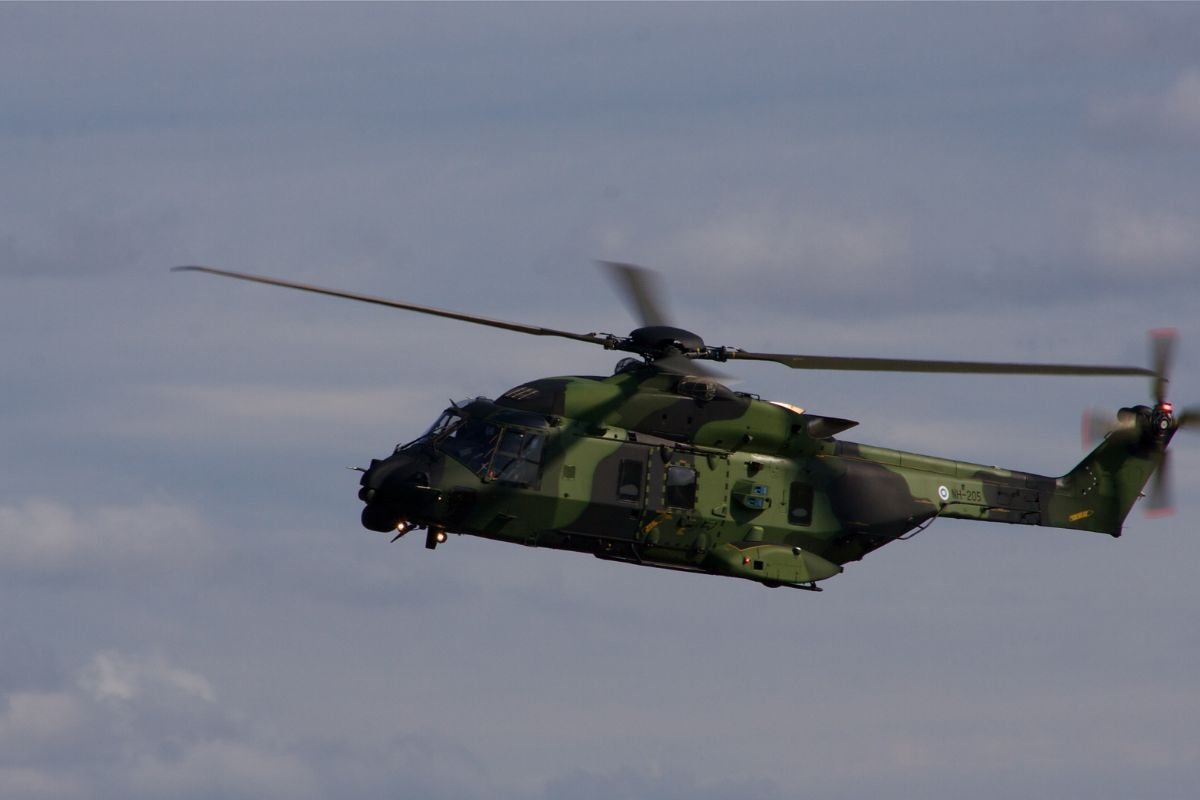
Image: A Finnish Army NHIndustries NH90 helicopter (No. NH-205) seen on the ground at Tampere-Pirkkala Airport in Finland.
The NH90 is a modern multi-role military helicopter used for transport, special operations, and tactical support missions.
