
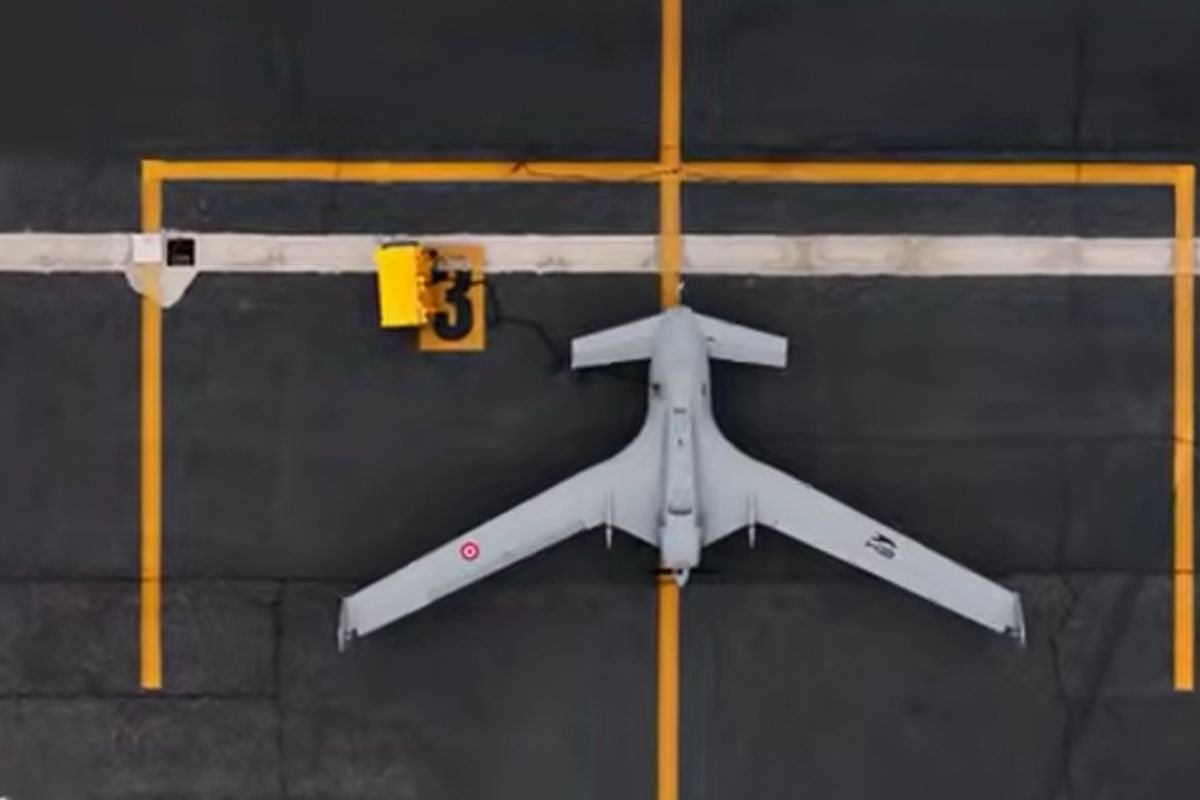
Turkey’s Baykar has once again pushed the boundaries of drone warfare with the unveiling of the K2 kamikaze drone, a formidable addition to the arsenal of unmanned aerial systems. This cutting-edge drone reflects a strategic shift in modern military tactics, combining precision strike capabilities with autonomous operational functions. The K2’s introduction signals the rising prominence of Turkish defense technology on the global stage.
Baykar’s latest innovation, the K2 kamikaze drone, enters a battlefield increasingly dominated by unmanned technologies. Unlike traditional drones focused on surveillance or reconnaissance, kamikaze drones are offensive weapons designed to detonate on impact, neutralizing targets without the need for returning to base. The urgency and precision offered by such systems make them invaluable in modern conflicts where rapid response and minimal collateral damage are priorities.
Advanced design and capabilities driving the K2 drone’s strategic impact
The K2 is not just another drone; it represents significant advancements in design and tactical utility that heighten its battlefield effectiveness. Equipped with a compact frame and cutting-edge stealth technology, the K2 exhibits enhanced survivability in hostile environments where traditional aerial platforms might falter.
Its propulsion system has been engineered for extended flight duration, enabling reconnaissance missions coupled with swift precision strikes. Thanks to a combination of lightweight composite materials and a powerful yet efficient engine, the K2 can reach operational altitudes and speeds that complicate enemy interception attempts.
Importantly, the K2 carries a specialized warhead optimized for high-impact strikes on armored and fortified targets. This explosive payload, combined with the drone’s precise targeting systems, enables it to incapacitate high-value targets swiftly. The K2’s sensors and navigation arrays incorporate the latest in GPS-denied environment technologies, allowing it to find and engage objectives even under intense electronic warfare conditions.
Baykar’s use of AI-powered autonomous decision-making algorithms is a game-changer in kamikaze drone deployment. These intelligent systems analyze real-time battlefield data to select the most strategic targets dynamically, ensuring maximum operational efficiency with minimal human intervention. This autonomy accelerates engagement times and reduces the cognitive load on operators, which is critical in high-tempo conflict scenarios.
The K2 also boasts modular payload options, increasing its versatility across various combat applications. Whether employed for precision strikes on enemy infrastructure, or as a tool for disrupting supply lines, the K2 brings multifaceted capabilities to any operation.
How kamikaze drones like the K2 are reshaping modern warfare tactics
The emergence of kamikaze drones such as the K2 has accelerated a transformation in how armed forces approach combat. These devices blur the lines between missiles and traditional UAVs, offering the ability to strike with surgical precision while operating autonomously in contested airspace.
One distinct advantage is their cost-effectiveness compared to manned aircraft or missile systems. The K2 can be rapidly deployed in swarms to overwhelm defenses, spreading enemy resources thin and creating tactical confusion. This swarm tactic leverages sheer numbers and speed to neutralize sophisticated anti-aircraft networks.
The K2 revolutionizes close air support missions, allowing frontline troops to call upon a precise strike exactly where and when needed, without risking pilot lives. Moreover, with its expendable nature, mission planners can assign high-risk objectives that would be unsuitable for reusable assets.
This capability forces adversaries to rethink traditional air defense postures and invest heavily in counter-drone technologies. The proliferation of such systems has already sparked innovation in electronic jamming, directed-energy weapons, and rapid interception platforms to keep pace with evolving drone threats like the K2.
By integrating seamlessly into networked warfare systems, the K2 enhances situational awareness across the battlefield. Ground units, command centers, and other drones communicate in real time to coordinate attacks, share intelligence, and adapt tactics fluidly. This interconnectedness offers a decisive edge, turning isolated assets into a cohesive and responsive force multiplier.
Given the unique attributes of kamikaze drones in asymmetric warfare, their deployment sets the stage for new doctrines emphasizing agility, precision, and automation above sheer force.
Baykar’s role in advancing drone technology amid global defense competition
Baykar, Turkey’s prominent drone manufacturer, has risen to international recognition by consistently delivering innovative UAV solutions that rival established global players. The unveiling of the K2 demonstrates its commitment to advancing autonomous weapon systems and strengthening Turkey’s strategic defense footprint.
Baykar’s investment in indigenous research and development has accelerated breakthroughs in avionics, propulsion, and AI-guided systems. This self-reliance reduces dependency on foreign components and enables rapid iterations responding to battlefield feedback. The company’s iterative development cycles ensure that products like the K2 incorporate the latest technologies sourced from both military and civilian sectors.
Turkey’s defense policy supports Baykar with substantial funding and operational frameworks, fostering an environment conducive to innovation. The K2 is an emblem of national pride and technological prowess, designed not only for domestic use but increasingly for export to allied nations looking to bolster their drone capabilities.
Baykar’s reputation also rests on its ability to customize platforms like the K2 to suit diverse mission requirements, from counterterrorism to conventional conflicts. The company has invested heavily in pilot training simulators, ground control stations, and software development kits, creating an ecosystem around its drones that eases adoption by foreign militaries.
Looking across the competitive landscape, Baykar’s K2 challenges traditional aerospace giants by offering cost-effective, high-performance alternatives. Its growing client base in the Middle East, Asia, and Africa underlines a paradigm shift where newer defense exporters impact global arms dynamics as much as long-established manufacturers.
The operational versatility and deployment scenarios for the K2 kamikaze drone
Understanding the strategic flexibility of the K2 drone is key to appreciating its battlefield value. Its design allows it to operate in a broad range of environments and missions, from urban warfare to vast desert or mountainous terrains.
In urban combat zones, the K2’s small size and stealth capabilities enable it to strike targets hidden within complex cityscapes, avoiding collateral damage through precise strikes. This is crucial in modern conflicts where civilian casualties carry significant political and humanitarian consequences.
Meanwhile, in more open environments such as deserts or rugged terrain, the K2’s endurance and speed help it cover large swathes of territory, scouting enemy positions and conducting deep strikes on supply convoys or fortified outposts. These abilities complement conventional ground operations by disrupting enemy logistics and command centers.
The drone can also integrate with manned aerial platforms and artillery units to act as a forward sensor and strike asset. For example, it can fly ahead of a strike package, identifying high-value targets and damaging or destroying them before manned aircraft enter danger zones. This synergy reduces risks and improves mission success rates.
Its autonomous operation suits rapid reaction missions where communication lines are vulnerable or jammed. The onboard AI allows the K2 to complete its objective even when link to operators is lost, guaranteeing mission continuity and reducing dependence on secure communication channels.
The K2 is proving especially effective in counter-insurgency and anti-terrorism roles. Its ability to engage mobile, elusive targets that would evade traditional airstrikes marks a significant tactical advancement. Moreover, it can be launched from various ground or naval platforms, enhancing deployment flexibility across theaters of operation.
Technical specifications and comparative analysis of the K2 drone’s performance
The K2 kamikaze drone’s specifications underline its advanced engineering and battlefield promise. Below is a detailed comparative table illustrating key metrics alongside other prominent kamikaze drones:
| Feature | K2 Kamikaze drone | Bayraktar TB2 (reconnaissance) | Switchblade 300 (US competitor) | Warmate (Polish kamikaze) |
|---|---|---|---|---|
| Weight (kg) | 12 | 685 | 2.5 | 5 |
| Max speed (km/h) | 130 | 220 | 100 | 85 |
| Operational range (km) | 20 | 150 | 10 | 10 |
| Payload (kg) | 3 | 55 | 0.5 | 1 |
| Flight endurance (minutes) | 25 | 24 hours | 10 | 15 |
As the table shows, the K2 offers a balanced synergy of speed, payload capacity, and flight endurance optimized for kamikaze roles. Although heavier than the ultra-light Switchblade 300, the K2 compensates with higher payload weight and longer endurance, giving it more destructive power and operational time. Its superior speed facilitates quick strikes critical in fast-moving conflicts.
These specifications position the K2 as a next-generation answer to emerging threats, blending high tactical agility with destructive capability in a compact form factor.
What is the primary mission of the K2 kamikaze drone?
The K2 is designed for precision strike missions, engaging high-value targets with an explosive payload and high accuracy. Its autonomous nature allows it to identify and neutralize threats quickly in contested environments.
How does the K2 differ from traditional reconnaissance drones?
Unlike reconnaissance drones focused on surveillance, the K2 is an attack drone, intended to destroy targets on impact rather than return for recovery. It carries a warhead and is optimized for offensive operations.
What makes the K2 effective in GPS-denied environments?
The K2 employs advanced navigation algorithms and AI to operate effectively even when GPS signals are jammed or unavailable, maintaining target accuracy through alternative sensors and data inputs.
Can the K2 be launched from multiple platforms?
Yes, the K2 is designed for flexible deployment and can be launched from mobile ground platforms, naval vessels, and potentially airborne platforms, enhancing its adaptability across different theaters.
What kind of targets is the K2 most suited for?
The K2 excels at engaging armored vehicles, fortified positions, and moving tactical targets. Its precision reduces collateral damage, making it suitable for both urban and rural combat scenarios.
Sources:
- https://defensemirror.com/news/41315/Turkey_s_Baykar_Unveils_K2__A_Reusable_Kamikaze_UAV_with_2000_Km_Range
- https://www.hurriyetdailynews.com/baykar-unveils-new-ai-powered-k2-kamikaze-drone-219947
