The USS Jimmy Carter stands as a unique marvel in naval engineering, crafted to undertake some of the world’s most secretive and complex underwater missions.
Hidden beneath the ocean’s surface, this specialized submarine combines cutting-edge technology with unparalleled stealth to serve national security in ways conventional vessels cannot. Since its commissioning in 2005, the Jimmy Carter has pushed the boundaries of undersea warfare and intelligence gathering, carving its place as the Navy’s foremost tool for covert operations. Its capability to support special missions deep under the sea marks a significant evolution in naval strategy, offering the United States an edge in the increasingly important domain of oceanic dominance.
The groundbreaking multi-mission platform that transforms undersea operations
The USS Jimmy Carter is unlike any other submarine in the U.S. Navy’s fleet because of a revolutionary modification known as the Multi-Mission Platform (MMP). This 100-foot extension effectively turns the submarine into a stealthy base for deploying unmanned underwater vehicles (UUVs), remotely operated vehicles (ROVs), and Navy SEAL teams directly into hostile or contested waters without jeopardizing the sub’s stealth. The MMP acts as a floodable compartment and mission bay, where specialized teams and equipment can enter and exit while the vessel remains submerged. This ability to interact directly with the ocean environment distinguishes the USS Jimmy Carter from traditional attack submarines designed primarily for speed and hunting enemy vessels.
The versatility provided by the MMP unleashes a host of operational possibilities. For instance, unmanned drones can be launched and recovered with ease, enabling intelligence gathering or sabotage deep underwater without risking human lives. The platform also serves as a storage and maintenance hub for experimental technologies that test new methods of ocean floor warfare or surveillance. This highly adaptive setup reflects a shift in naval focus away from conventional submarine combat towards multi-dimensional undersea operations that combine special operations, reconnaissance, and technological experimentation.
Such capabilities have repercussions not just for warfare but for undersea research and security. The Jimmy Carter can maintain surveillance on critical maritime infrastructure such as undersea cables, offering the U.S. Navy the means to protect or, if required, disrupt these vital communication lifelines covertly. Its added length for the MMP increases internal volume but does so at the cost of a larger profile, which has been carefully managed through stealth optimization techniques to maintain its low detectability.
Precision maneuvering: Submarine thrusters that redefine underwater control
Another defining innovation of the USS Jimmy Carter involves its sophisticated set of precision maneuvering thrusters that empower the submarine to maintain position accurately on the ocean floor. Unlike traditional attack submarines built for swift movement and stealth, the Jimmy Carter must hold extremely steady in strong currents to carry out delicate tasks such as tapping undersea fiberoptic cables or deploying sensor arrays on the seabed.
These thrusters allow for fine adjustments in all six degrees of motion—pitch, yaw, roll, and translation along the X, Y, and Z axes—giving the crew the ability to “hover” silently and remain virtually motionless during critical operations. Holding position precisely is essential when dealing with the complex tasks of interacting with fragile underwater infrastructure without causing damage or alerting potential adversaries.
The tactical applications of this precise control are vast. For example, specialists aboard can position the sub adjacent to a fiberoptic cable and release divers or robotic devices to install tapping equipment that intercepts communications. Because the submarine does not rely on torpedo tubes for launching or recovering gear, it can perform these underwater tasks discreetly and more effectively than other platforms.
This capability amplifies the Jimmy Carter’s role as a vital intelligence asset in the U.S. Navy’s arsenal. Protecting or exploiting undersea infrastructure has become increasingly critical as global internet and military communications depend heavily on underwater networks. The precision thrusters effectively transform the submarine into an underwater workshop, capable of executing complex covert missions beneath miles of ocean.
Legacy and secret missions: From Ivy Bells to Mission 7, whispers of covert operations
The reputation of the USS Jimmy Carter is deeply intertwined with the legacy of Cold War intelligence operations like Operation Ivy Bells, in which submarines covertly tapped Soviet underwater communication cables. The Jimmy Carter is widely believed to carry on this tradition, but with considerbly more advanced capabilities reflective of 21st-century technology and mission requirements.
Very little detailed information about the Jimmy Carter’s operational history is publicly known, reinforcing its aura of mystery. However, there are hints, such as the crew’s reported reception of a Presidential Unit Citation for a clandestine mission commonly referred to as “Mission 7.” During deployments, the submarine has returned flying a Jolly Roger flag, a naval tradition that signals the successful completion of covert operations.
These murky glimpses suggest that the USS Jimmy Carter has already played an important role in some of the United States’ most sensitive and complex undersea missions. These might involve tapping or sabotaging strategic undersea cables, retrieving secret intelligence, or deploying cutting-edge sensor networks on the ocean floor for persistent surveillance. The submarine’s ability to deploy Navy SEALs, along with its unmatched stealth, enables operations in hostile or denied environments with little risk of detection.
While the true scope of these covert activities remains classified, the impact on national security is undeniable. The Jimmy Carter quietly exemplifies the evolution of underwater espionage from risky Cold War gambits to high-tech, surgical missions conducted in the depths of the ocean in total secrecy.
Future seabed warfare: The Jimmy Carter as a blueprint for next-gen underwater assets
As naval warfare continues to evolve, the USS Jimmy Carter has emerged as a prototype for planned future submarines intended specifically to dominate the seabed environment. Military strategists recognize that future conflicts will focus not only on underwater combat but also on controlling or disrupting critical undersea infrastructure such as fiberoptic cables, seabed sensor arrays, and communication nodes.
The lessons learned from decades of Jimmy Carter operations feed directly into the design concepts for these next-generation platforms. They will likely feature further enhanced multi-mission bays, advanced unmanned vehicle integration, and expanded precision thrusters for superior station keeping and manipulation of the ocean floor environment.
One of the strategic shifts signified by the Jimmy Carter is the increasing importance of undersea infrastructure warfare. Instead of merely sinking enemy vessels, navies now must secure the digital and communication arteries running beneath the ocean, which are crucial to the global economy and military command and control. The Jimmy Carter’s specialized abilities make it a critical asset in this new battlefield.
The U.S. Navy’s ongoing investment in these advanced undersea warfare platforms suggests a long-term commitment to maintaining underwater superiority through combinations of stealth, technological innovation, and special operations capabilities. In essence, the Jimmy Carter is more than just a submarine; it is a glimpse into the future of maritime power projection.
Technological marvels and strategic roles: What makes the Jimmy Carter indispensable
Several factors set the USS Jimmy Carter apart from all other attack submarines, making it an indispensable tool for America’s covert maritime missions. The nuclear-powered Seawolf-class platform itself boasts remarkable stealth and speed, optimized for evading sonar and enemy detection. But the real game-changer lies in the extensive custom modifications and technological add-ons tailored to covert undersea operations.
Key technological highlights include:
- Multi-Mission Platform – a floodable compartment that supports divers and multiple robotic systems.
- Advanced precision thrusters – enable near-static positioning for delicate undersea tasks.
- Specialized sensor arrays – for deep-sea reconnaissance and surveillance of underwater infrastructure.
- Non-torpedo based deployment systems – allow rapid and stealthy release and recovery of equipment.
- Support for Navy SEAL and special operations teams – facilitating covert insertion and extraction in enemy waters.
In 2026, the Jimmy Carter remains one of the most sophisticated platforms in existence, combining versatility with unmatched underwater stealth. It is heavily relied upon for missions that require precision, discretion, and the ability to operate in denied environments unreachable by most submarines. This remarkable fusion of technology and tactics puts the vessel at the forefront of America’s underwater defense strategy.
| Feature | Description | Strategic role |
|---|---|---|
| Multi-Mission Platform (MMP) | 100-foot extension with floodable mission bay | Deploy UUVs, Navy SEALs, and covert gear without surfacing |
| Precision thrusters | Six-degree maneuver control allowing hovering | Maintain position above seabed infrastructure for tapping and surveillance |
| Non-torpedo deployment systems | Specialized doors and launch systems outside torpedo tubes | Rapid, stealthy equipment insertion and recovery |
| Advanced stealth technology | Designed for ultra-quiet operation and sonar evasion | Avoid detection during deep covert missions |
| Special operations support | Facilities for deploying Navy SEAL teams and divers | Covert operations in hostile or denied waters |
This combination of features means the Jimmy Carter is not only a submarine but an underwater command and control center, research lab, and special operations platform all in one.
Exploring classified missions: The mystery behind the Jolly Roger and Mission 7
The USS Jimmy Carter’s reputation for secrecy is reinforced by symbols and awards that hint at its covert achievements. Perhaps the most iconic is the flying of the Jolly Roger flag upon returning from a deployment—a naval tradition historically signaling a successful secret mission.
Alongside this, the crew’s reported earning of a Presidential Unit Citation for an operation only known as “Mission 7” adds to the intrigue surrounding the sub’s capabilities. While the exact nature of these missions is classified, analysts speculate that they may involve:
- Installation or removal of tapping devices on undersea cables vital to military and civilian communication
- Deployment of advanced underwater sensors for long-term intelligence gathering
- Extraction or insertion of special forces teams deep in contested waters
- Covert sabotage operations targeting enemy infrastructure
It’s important to note that these operations rely heavily on the Jimmy Carter’s unique modifications—especially the MMP and precision maneuvering systems—that provide the versatility and stealth required to execute missions nobody else can.
Such cloaked successes highlight the growing strategic importance of undersea warfare, beyond conventional naval battles, underscoring the transition to electronic and infrastructure dominance beneath the waves.
As naval warfare shifts, the Jimmy Carter exemplifies the fusion of advanced technology, specialized skill sets, and strategic foresight necessary for the future of undersea conflict.
What is unique about the USS Jimmy Carter compared to other submarines?
The USS Jimmy Carter is uniquely modified with a 100-foot Multi-Mission Platform that allows deployment of special forces and unmanned vehicles in covert missions, something no other attack submarine in the U.S. Navy can do.
What kind of missions does the Jimmy Carter typically conduct?
The submarine specializes in covert undersea missions, including tapping undersea cables, deploying Navy SEALs, conducting intelligence gathering, and underwater infrastructure sabotage.
Why are precision thrusters important for the USS Jimmy Carter?
These thrusters let the submarine hover precisely above targets on the ocean floor, essential for delicate tasks like installing spying equipment and maintaining stealth in strong currents.
How does the USS Jimmy Carter contribute to national security?
By enabling covert underwater operations, monitoring and manipulating key undersea infrastructure, the Jimmy Carter plays a critical role in securing communications and intelligence that are vital for defense.
Are the missions of the USS Jimmy Carter publicly known?
Most of the submarine’s missions remain classified, but symbolic elements like the Jolly Roger flag and Presidential Unit Citations suggest successful secret operations crucial to U.S. national security.
Sources:
- https://en.clickpetroleoegas.com.br/USS-Jimmy-Carter-became-the-most-enigmatic-submarine-in-the-US-Navy–a-nuclear-giant-capable-of-launching-underwater-drones-%28VML-97%29.
- https://modernengineeringmarvels.com/2026/03/12/the-navy-built-a-one-off-super-sub-for-deep-seafloor-missions
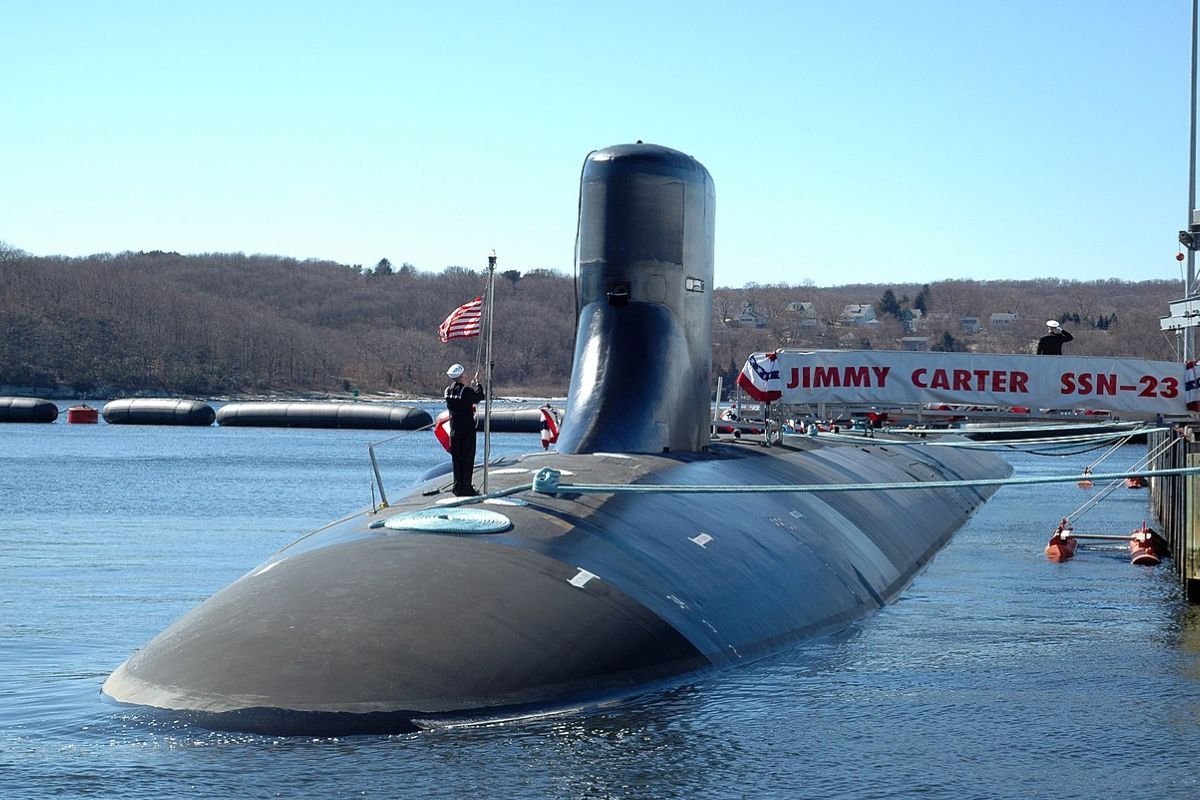
Image: At Naval Submarine Base Groton, Connecticut, a Sailor raises the Stars and Stripes aboard the Seawolf-class attack submarine USS Jimmy Carter (SSN-23) during its commissioning ceremony.
The submarine features a unique 100-foot Multi-Mission Platform hull extension, allowing it to deploy advanced sensors, weapons, and undersea vehicles for specialized missions.
