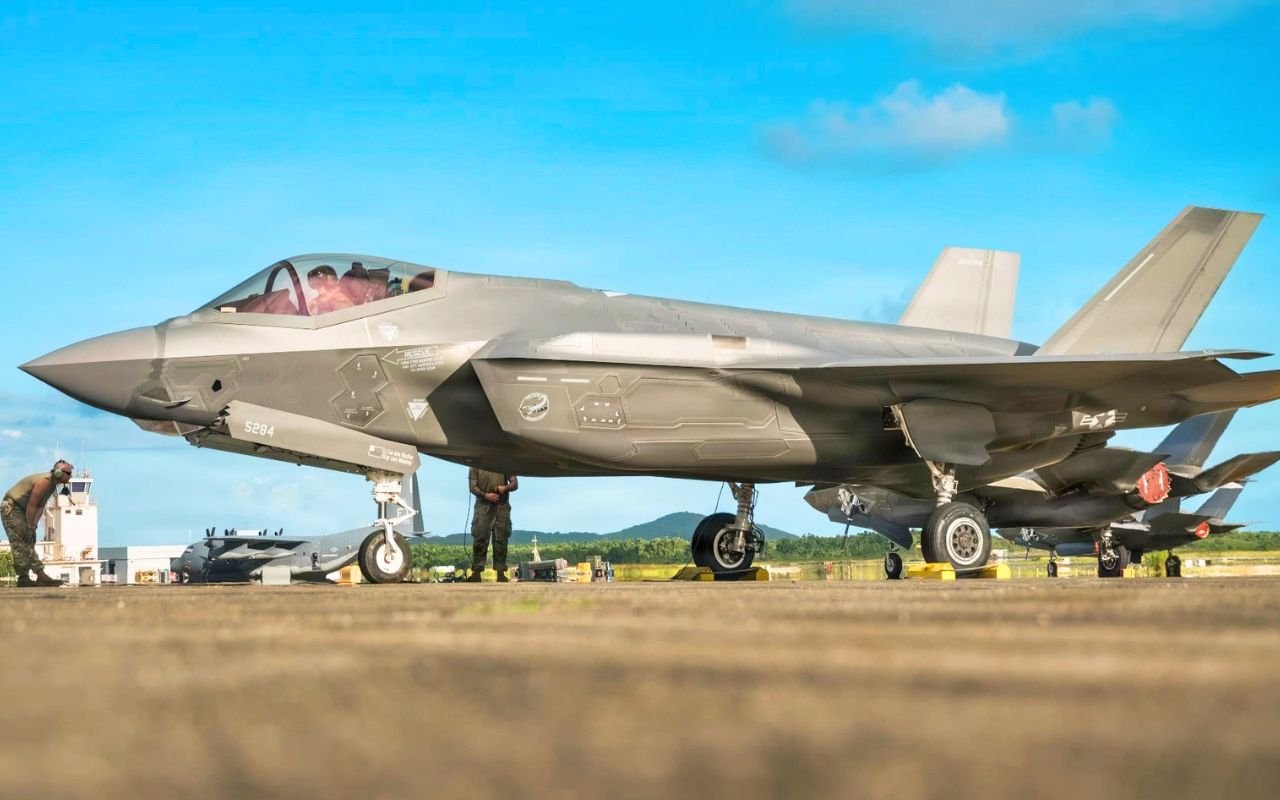
In a strategic chess move echoing through the Asia-Pacific, 48 next-generation F-35A stealth fighters will soon be stationed at Japan’s Misawa Air Base, signaling unmatched aerial firepower and a robust deterrent against growing threats.
Japan’s positioning of these advanced aircraft underscores an intensifying competition in military technology and regional defense dynamics. With the People’s Liberation Army (PLA) expanding its reach and capability, this deployment reflects a multifaceted approach to maintaining power equilibrium across contested waters and skies. The integration of the F-35A fleet aligns with decades of U.S.-Japan security cooperation, amplifying the alliance’s capacity to project air dominance and networked defense over critical Pacific corridors. This move not only equips Japan with superior air combat readiness but also enhances the United States’ tactical footprint along the First Island Chain, an area vital to the containment of China’s military ambitions.
The strategic significance of Misawa’s F-35A deployment in Pacific security
Japan’s hosting of 48 cutting-edge F-35A stealth fighters at Misawa Air Base is far more than simply an upgrade of military hardware; it marks a pivotal moment in the Asia-Pacific’s strategic calculus. Stationed at a location long familiar to U.S. forces since their peacetime arrival in 1945, these fighters symbolize a modernized and heightened response to evolving threats posed by China’s expanding military presence.
The strategic radius of the F-35A, offering an operational range of approximately 1,300 miles (2,100 km), allows these aircraft to cover vast areas including Taiwan, the East China Sea, and even reach toward the coastal mainland of China. This capability transforms Japan into a critical node for power projection, enabling swift response without extensive mid-air refueling support, which typically diminishes mission flexibility and stealth.
Moreover, the fighters’ stealth technology combined with advanced sensor fusion makes them exceptionally suited for penetrating sophisticated air defenses like those deployed by the PLA. The F-35’s agility, advanced radar, and electronic warfare systems give Japan and U.S. forces a pronounced tactical advantage, substantially complicating any adversary’s planning.
Japan’s defense modernization complemented by this deployment also signals a deepening of the U.S.-Japan alliance, showcasing a shared commitment not only to regional stability but to deterrence strategy against potential aggression. This aligns with broader American pivot strategies toward Asia, emphasizing forward-deployed assets to counterbalance Beijing’s growing assertiveness in disputed territories.
In practical terms, the presence of these fighters on Japanese soil enables immediate coordination with allied forces. The synergy with maritime assets like Japan’s JS Kaga mini-carrier enhances a multidimensional defense capability. This enables coordinated operations between land-based air platforms and naval aviation, multiplying the overall effect in both defensive and offensive scenarios.
The integration into existing Japan Self-Defense Forces (JSDF) infrastructure also allows rapid scalability of force in response to threats or crises. This positioning places Misawa at the forefront of a strategic network designed to maintain air superiority along vital maritime and aerial routes, serving as a bulwark against escalations in the Pacific.
Networking strength: Multi-Function Advanced Data Link (MADL) and alliance interoperability
One of the less visible, yet crucial, keystones of the F-35A’s power lies in its ability to operate within an intricate web of allied networks via the Multi-Function Advanced Data Link (MADL). This secure, high-speed communications system allows the F-35 to share battlefield information almost instantaneously, creating a near real-time tactical awareness bubble over the First Island Chain.
This connectivity binds together American, Japanese, South Korean, Australian, and increasingly Southeast Asian air forces into a cooperative defensive umbrella. By feeding encrypted sensor data between F-35s and other allied systems, the MADL ensures a dynamic sharing of threats, targets, and battlefield conditions, reducing response times and exponentially improving combat effectiveness.
The value of this networked capability emerges starkly when considering potential confrontations with technologically sophisticated adversaries like China, whose own J-20 stealth fighters are land-based and less supported by such integrated communication systems. The F-35’s ability to “see without being seen” becomes further amplified when multiple stealth fighters coordinate over vast distances.
Additionally, the alliance benefits from this data fusion by extending situational awareness across differently purposed platforms—from amphibious mini-carriers to conventional air bases and ground forces. This integrated approach to defense widens operational possibilities, using stealth fighters as both lance and shield in multi-domain combat environments.
For example, the joint usage of the MADL between U.S. F-35A units at Misawa and Japanese F-35Bs operating from ships like the JS Kaga creates a powerful maritime-air grid. This network not only protects critical sea lanes but also allows for rapid offensive strikes if necessary, acting as a force multiplier and solidifying allied strategic posture.
The presence of MADL-capable F-35s has prompted regional partners, including the Philippines and Singapore, to explore hosting and procuring these aircraft, reinforcing an evolving cooperative framework designed to fill strategic gaps along the arc from Japan through Southeast Asia to Australia. This connectivity-driven strategy underpins the modern concept of collective defense and deterrence in the region.
The role of Japan’s JS Kaga mini-carrier in integrated air power projection
The auspicious arrival of the F-35A at Misawa complements Japan’s increasingly potent naval aviation capabilities, particularly with the JS Kaga mini-carrier playing a pivotal role. Recently refitted to carry vertical take-off and landing (VTOL) F-35Bs, JS Kaga is a compact yet formidable platform designed for a new era of maritime power projection.
The JS Kaga displaces roughly 27,000 tons at full load, with an 814-foot flight deck, considerably smaller than the U.S. supercarriers but uniquely suited for rapid deployment of stealth fighters in contested littoral zones. Unlike older helicopter carriers, this vessel is configured to launch and recover fixed-wing stealth jets that enhance strike capabilities versus traditional naval air wings.
This synergy between Japan’s F-35Bs aboard JS Kaga and the U.S. F-35As stationed at Misawa builds a layered air combat network that can quickly respond to threats along Japan’s maritime approaches. It extends the reach of stealth air power deep into contested waters and counterbalances China’s growing naval forces.
Having a forward-deployed, flexible mini-carrier at sea working in tandem with land-based F-35s allows for rapid concentration of force that is difficult for adversaries to target. This dispersed yet connected force structure significantly complicates enemy targeting and missile defense efforts.
Moreover, the JS Kaga’s ability to transport troops, helicopters, and sustain amphibious operations strengthens Japan’s ability to defend remote islands and conduct rapid crisis response in territorial skirmishes. In essence, it acts as a marine-air force bridge, elevating Japan’s role not just as a defensive bastion but as an active power projection state capable of shaping regional outcomes.
This maritime-air integration underlines Japan’s evolution from a post-war pacifist stance toward a more assertive posture, enabled by technology and strategic collaboration, underscoring the shared interests and responsibilities of the U.S.-Japan security alliance.
Operational readiness and tactical impact of F-35A squadrons in the First Island Chain
The full operational deployment of 48 F-35A fighters under the 35th Fighter Wing at Misawa represents a significant upgrade in the tactical readiness of U.S. and allied forces. Transitioning from fourth-generation platforms like the F-16s to these stealth fighters boosts survivability and lethality in air operations.
These units have undergone rigorous training exercises focusing on multi-domain warfare, integrating electronic warfare, sensor fusion, and precision strike capabilities. Operational drills simulate high-threat environments with dense Chinese missile networks and electronic countermeasures, shaping a doctrine of agile and stealthy airpower.
The F-35’s extended range and low radar signature allow them to conduct deep interdiction or escort missions, supporting both naval and ground operations. They also contribute critical intelligence gathering through advanced sensors, providing commanders with real-time battlefield insights.
Tactically, the presence of such a force near the frontline creates deterrence by denial, limiting PLA’s freedom of maneuver both over the air and on sea lanes. In crisis scenarios, the ability to quickly mass F-35 squadrons can impose severe risks on Chinese forces contemplating aggression, thereby reinforcing peace through strength.
This is especially relevant as the U.S. continues developing more sophisticated logistical cross-servicing agreements in the Indo-Pacific to sustain long-term air operations, while Japan’s acquisition of additional F-35Bs ensures a complementary force multiplier capable of dispersed and naval-based operations.
The convergence of training, technology, and geographic advantage makes these squadrons one of the most potent components in America’s Pacific deterrence architecture, redefining power projection well into the foreseeable future.
Long-term implications for regional power dynamics and future military alliances
The deployment of 48 F-35A stealth fighters near China’s doorstep signals a clear message to regional and global players about shifting balances of power. This move reflects not just military modernization but an evolving geopolitical landscape marked by heightened competition for influence and security guarantees.
This growing aerial capability strengthens Japan’s role as a vital American partner, encouraging further military sales and collaborative defense projects. Additionally, smaller regional players are witnessing these developments with strategic interest, possibly accelerating their own modernization efforts to keep pace with emerging threats.
The deployment also places China under unprecedented pressure, forcing a reassessment of its own air defense networks, development timelines, and possible expansion of its naval aviation capabilities. It likely prompts Beijing to consider faster deployment of next-generation platforms or increase its reliance on asymmetric warfare tactics, including cyber and missile capabilities.
Furthermore, the expansion of F-35 deployment could bolster multilateral defense pacts, enabling more unified responses to crises in the region. Countries such as South Korea, Australia, and Singapore stand to benefit from closer interoperability, facilitated by the common platform and secure data links.
Looking ahead, this enhanced presence at Misawa may act as a catalyst for new defense dialogues and joint exercises focused on integrated responses to threats posed by China’s advanced military technologies. The evolving role of airborne stealth fighters in combination with naval power creates new doctrinal concepts emphasizing flexibility, rapid response, and layered defense systems tailored to Pacific realities.
In this way, the F-35A deployment is more than a military upgrade; it’s a key element shaping the future security architecture of the Pacific Basin, influencing alliance behaviors and the strategic calculations of regional powers for years to come.
| Date | Event | Location | Significance |
|---|---|---|---|
| 1945 | U.S. forces first arrived at Misawa Air Base | Japan | Established long-term U.S. military presence in Asia-Pacific |
| 2026 | Deployment of 48 F-35A stealth fighters | Misawa Air Base, Japan | Significant boost to Japan-U.S. alliance and regional deterrence |
| 2024 | JS Kaga mini-carrier refit completed | Japan Maritime Self-Defense Force | Enhanced maritime strike and power projection platform |
| Ongoing | Multinational exercises involving F-35s and allied forces | Indo-Pacific Region | Improved interoperability and joint operational readiness |
Essential takeaways about the F-35A presence at Japan’s Misawa base
- Extended range and stealth capabilities allow projection deeply into contested zones without compromising detection.
- Multi-Function Advanced Data Link (MADL) ties allied forces into a sophisticated real-time network, enhancing battlefield awareness.
- Integration with JS Kaga mini-carrier strengthens maritime-air cooperation and rapid response flexibility.
- Tactical training and operational readiness prepares forces for multi-domain combat in high-threat scenarios.
- Impact on regional power dynamics encourages closer collaboration and deters escalation from adversaries.
Why is Japan hosting so many F-35A stealth fighters?
Japan’s hosting of 48 F-35A stealth fighters enhances regional defense capacity amid growing Chinese military activity, reinforcing both deterrence and power projection along vital Pacific corridors.
How does the F-35A compare against China’s J-20 fighter?
While the J-20 is a capable land-based stealth fighter, the F-35A offers superior networked capabilities, stealth technology, and a longer operational range, enabling more versatile and coordinated operations.
What is the role of the JS Kaga mini-carrier in this strategy?
JS Kaga supports Japan’s F-35B jets, providing a mobile platform for rapid deployment of stealth fighters at sea, enhancing maritime strike capabilities alongside land-based operations.
How does the Multi-Function Advanced Data Link (MADL) increase effectiveness?
MADL enables a secure, high-speed communication network among allied F-35s, allowing for real-time data sharing, coordinated attacks, and a collective tactical advantage over adversaries.
What impact will this deployment have on regional security?
The deployment significantly strengthens deterrence against Chinese expansionism, fosters tighter military alliances, and is likely to spur modernization and cooperation among Indo-Pacific partners.
