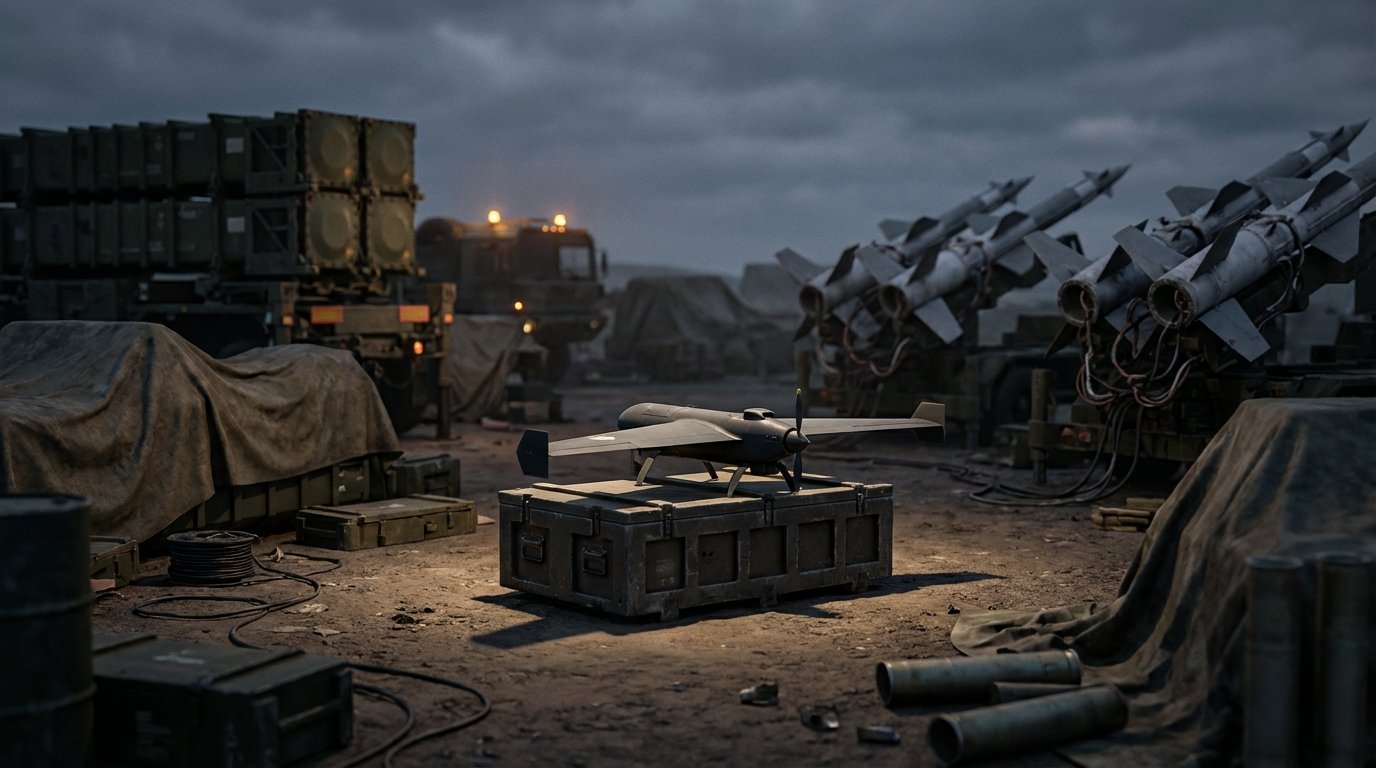
The ongoing conflict between low-cost Iranian drones and high-value U.S. missile defenses reveals a staggering mismatch with serious strategic consequences.
In the midst of escalating tensions in West Asia, an economic and military paradox emerges: Iran deploys drones costing around €20,000 each while the United States counters with missile interceptors priced at €3 million to €12 million apiece. This asymmetry is bleeding U.S. missile stockpiles rapidly during Operation Epic Fury. Despite significant degradation of Iran’s conventional capabilities due to relentless U.S. and allied strikes, the persistent use of inexpensive Iranian Shahed drones and ballistic missiles continues to strain American defense resources, highlighting an urgent need to reassess missile production and defense strategy moving forward.
How iran’s low-cost drones exploit the high-cost us missile defense system
The military dynamic between Iran and the United States has evolved into a potent example of asymmetrical warfare, where Tehran leverages economical drones — specifically Shahed models costing approximately €20,000 — against the U.S.’s costly defensive arsenal. The interceptor missiles used to shoot down these drones, such as those employed in Patriot or THAAD systems, carry price tags ranging from €3 million to €12 million each.
This creates a severe imbalance: vast waves of drones can be launched by Iran at a fraction of the cost it takes for the U.S. to neutralize them, forcing American forces into depleting expensive missile inventories rapidly. Military analysts like Reuben F. Johnson highlight this strategic “stress test,” emphasizing how Tehran’s swarm tactics with low-cost drones create an economic attrition, or “cost-asymmetry crisis,” that can potentially weaken the U.S. missile reserves over time.
Although Iran’s air force and conventional air defense systems have suffered an approximately 80% reduction in combat effectiveness due to sustained air strikes, the drone and missile tactics remain resilient and effective in exerting economic pressure. This asymmetric warfare method allows Iran to sustain offensive maneuvers despite its faltering conventional defenses.
For example, during Operation Epic Fury, waves of Shahed drones attacked U.S. and allied installations, costing Iran mere tens of thousands of euros per drone but forcing the American military to respond with interceptors that cost exponentially more. This imbalance is not just a budgetary annoyance — it fundamentally alters the strategic calculus of regional and global security.
Comparing cost efficiency: iranian drones vs. western interceptors
When juxtaposing Tehran’s drone production with the expenditure required for U.S. missile defense, the divergence in economic efficiency becomes startlingly clear. While an Iranian Shahed drone averages about €20,000 to €50,000, each missile interceptor launched carries a multi-million-euro price tag.
Several factors underpin this divergence:
- Production complexity: U.S. interceptors involve highly sophisticated electronics, guidance systems, and propulsion, driving costs into millions.
- Mass production challenges: U.S. defense contractors face lengthy lead times to mass-produce interceptors, slowing down replenishment.
- System integration: Advanced ballistic missile defense combines sensors, command and control, and multi-layered missile systems, compounding costs.
By contrast, Iranian drones utilize simpler technology, are relatively straightforward to manufacture, and thus can be deployed in large numbers to saturate air defenses economically. This tactical approach creates a persistent threat that saps costly Western assets just as rapidly as missile stockpiles can be rebuilt.
Geopolitical impact of energy infrastructure strikes amid ongoing missile depletion
The imbalanced arms exchange extends beyond simple missile economics, entangling global energy markets and regional security. Iran’s reliance on drone and missile strikes targeting critical energy infrastructure illustrates Tehran’s strategic use of low-cost weapons as instruments of economic leverage and disruption.
For instance, in early March 2026, Iranian strikes on major oil refineries in the United Arab Emirates caused significant operational halts, affecting global oil supplies. The disruption contributed to volatility in oil prices, bolstering fears that prices could soar near the psychologically and economically disruptive mark of €200 per barrel.
Further complicating the situation is the deployment of naval mines in the Strait of Hormuz, a vital chokepoint for global energy shipments. The Strait’s effective closure due to these mines jeopardizes the transportation of thousands of kilometers of oil and liquefied natural gas daily, increasing global energy insecurity. The U.S. and allied navies face difficult decisions, balancing rapid clearance operations with avoiding escalation.
This strategic targeting of economic infrastructure, facilitated by relatively cheap drones and missiles, is a core pillar of Iran’s plan to strain U.S. and Western economies. Tehran’s ability to maintain continuous strikes using affordable weapons directly impacts global markets and exerts pressure far beyond military clashes.
Strategic ripple effects on global oil markets
The persistent threat to global oil shipments from Iranian drone and missile strikes has cascading repercussions:
- Surging oil prices: The risk of supply shortages pushes crude prices toward €200 per barrel, potentially triggering inflationary pressures worldwide.
- Energy security concerns: Nations dependent on Gulf oil face challenges in diversification and securing alternative routes.
- Geopolitical frictions: Regional and global powers may increase military presence to protect shipping lanes, heightening tensions.
These developments underscore how tactical military decisions in the skies are intricately linked to planetary economic stability and diplomatic relations.
Innovation in drone defense: exploring cost-effective missile alternatives
Recognizing the peril of depleting expensive missile interceptors, some countries are pioneering innovative solutions to counter low-cost drones more economically. Ukraine, for instance, has developed tiny drone interceptors priced between €1,000 and €2,000 each, demonstrating the possibility of low-budget defense systems that can be produced in high volume.
This new class of counter-drone technology relies on swarm interception tactics and lightweight materials, enabling cheap and rapid production. Although America and its allies have traditionally depended on multi-million euro interceptors designed for ballistic missile defense, the urgent need to address drone swarms has accelerated research into these cost-effective, scalable solutions.
However, transitioning from traditional missile defense to a multi-tiered drone defense system is complex. Existing infrastructure must adapt, sensor networks must be upgraded for drone detection, and command systems need reprogramming to handle shorter reaction times. Despite these hurdles, the shift is essential to close the economic gap exploited by adversaries like Iran.
Challenges to adapting U.S. missile defense systems
Several barriers complicate reorienting America’s missile defenses to counter low-cost drones:
- Budgetary constraints: Redirecting funds to develop and produce low-cost interceptors may reduce resources for high-end missile defense.
- Technology integration: Existing missile defense systems like Patriot and THAAD are optimized for ballistic threats, requiring overhaul for drone swarm threats.
- Industry readiness: Mass production capacity for inexpensive interceptors is not yet scaled in the U.S.
These challenges emphasize why sustained innovation and investment are critical to maintain a strategic edge amid evolving airborne threats.
The dangerous logistics of munitions depletion in prolonged conflict
The sustained use of expensive interceptors against swarms of affordable Iranian drones places the U.S. stockpiles under unprecedented strain. With advanced interceptor missiles often taking months or years to produce due to complex manufacturing, the current usage rate is unsustainable if the conflict continues at its present intensity.
This dynamic was already highlighted in early 2026 when experts warned about the “munition production lag” — the gap between missile usage and replenishment speeds. The U.S. Department of Defense is under pressure to boost production capacity, but ramping up such sophisticated munitions is hindered by the intricacies in supply chains, high-quality components, and skilled labor force requirements.
Meanwhile, Iran is rapidly producing drone swarms and ballistic missiles on a much simpler industrial scale. This growing supply stockpile allows Tehran to keep up relentless pressure on U.S. and allied forces, forcing America into costly defensive expenditures that deplete readiness for potential larger-scale conflicts.
| Weapon Type | Unit Cost (€) | Production Time | Operational Use |
|---|---|---|---|
| Shahed Drone (Iran) | 20,000 – 50,000 | Weeks | Swarm attacks & reconnaissance |
| Patriot Interceptor Missile (US) | 3,000,000 – 12,000,000 | Months to Years | Ballistic missile & drone interception |
| Ukraine drone interceptors | 1,000 – 2,000 | Weeks | Drone swarm interception |
This table illustrates the stark contrast between weapon costs and production timelines, underscoring the long-term challenge of sustaining missile stocks while countering affordable Iranian drone tactics.
Operational impact and strategic recalibration needed
The ongoing drone-missile cost imbalance is forcing U.S. military strategists to reconsider how conflicts in asymmetric theaters are fought. Expensive missile stockpiles designed primarily for large ballistic threats are vulnerable to attrition when faced with cheap, disposable drone swarms.
Operationally, this means reallocating resources towards enhanced detection, interception innovation, and coordinated multi-domain defense involving cyber and electronic warfare to degrade drone effectiveness before missile intercepts become necessary.
Military leaders are increasingly emphasizing integration of counter-drone sensors, electronic warfare tactics to jam or disable drones, and deploying rapid-fire directed energy weapons that could offer lower per-use cost defenses.
Failing to address the imbalance could risk exhausting the U.S. missile stockpile at a critical moment, jeopardizing air defense capability against more significant threats from state actors or extremist groups.
Adapting strategies to incorporate cost-effective technologies and improving stockpile preservation are vital for maintaining regional stability and safeguarding global security architecture amid these unprecedented challenges.
Why are the cost differences between Iranian drones and U.S. interceptors so significant?
Iranian drones like the Shahed use simpler technology and materials, enabling much cheaper production compared to the advanced guidance, propulsion, and sensor systems integrated into U.S. interceptors, which drive up their cost significantly.
What risks does the imbalance pose to U.S. military readiness?
The rapid depletion of expensive missile stockpiles caused by continuous drone swarms could leave the U.S. vulnerable to larger-scale missile attacks, potentially compromising national and allied defense capabilities.
How can the U.S. counter the low-cost drone threat more effectively?
Investing in lower-cost interceptor technologies, upgrading detection and electronic warfare capabilities, and developing directed energy weapons offer feasible solutions to reduce per-engagement expenses and improve response rates to drone swarms.
What is the strategic aim behind Iran’s drone and missile attacks on energy infrastructure?
Iran aims to disrupt global oil supply routes, notably through the Strait of Hormuz and key oil refineries, to increase oil prices and create economic stress on the U.S. and its allies, thereby exerting geopolitical leverage.
