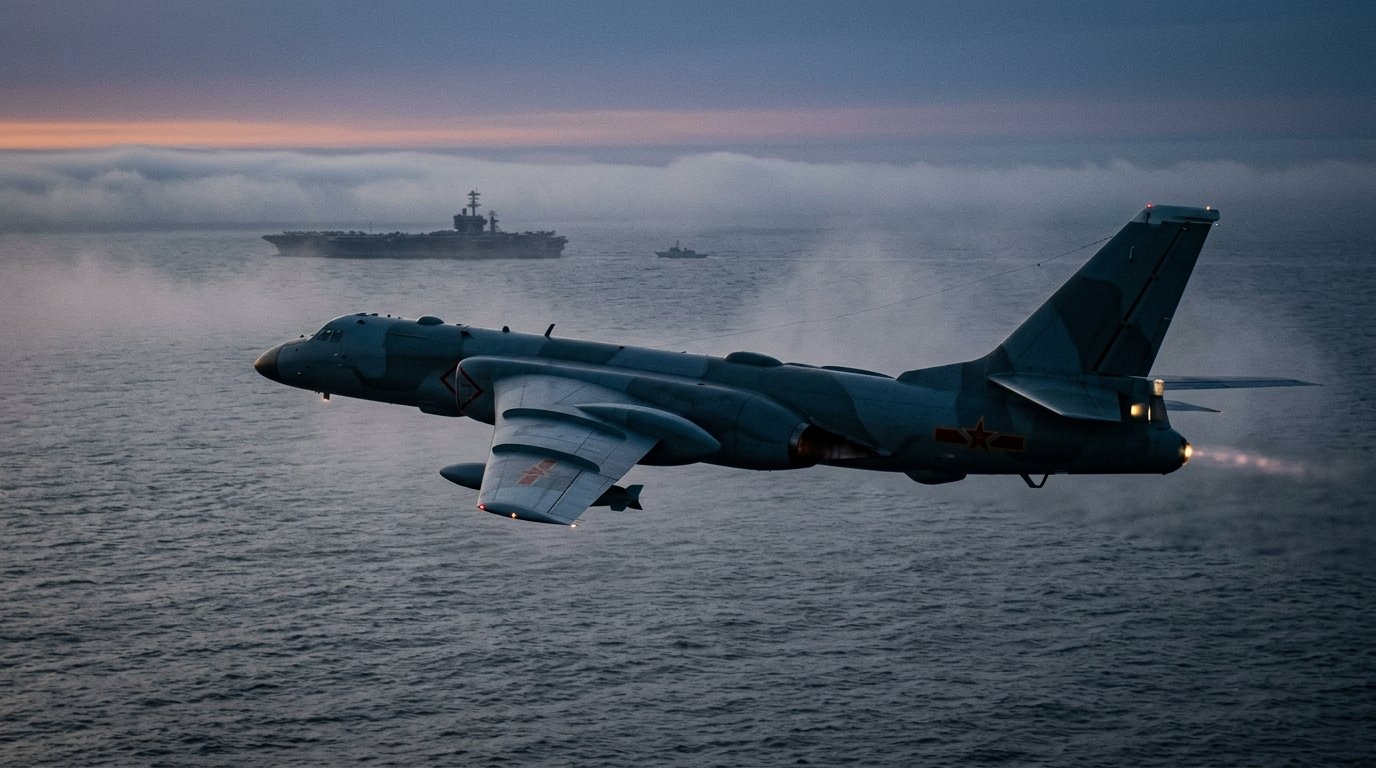
China’s Xi’an H-6 bomber, though rooted in a Cold War Soviet design, has been transformed into a formidable tool threatening the very heart of U.S. naval power, the mighty nuclear aircraft carriers.
Though the H-6 traces its origins back to the 1950s, its evolution into a missile-launching platform capable of deploying hypersonic and supersonic anti-ship weapons marks it as a centerpiece of Beijing’s anti-access/area-denial strategy. Its ability to project power across the First Island Chain has unsettled U.S. naval planners and raised profound questions about the future of American deterrence in the Indo-Pacific region.
The evolution of the H-6 bomber into a missile carrier challenging U.S. naval supremacy
The H-6 bomber wasn’t originally designed to contest modern naval fleets. Its roots lie in a Soviet-era medium bomber, but China has significantly upgraded the platform to serve as a missile truck rather than a conventional bomber. This transformation highlights an ingenious military approach: leveraging legacy equipment and retrofitting it for contemporary strategic needs, thereby marrying cost-effectiveness with deadly function. The U.S. Navy’s legendary aircraft carriers have long been the backbone of American military presence, enabling power projection deep into contested waters. China’s aim is clear—to neutralize these carriers’ dominance by denying them access close to its shores, especially within what’s known as the First Island Chain, a series of key strategic islands including Taiwan, Okinawa, and the Philippines. The significance of this shift can be understood by recognizing that while the H-6 itself isn’t stealthy or as advanced as modern 5th generation fighters, it carries weapons that can strike from beyond the reach of most U.S. naval aircraft defenses. To put it simply, the bomber acts as a “flying missile launcher,” unleashing waves of advanced missiles designed specifically to overwhelm warship defenses. By turning an aged airframe into a platform for hypersonic anti-ship ballistic missiles (ASBMs) and supersonic cruise missiles, China demonstrates a tactical doctrine that prizes saturation attacks and long-range engagement. The bomber’s versatility is enabled by its ability to carry payloads such as the YJ-21 hypersonic missile and the YJ-12 supersonic missile, weapons designed to rapidly saturate a carrier group’s defenses and strike from unexpected distances. The H-6’s transformation evidences a new era in warfare where legacy systems adapted with advanced munitions can challenge even the most sophisticated naval forces, reshaping the balance of power in the Pacific. This strategy hinges on accessibility and the ability to field masses of cheap, effective strike weapons—rather than relying solely on surface combatants or stealth aircraft, which are expensive and complex to produce.
The rise of missile saturation tactics and how it reshapes naval defense
One of the most alarming aspects of the H-6’s role is its ability to initiate saturation missile attacks. China’s military doctrine envisions launching not just one or two missiles, but volleys numbering in the dozens or even hundreds, intended to overwhelm ship-based missile defense systems. The YJ-12 supersonic missile, capable of reaching speeds of Mach 3 with a range of around 400 kilometers, is particularly suited for these saturation attacks. When dozens of such missiles are combined with the YJ-21 hypersonic ballistic missile—achieving terminal speeds near Mach 10 and capable of striking targets at ranges nearly four times greater—the effectiveness of defense systems diminishes sharply. U.S. naval vessels are equipped with layers of defense systems, including the Aegis Combat System and the Standard Missile series. However, the prospect of multi-axis, high-speed missile attacks from bombers hovering beyond the horizon represents a serious challenge. The cost and complexity of intercepting hypersonic threats, combined with sheer attack volume, may degrade an aircraft carrier group’s ability to respond effectively. This tactic—leveraging quantity and quality to impose a threat environment so dense that defenses are no longer reliable—is a fundamental shift in maritime warfare. Instead of direct engagement with enemy fleets, the focus moves toward attrition through sustained, high-intensity missile barrages, worn down over time to achieve strategic access denial. Such developments force the U.S. Navy to reconsider the traditional confidence held in the sanctity of carrier strike groups, especially near Chinese maritime zones. The implications extend beyond military hardware to the very concept of naval power projection in the 21st century.
The strategic implications of the H-6’s threat on U.S. alliances in the Indo-Pacific
The H-6’s capability to threaten U.S. nuclear carriers carries profound strategic repercussions for regional security and American alliances. Many countries within the First Island Chain rely heavily on the United States’ military presence as a deterrent against Chinese expansionism and coercion. Should U.S. aircraft carriers be deterred from operating near Chinese-held waters due to the threat posed by H-6 bombers armed with advanced missile systems, it erodes the credibility of America’s security commitments. Allies could begin to question the reliability of U.S. defense guarantees if the most visible and powerful symbols of American military might become vulnerable in contested spaces. This shifts regional security dynamics significantly. Nations like Japan, South Korea, the Philippines, and Taiwan may increasingly consider alternative defense postures, diplomatic alignments, or even pursue more robust indigenous defense capabilities to compensate for perceived shortfalls. Moreover, it reinforces Beijing’s ambitions to assert dominance within its near seas, effectively redrawing the strategic map. Maintaining freedom of navigation and access through these key maritime choke points becomes a rising challenge. The H-6 bomber’s role isn’t just tactical; it exemplifies a broader geopolitical gambit. The looming question is whether U.S. policymakers and military strategists can adapt doctrine and assets fast enough to counteract this missile truck strategy before the erosion of deterrence becomes irreversible. The stakes extend beyond military hardware—alliances, regional stability, and the future balance of power depend substantially on the ability to mitigate this evolving threat.
Potential alliance responses and regional security recalibrations
Regional nations already face tough choices, balancing economic ties to China with security concerns. The H-6’s emerging role adds urgency to discussions about increasing joint military exercises, enhancing missile defense systems, and expanding multilateral cooperation mechanisms.
Options on the table include:
- Investing in missile defense technologies capable of intercepting hypersonic and supersonic threats;
- Deepening intelligence sharing and early warning networks;
- Expanding the presence of allied naval forces in strategically important waters;
- Accelerating development of unmanned maritime and aerial systems for denser surveillance and rapid response;
- Increasing diplomatic efforts to deter escalation and manage tensions through dialogue.
In effect, the H-6 bomber’s menace challenges not just U.S. naval power but the very framework governing Indo-Pacific security cooperation.
Technical specifications and missile capabilities turning the H-6 into a formidable missile platform
The H-6’s impressiveness lies in its payload versatility and the advanced missile technologies it carries. Unlike traditional bombers that rely on gravity bombs or unguided munitions, the H-6 serves primarily as a launch platform for a diverse missile arsenal with strategic and tactical uses.
Among the key weapons systems are:
| Missile model | Type | Speed | Range (km) | Capability |
|---|---|---|---|---|
| YJ-21 | Hypersonic anti-ship ballistic missile (ASBM) | Up to Mach 10 terminal speed | 1,500 | Penetrates modern missile defenses; highly maneuverable during terminal phase. |
| YJ-12 | Supersonic cruise missile | Mach 3 | 400 | Used in saturation attacks against naval groups, designed to overwhelm enemy defenses. |
| CH-AS-X-13 | Nuclear-capable air-launched ballistic missile (ALBM) | Subsonic (ballistic trajectory) | Greater than 1,500 | Targets large naval formations from long distances with nuclear payload. |
These missiles represent cutting-edge developments in China’s anti-access/area-denial arsenals. The YJ-21, in particular, challenges traditional naval warfare paradigms due to its speed and flight path unpredictability, making interception by current U.S. shipborne systems extremely difficult.
The synergy of the H-6’s missile payload and its operational range allows China to hold critical sea lanes and carrier battle groups at risk without exposing its own forces directly to counterattack.
Why America’s traditional focus on high-tech platforms risks blinding U.S. Navy strategy
The H-6’s resurgence underscores a crucial strategic lesson: technological sophistication alone does not guarantee dominance. The United States has long invested heavily in high-tech platforms like stealth fighters and advanced nuclear carriers. However, China’s approach highlights the evolving nature of modern warfare where old designs coupled with innovative missile technology and mass production yield potent capabilities.
This concept echoes lessons witnessed in asymmetric conflicts, where less advanced but cleverly adapted weapons – such as improvised explosive devices (IEDs) or unmanned drones – have disrupted forces with superior technology. The H-6 bomber fits into this paradigm by maximizing impact via combined effect rather than relying on singular superior platform capabilities.
China’s deployment of the H-6 in an anti-access/area-denial role embodies what defense analysts call a ‘missile truck strategy’ – a cost-effective counter to expensive, complex naval groups and platforms. It prioritizes quantity, saturation, and stand-off engagement over dogfights or direct carrier strikes by stealth aircraft.
The implications for the U.S. Navy’s strategy are profound. Persisting in a reliance on advanced platforms without adjusting to the reality of mass missile saturation assaults risks degradation of naval power in Asia-Pacific waters.
Adapting to this challenge demands integration of layered missile defenses, improved early warning, and innovative countermeasures tailored to neutralize the threat posed by missile carriers like the H-6.
The question remains: can the U.S. military adapt quickly enough to preserve unchallenged naval superiority in contested spaces?
Theoretical shifts in future combat and procurement policies
Future American naval doctrine may require breakthroughs in directed energy weapons, electronic warfare, and enhanced missile interception capabilities to protect carriers against saturation missile attacks. This might involve significant reallocation of defense budgets and reevaluation of fleet compositions while fostering cutting-edge research in missile defense technologies and unmanned systems.
In sum, the H-6 bomber’s reinvention epitomizes a broader geopolitical pivot. It forces a reconsideration of what “modern” warfare means—turning attention toward resilient, adaptive strategies that fuse legacy hardware with emerging technologies for maximum strategic effect.
What is the primary function of China’s H-6 bomber in 2026?
It serves mainly as a missile launch platform equipped to carry advanced hypersonic and supersonic anti-ship missiles designed to threaten U.S. naval vessels, particularly aircraft carriers.
How do the YJ-21 and YJ-12 missiles impact U.S. naval defenses?
The YJ-21, with hypersonic speeds and long range, and the YJ-12, capable of saturation attacks, significantly strain the ability of current U.S. ship defense systems to intercept incoming missile volleys.
Why does the H-6 bomber matter strategically to China’s anti-access/area-denial (A2/AD) doctrine?
By threatening U.S. aircraft carriers near Chinese waters, the H-6 bomber plays a key role in preventing American naval power projection, thereby bolstering China’s control over contested maritime regions.
Can the U.S. Navy counter the threat posed by the H-6 effectively?
While challenging, the U.S. Navy is exploring multi-layered missile defense systems, electronic warfare, and advanced early warning mechanisms as part of its evolving response to saturation missile attacks.
What makes the H-6’s missile truck strategy a significant change in modern warfare?
It exemplifies how combining older aircraft platforms with modern missile technology in mass can effectively threaten superior naval forces without relying on next-generation stealth or expensive platforms.
