
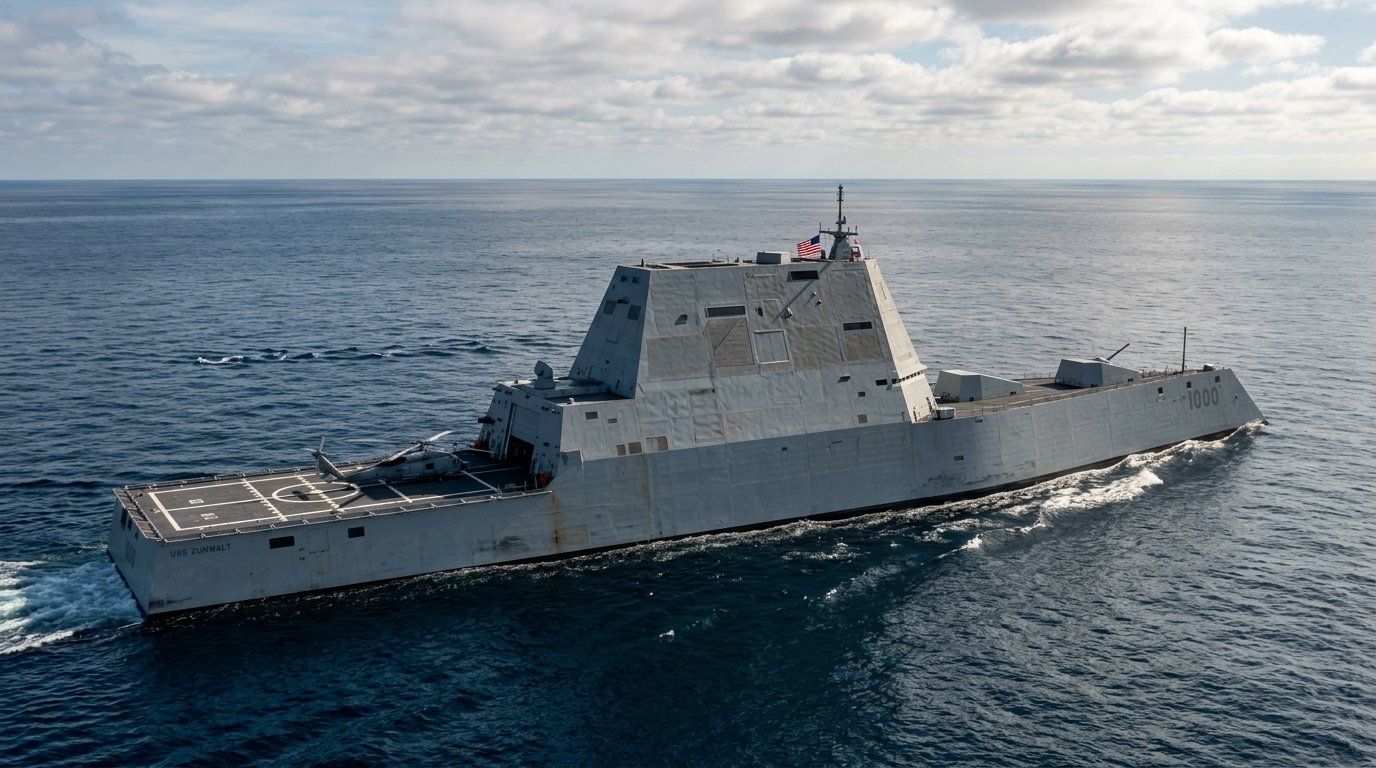
The U.S. Navy’s Zumwalt-class destroyer, once mocked as an $8 billion white elephant, is now pushing the boundaries of naval warfare with its transformation into a hypersonic missile carrier. This high-tech warship, initially designed for a world that no longer exists, is experiencing an unexpected comeback in 2026.
In the post-Cold War era, the U.S. Navy invested billions in the Zumwalt-class destroyers, a fleet built around an outdated vision of warfare. These ships embodied cutting-edge stealth technology intended to dominate land-attack missions. However, rapid shifts in global threats and technological missteps halted their trajectory, relegating them as costly experiments. Yet, as the world returns to great power competition, the Navy has found new hope for these vessels by outfitting them with hypersonic Conventional Prompt Strike (CPS) missiles, allowing a strategic reach far beyond original capabilities.
How The Zumwalt-Class Became A Symbol Of Post-Cold War Misguided Military Strategy
The demise of the Soviet Union in the early 1990s led many within U.S. defense circles to believe the era of large-scale conventional warfare was over. The new enemy was decentralized—terrorist networks, rogue states, and unconventional threats dominated the strategic landscape. This shift profoundly impacted naval procurement strategies, including the dramatic pivot toward stealth and precision land-attack capabilities.
The Zumwalt-class destroyers were conceived to embody this new age: a stealthy, futuristic warship designed to strike ashore with pinpoint accuracy. Drawing on technologies originally developed for stealth aircraft, these destroyers featured a low radar profile and innovative design elements meant to confuse enemy sensors. The logic was that in a world fighting smaller, less advanced militaries, excessive firepower was less relevant than precision and survivability.
Yet the assumptions underpinning the Zumwalt project’s design cycled against reality in fast-forward. By the time of its commissioning, the geopolitical landscape had shifted underfoot again, emphasizing the return of near-peer adversaries—countries with advanced anti-access/area-denial (A2/AD) capabilities and sophisticated sea denial strategies. The Navy’s focus needed to rapidly adapt to these renewed challenges, but the Zumwalt was crafted for a world that no longer existed.
The irony lies in the $24.5 billion budget spent on constructing just three of these massive vessels, each costing approximately $8 billion. This was an unprecedented price tag that dwarfed the cost of many other surface combatants. Additionally, the fleet encountered serious setbacks, notably with the Advanced Gun System (AGS). This large-caliber naval gun was engineered to launch highly precise, long-range projectiles but was left without compatible ammunition, making the AGS a multi-billion-euro dead end.
Technological overreach and budgeting woes
The Zumwalt’s design featured cutting-edge attributes—advanced automation, stealth shaping, and reduced crew requirements. However, these innovations proved difficult to implement, extending development times and escalating costs. Budget overruns became emblematic of the program’s troubles, fueling public criticism and congressional scrutiny.
For example, the ship’s powerful 155-mm guns required specialized ammunition costing as much as €800,000 to €1 million per round. Production was halted when it became clear there wasn’t enough demand to justify manufacturing. As a result, these main weapons systems were effectively rendered useless, forcing the Navy to rethink the Zumwalt’s role.
These challenges raised questions about whether the Navy should have pursued a smaller, more numerous class of ships or invested earlier in emerging technologies like unmanned systems. Instead, the Zumwalt became a testbed fraught with promise but burdened by the realities of a shifting strategic environment and technological limitations.
The high-stakes transformation: turning a failed warship into a hypersonic missile platform
Despite the Zumwalt’s initial setbacks, the U.S. Navy is refusing to discard this high-cost asset. Instead, a radical overhaul redefines its operational purpose. By removing the problematic Advanced Gun System, these destroyers are being equipped with a new arsenal: the 12-round Conventional Prompt Strike (CPS) hypersonic missile battery.
This upgrade is no mere retrofit. Hypersonic weapons, capable of exceeding Mach 5 speeds and traveling over 1,700 kilometers, represent a generational leap in naval strike capacity. This range eclipses the Zumwalt’s original 100-kilometer land-attack reach, repositioning the destroyer as a long-range deterrent against powerful adversaries like China and Russia.
The CPS missile program symbolizes the Pentagon’s gamble on salvaging an expensive program by fitting it with revolutionary weapons that challenge traditional naval power equations. While CPS is still undergoing development and has not yet reached operational maturity, its potential strategic value is significant.
In particular, these missiles utilize a cold-gas launch system that ejects the missile from the ship before the booster ignites, minimizing the risk to the vessel and its crew while offering rapid strike capabilities against targets anywhere on the globe in under an hour.
Challenges ahead with hypersonic weapon integration
Hypersonic technology is in its infancy, and integrating these weapons with the Zumwalt platform poses complex technical and operational hurdles. The Navy has yet to define a timeline for CPS to reach reliable operational status, reflecting broader uncertainties about hypersonic weapon adoption.
Critics argue this revival effort risks repeating mistakes by pouring more funds into an aging hull without fully addressing fundamental flaws or exploring alternative solutions such as unmanned warships or more flexible missile platforms.
Nonetheless, proponents see this as a cost-effective way to project power in contested environments, leveraging the Zumwalt’s stealth and upgraded offensive ability to deter future conflict and maintain sea control in an increasingly challenging geopolitical context.
Key features and capabilities that make the Zumwalt revolutionary in modern naval warfare
The Zumwalt-class represents the intersection of numerous advanced systems designed to create a next-generation warship capable of operating in hostile environments where detection and engagement risks run high.
Among its ground-breaking features:
- Stealth technology: Radar-absorbent materials and innovative hull design reduce its radar cross-section, making it one of the least detectable vessels at sea.
- Advanced automation: Sophisticated control systems minimize crew requirements, increasing operational efficiency and reducing human error.
- Electric propulsion: The Integrated Power System provides silent movement and the potential to power energy-intensive weapons in the future.
- Multi-mission flexibility: Originally built for land-attack, now evolving towards hypersonic strike and command roles.
Though these capabilities did not match the real-time needs of past decades, their potential utility in renewal scenarios and emerging warfighting domains remains significant today. The Zumwalt’s low acoustic and radar signature could enable it to operate within contested zones with decreased risk of detection, an invaluable trait as near-peer conflicts loom.
Economic and strategic impact of the Zumwalt program’s revival
The Zumwalt program embodies a complex case study in military spending, strategic planning, and defense innovation. The enormous €24.5 billion investment spanning three hulls broke new ground but also highlighted how ambitious projects can run into unforeseen obstacles.
A detailed look at costs involved:
| Aspect | Cost (approx.) | Comments |
|---|---|---|
| Individual Zumwalt-class destroyer | €8 billion | Among the most expensive surface ships globally |
| Total program spending | €24.5 billion | Only three ships built, heavy development overruns |
| Advanced Gun System ammo | €800,000-1,000,000 per round | Costs made production impossible |
| Hypersonic missile retrofit | Projected high cost over several years | Still under development, uncertain timeline |
The economic strain raises valid criticisms of resource allocation vs. benefit. With immense funding locked into a very limited number of ships, some experts suggest broader investments in drone fleets or missile research might have yielded more flexible results.
Strategically, however, the Zumwalt’s rebirth as a stealthy hypersonic platform offers the Navy an asymmetric edge less dependent on traditional carrier strike groups. This adaptation could prove pivotal in scenarios where rapid, long-range strike capabilities are vital for deterrence and power projection.
What the Zumwalt program tells us about future naval warfare and defense innovation
The Zumwalt saga underscores the tension between visionary military innovation and the practical demands of evolving combat environments. While it initially epitomized excess and misjudgment, the program’s conversion into a hypersonic missile launcher may signal a new paradigm where legacy platforms are repurposed to meet emergent threats.
This evolution highlights the increasing importance of hypersonic weapons, stealth, and flexible missile deployment in future naval conflicts. Gone are the days when raw firepower alone dictated naval supremacy. Modern warfare prioritizes speed, survivability, and stand-off capabilities, often integrating unmanned and AI-assisted systems.
The Zumwalt’s journey serves as a cautionary tale but also a hopeful example of adaptability in defense procurement. It invites defense strategists to rethink the wisdom of sunk costs while embracing innovation that keeps pace with geopolitical shifts.
Looking forward, the lessons learned from the Zumwalt may influence designs emphasizing modularity, weapons-agnostic systems, and scalable offensive options. Navies worldwide will watch closely whether this gamble pays off or deepens the shadow of past miscalculations.
The recent hypersonic test launches from the USS Zumwalt indicate ongoing progress despite lingering technical hurdles, underscoring relentless efforts to harness this cutting-edge technology for future conflicts.
This documentary-style overview details the Zumwalt-class’s original mission, technological breakthroughs, and current transformation into a hypersonic weapon platform, providing insight into the Navy’s evolving strategic posture.
What was the original mission of the Zumwalt-class destroyers?
They were designed mainly for stealthy land-attack missions against coastal targets, focusing on precision strikes against decentralized threats.
Why did the Zumwalt project cost so much?
High costs stemmed from integrating groundbreaking stealth technology, advanced automation, and the failure of the expensive Advanced Gun System that lacked usable ammunition.
What is the Conventional Prompt Strike (CPS) missile?
CPS is a hypersonic missile system designed to deliver rapid, non-nuclear strikes at ranges exceeding 1,700 kilometers, greatly enhancing naval long-range strike capabilities.
Are the Zumwalt-class destroyers fully operational with hypersonic missiles?
As of now, CPS integration is in the testing and development phase, with no definitive timeline for full operational readiness.
Could the funds spent on Zumwalt better support other naval priorities?
Some experts argue investment in unmanned systems and traditional missile technology might have offered better returns, but the Navy bets on Zumwalt’s unique stealth and new missile potential.
