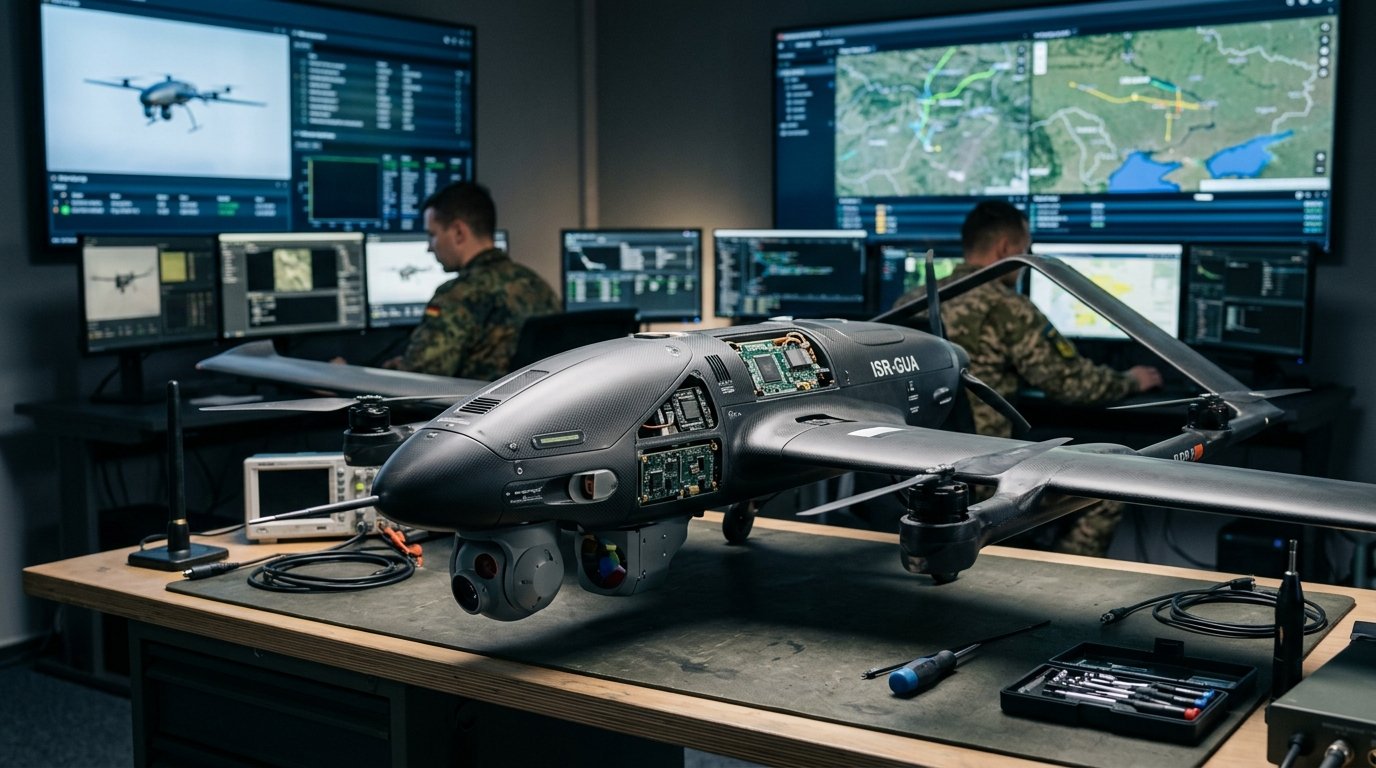
Ukraine is making remarkable strides in intelligence, surveillance, and reconnaissance (ISR) drone technology by integrating state-of-the-art German electronics, reshaping the modern battlefield landscape.
In recent years, Ukraine has intensified efforts to enhance its ISR capabilities, a vital component in modern warfare. The collaboration with Germany, leveraging advanced electronics, has unlocked new dimensions in drone performance, accuracy, and endurance. These developments are pivotal amid ongoing geopolitical tensions and create ripple effects across defense industries and strategic alliances. Understanding this progress requires diving into the technological intricacies, military applications, and strategic implications of Ukraine’s ISR drone advancements.
Revolutionizing ISR drone capabilities with advanced German electronics integration
The fusion of Ukrainian pilot projects with German electronics has triggered a revolutionary leap in ISR drone functionality. The incorporation of sophisticated sensors, processors, and communication modules from German suppliers has dramatically improved the drones’ operational efficiency and data gathering capacity. Central to this advancement is the use of cutting-edge imaging technologies that dramatically enhance target acquisition and battlefield awareness. German electronics are renowned worldwide for their robustness, precision, and miniaturization, traits that perfectly complement the evolving requirements of ISR platforms. Ukrainian engineers have optimized these components within drone architectures, allowing for extended flight times, higher resolutions in both visual and infrared spectrums, and secure encrypted data links resistant to jamming or interception. This collaboration has also enabled the development of multi-spectral and synthetic aperture radar (SAR) systems onboard drones. These systems provide critical intelligence even in adverse weather or low-visibility conditions. For example, SAR can penetrate foliage or smoke, enabling ground forces to detect concealed enemy positions—a game changer in stealth reconnaissance missions. Integrating such technology demands intricate hardware-software synergy, an area where German expertise in electronics manufacturing excels. Ukraine’s ability to source and incorporate high-performance German microchips helps overcome previous constraints posed by limited access to Western technology. These chips underpin the advanced onboard computing power required for real-time data processing, automatic target recognition, and autonomous flight control algorithms. Moreover, the integration isn’t limited to hardware alone. The software frameworks provided alongside German electronics enhance the drones’ interoperability with existing command and control (C2) systems, ensuring seamless transmission of ISR data directly to decision-makers in near real-time.
This integration results in drones that are not only more reliable and capable but also lighter and more energy-efficient. Such design improvements translate into tactical advantages such as rapid deployment, reduced logistical footprint, and extended mission endurance. For instance, newer drones can now sustain flight durations upwards of six hours, a previously unattainable parameter significantly broadening operational envelopes.
The success of this technological fusion heralds a new chapter in Ukraine’s drone capabilities, signaling a shift from reliance on less advanced platforms to creating bespoke ISR systems tailored for modern conflict demands.
Strategic advantages of enhanced ISR drones on Ukraine’s frontlines
With upgraded ISR drones equipped with German electronics, Ukrainian forces gain unprecedented tactical advantages that significantly influence frontline dynamics. These drones underpin superior battlefield situational awareness, which is paramount in 21st-century combat scenarios that demand swift decision-making based on accurate, timely intelligence.
The enhanced ISR drones provide continuous, high-fidelity surveillance covering extended territories without exposing human operators to direct threat. This capability allows Ukrainian commanders to detect enemy movements, artillery placements, and logistical nodes with pinpoint accuracy.
One critical strategic advantage is the improved coordination these drones enable among Ukrainian ground units and artillery batteries. The real-time flow of ISR data facilitates precise targeting and rapid adjustments to fire missions, thereby increasing combat efficiency and reducing collateral damage.
For example, during a recent engagement, ISR drones identified an enemy artillery unit concealed within dense forest terrain. The drone’s SAR imaging penetrated the canopy, relaying exact GPS coordinates to Ukrainian artillery controllers, who swiftly neutralized the threat. This operation highlights how integrated German electronics empower ISR drones to deliver actionable intelligence irrespective of challenging environmental conditions.
Beyond direct combat applications, high-end ISR drones support Ukraine’s counter-intelligence efforts by monitoring infiltration routes, supply chains, and potential sabotage activities. The ability to conduct persistent surveillance over hostile or contested areas aids in disrupting enemy logistical networks before they can culminate in operational gains.
Another advantage lies in psychological warfare. The presence of highly visible ISR drones with cutting-edge sensors generates a deterrence effect. Adversaries aware of their movements continuously monitored by advanced aerial units often experience reduced morale and heightened operational caution. This intangible force multiplier complements kinetic battlefield efforts.
Finally, these drone platforms serve as testbeds for Ukraine’s domestic defense industry, nurturing innovation and accelerating development cycles for future unmanned aerial vehicles (UAVs). The hands-on experience gained in operating and maintaining sophisticated ISR drones with German electronics escalates Ukraine’s self-reliance in military technology.
The strategic value cascades from immediate battlefield gains to long-term capabilities enhancement, embedding ISR drones as cornerstones of Ukraine’s military modernization roadmap.
Technical specifications and performance benchmarks of next-gen Ukrainian ISR drones
Delving deeper into the technical attributes, Ukrainian ISR drones integrating German electronics exhibit marked superiority across essential performance metrics. These include flight endurance, payload capacity, sensor resolution, communication robustness, and electronic counter-countermeasures.
Standard operational endurance has surged from around 2-3 hours on older models to approximately 6-7 hours in the new generation. This jump results from power-efficient microcontrollers and avionics enabled by German semiconductor advancements. Extended endurance expands mission reach and loiter time over critical zones.
The payload capacity has also seen improvement, accommodating multi-sensor packages combining high-definition electro-optical cameras, infrared imaging, SAR, and even signals intelligence (SIGINT) suites. The modular design approach lets units rapidly swap or upgrade sensor sets according to mission parameters.
Sensor resolutions have achieved remarkable clarity, with electro-optical cameras now offering high-definition video streaming at resolutions above 4K. Infrared sensors integrated from German tech capture detailed thermal variations crucial for detecting hidden threats during night operations or in low-visibility settings.
Communication systems utilize encrypted data links compliant with NATO standards, ensuring secure and jam-resistant channels. This guards against electronic warfare attempts aimed at severing drone-C2 connectivity. The communication stack also integrates automated frequency hopping and spread-spectrum techniques enhancing resilience.
Electronic counter-countermeasure systems are embedded within the drone’s avionics, detecting and mitigating hostile jamming or spoofing efforts. This ensures uninterrupted mission continuity, which is vital in contested airspace environments typically encountered in Ukraine’s active conflict zones.
To illustrate the impressive nature of these advancements, a performance comparison table highlights current Ukrainian ISR drone benchmarks versus previous generations:
| Specification | Previous Generation | Current ISR Drones (with German Electronics) |
|---|---|---|
| Flight endurance (hours) | 2-3 | 6-7 |
| Sensor resolution (electro-optical) | HD (1080p) | 4K+ Ultra HD |
| Supported sensor types | EO, IR | EO, IR, SAR, SIGINT |
| Data link security | Standard encryption | NATO-grade, jam-resistant |
| Payload capacity (kg) | 5-7 | 10-12 |
This technical leap empowers Ukrainian forces with drones suitable for complex multi-role ISR missions, elevating situational awareness and operational precision.
Challenges and solutions in integrating foreign technology into Ukrainian drone platforms
While the integration of German electronics into Ukrainian ISR drones marks a significant success, it has not been without hurdles. Navigating technological, logistical, and political challenges is essential to understanding the broader context of this advancement.
One core challenge is compatibility. The Ukrainian drone frameworks originally designed with locally sourced or older-generation components require substantial redesign and engineering to accommodate cutting-edge German hardware. Electrical interfaces, power supplies, and software architectures needed adaptation to integrate seamlessly.
To counter these issues, Ukrainian engineers employed modular system designs and open architecture principles. This flexibility speeds up integration processes and future-proofs drone platforms, allowing easier upgrades or modifications without comprehensive redesigns.
Supply chain interruptions represent another significant challenge. Geopolitical complexities sometimes delay delivery of sensitive electronic components crucial for drone production. Ukraine has responded by diversifying suppliers and developing partial domestic production capabilities for critical parts, reducing reliance on a single source.
Security concerns around foreign technology use in military systems also necessitate strict vetting and encryption protocols. Collaborative cyber-defense measures between German and Ukrainian technicians ensure the integrity of integrated electronics, preventing espionage or sabotage risks.
Additionally, training Ukrainian operators and maintenance crews to handle newly integrated systems requires comprehensive programs. Germany has provided expert-led workshops and technical documentation to accelerate skill development, ensuring operational readiness and sustainability.
Overcoming these hurdles reveals a broader lesson on the significance of international cooperation in modern defense technology – transcending political divides for enhanced collective security. Ukraine’s ISR drone evolution exemplifies how partnerships can drive innovation amid adversity.
Key future trends shaping ISR drone innovation in Ukraine and beyond
The integration of advanced electronics is merely a stepping stone towards a future where ISR drones embody full autonomy, enhanced AI capabilities, and network-centric warfare roles. Ukraine’s current trajectory points towards several disruptive trends destined to redefine unmanned aerial surveillance.
Artificial intelligence (AI) and machine learning algorithms will increasingly automate target recognition, threat classification, and decision support onboard ISR drones. Autonomous navigation and mission planning reduce operator workload and improve responsiveness under dynamic battlefield conditions.
Enhanced swarming tactics – where multiple drones coordinate in real time – are set to become operational realities. These tactics multiply ISR coverage, complicate enemy defenses, and enable rapid area domination through collective sensor fusion and real-time data sharing.
Further miniaturization of German and other European electronics will continually shrink drone size without sacrificing capability, allowing Ukraine to deploy a broader variety of ISR systems, including micro and nano drones suited for urban warfare and covert operations.
Integration with space-based assets such as satellites and high-altitude pseudo-satellites (HAPS) will enhance ISR data accuracy and range. Hybrid systems combining terrestrial drones with orbital sensors will provide layered intelligence solutions unmatched in current conflict scenarios.
Investment in advanced electronic warfare defenses will also expand to protect ISR drones from emerging threats like advanced jamming and directed energy weapons, ensuring uninterrupted operational status in highly contested airspaces.
In summary, Ukraine’s current advancements integrating German electronics establish a foundation for sophisticated ISR drone ecosystems marked by autonomy, network collaboration, and resilience. These innovations will deeply influence modern warfare, civil surveillance, and defense-industry paradigms globally.
One insightful video explores the latest Ukrainian ISR drone technologies highlighting German electronic integration, showcasing operational footage and expert commentary.
This video provides an overview of German innovations in drone electronics applications for ISR, demonstrating how these technologies enhance drone functionality and battlefield surveillance capabilities.
- Extended operational endurance through power-efficient German microchips.
- Multi-sensor payload versatility including EO, IR, SAR, and SIGINT.
- Secure data links resistant to jamming and interception.
- Real-time data processing for improved battlefield decision-making.
- Modular and upgradeable drone designs enhancing adaptability.
What role do German electronics play in Ukraine’s ISR drones?
German electronics provide advanced sensors, processors, and secure communications that drastically improve drone performance, endurance, and intelligence-gathering capabilities.
How do ISR drones improve battlefield operations?
By delivering real-time, high-fidelity intelligence, ISR drones enable better decision-making, precision targeting, and enhanced situational awareness on the frontlines.
What technical challenges are involved in integrating foreign technology?
Challenges include hardware compatibility, supply chain disruptions, cybersecurity risks, and the need for operator training, all addressed through modular design and international cooperation.
What future technologies might enhance ISR drones further?
Future enhancements will include AI automation, drone swarming, integration with space assets, miniaturization, and advanced electronic warfare countermeasures.
How does Ukraine benefit strategically from these drone advancements?
Improved ISR drones provide Ukraine with superior reconnaissance, operational efficiency, and long-term military technology independence, strengthening defense capabilities.
