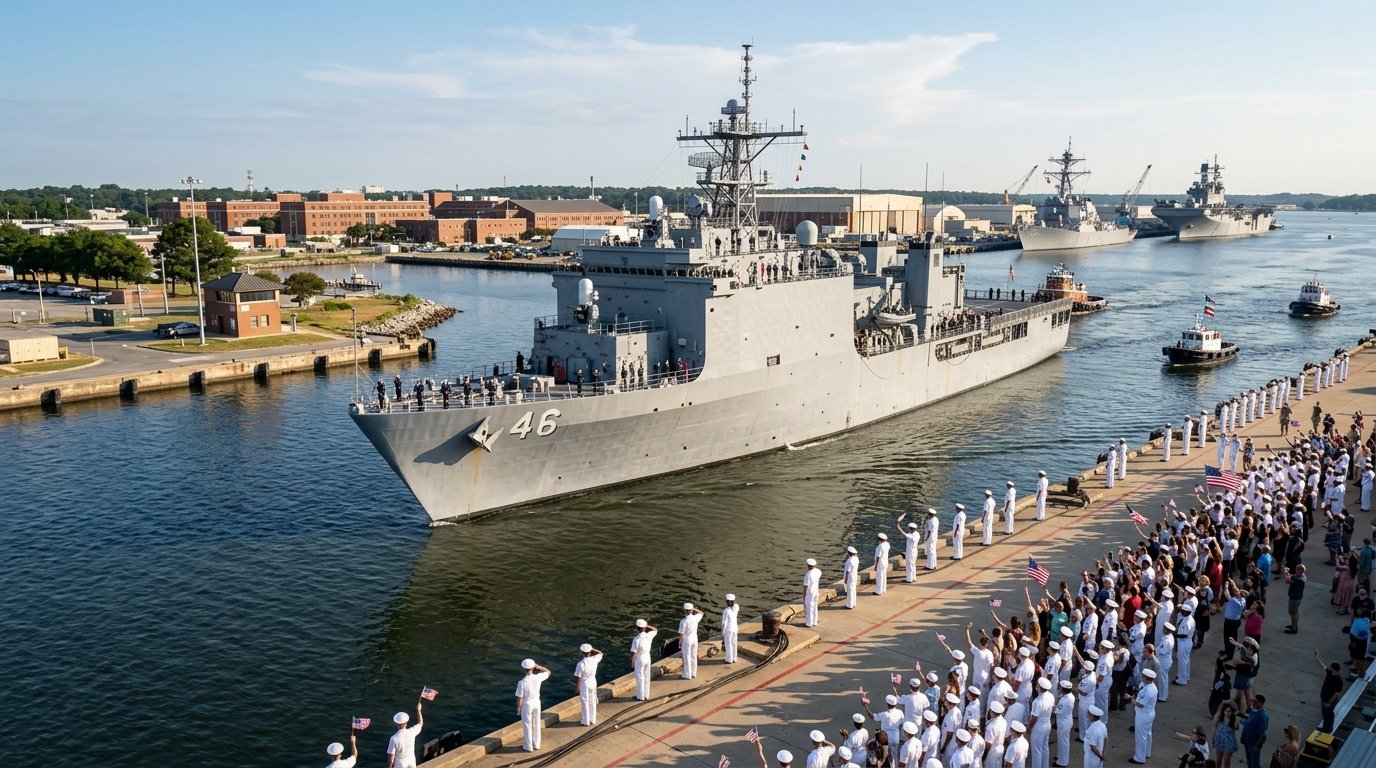
The return of the USS Tortuga (LSD-46) to active duty after a comprehensive ten-year refurbishment marks a significant milestone in naval modernization and strategic readiness.
The USS Tortuga, a cornerstone of the U.S. Navy’s amphibious capabilities, has just completed an extensive overhaul lasting over a decade. This period of transformation was designed to enhance its operational efficiency, extend service life, and integrate cutting-edge technologies. As the ship sails back into service, the Navy demonstrates its commitment to maintaining a versatile and powerful fleet capable of responding to global challenges. This article delves deep into what the USS Tortuga’s overhaul entails, the importance of Whidbey Island-class dock landing ships, and the wider implications for naval forces worldwide.
Transforming a naval giant: the extensive modernization of USS Tortuga
The USS Tortuga (LSD-46), named after the Dry Tortugas islands located nearly 97 kilometers west of Key West, Florida, carries a legacy dating back to its commissioning in 1990. Being a Whidbey Island-class dock landing ship, it has served crucial roles deploying Marines, amphibious vehicles, and landing craft. Now, after more than 30 years of service, its decade-long overhaul was intended to refurbish critical systems and adapt the warship to modern warfare demands.
This transformational overhaul focused on a comprehensive range of upgrades. The vessel’s propulsion system was rebuilt to enhance fuel efficiency and reliability, allowing for longer and more demanding missions. The command and control systems were replaced with state-of-the-art technology to improve communication and battlefield awareness. Even the ship’s well deck, which launches and recovers small craft, received major mechanical refurbishments to accommodate newer amphibious assets used by the Marine Corps.
Upgraded weapons and defense systems were also installed, providing enhanced protection against evolving threats. New radar and electronic warfare capabilities were integrated, raising the ship’s defensive posture while remaining versatile in offensive support. These modifications demonstrate the Navy’s understanding that dock landing ships are no longer just transport vessels but must actively participate in contested maritime environments.
The overhaul project extended beyond hardware. Crew living quarters received modern updates, improving habitability for long deployments. Energy conservation measures were introduced, reducing the ship’s environmental footprint. The overhaul process itself served as an example of sustainable naval refurbishment practices.
Perhaps most notably, the intensive maintenance work was carried out at a renowned shipyard, benefiting local economies and preserving critical naval industrial skills. The project showcases a successful blend of tradition and innovation, standing as a symbol of the Navy’s dedication to fleet readiness for decades to come.
Whidbey Island-class ships: backbone of U.S. amphibious assault and rapid deployment
Understanding the USS Tortuga’s role requires appreciating the Whidbey Island-class dock landing ships as a whole. These vessels are specialized amphibious warfare ships designed to transport and launch Marines, vehicles, and equipment for beach assaults, humanitarian missions, or crisis response around the world.
Launched primarily in the late 1980s and early 1990s, Whidbey Island-class ships possess a large well deck to host multiple landing craft air cushioned (LCAC) hovercraft and traditional landing boats. This ability allows the Marines to deploy rapidly onto hostile shores or inaccessible environments without relying on fixed ports. Their power and flexibility have made them indispensable during conflicts and disaster relief operations alike.
The USS Tortuga, as the sixth ship of this class, shares these essential characteristics. The ship can transport approximately 500 Marines with their gear, along with various armored vehicles and helicopters. In addition to combat roles, these vessels often participate in multinational exercises, evacuation missions, or convey aid across vast distances.
An important aspect of these ships is their integration with Marine Expeditionary Units (MEUs). These combined arms teams rely heavily on the mobility and rapid response capabilities provided by dock landing ships like Tortuga. Overhauls such as this one ensure that the interface between ship and Marines remains seamless and highly effective.
The strategic value in modern maritime conflicts
With rising tensions in contested sea regions around the world, the ability to quickly deploy troops and equipment is vital. Whidbey Island-class ships function as critical nodes enabling amphibious task forces to expand influence or rapidly respond to crises. Their blend of speed, cargo capacity, and durability makes them a primary asset for forward-deployed naval forces.
Additionally, the versatility of the ships supports non-combat operations such as humanitarian aid or disaster response. For instance, when typhoons or earthquakes strike overseas, the Tortuga and sister ships can carry supplies, medical teams, and engineers swiftly to assist vulnerable populations.
The sustained investment in these ships underscores their role as a cornerstone in U.S. naval strategy, ensuring power projection across multiple theaters and mission types.
USS Tortuga’s renovation timeline and technological upgrades summarized
The refurbishment of the USS Tortuga spanned over a decade, marking one of the most comprehensive mid-life modernizations for a dock landing ship in recent history. Below is a detailed timeline and description of the major upgrades that reshaped the vessel:
| Year | Upgrade Focus | Key Features |
|---|---|---|
| 2014-2016 | Initial systems decommissioning and hull repairs | Hull reinforcement, corrosion control, propulsion system diagnosis |
| 2016-2018 | Propulsion and power plant modernization | Engine rebuilds, fuel efficiency improvements, upgraded generators |
| 2018-2020 | Weapons and defense systems overhaul | New missile launchers, advanced radar, electronic countermeasures |
| 2020-2023 | Communications and command system replacement | Installation of modern C4ISR suites, enhanced network capabilities |
| 2023-2024 | Crew living quarters and sustainability upgrades | Habitability improvements, energy-saving systems, waste management enhancement |
These upgrades not only extend the USS Tortuga’s service life by several decades but also align the vessel with modern naval warfare requirements. By incorporating cutting-edge technologies and improving crew conditions, the Navy ensures that the Tortuga remains a mission-ready platform well into the 21st century.
Economic and strategic ripple effects of this massive ship overhaul
Undertaking a decade-long overhaul of a major U.S. Navy ship like the USS Tortuga induces significant economic and strategic consequences. On the economic side, the project has supported jobs in skilled trades including shipbuilding, engineering, and logistics. The work was largely concentrated at a key naval shipyard, which benefited from continued contracts and investment, thus helping maintain a vital industrial base.
This sustained workload guards against the erosion of essential skills that are critical for the U.S. maintaining naval superiority. Skilled labor retention through projects like this ensures readiness for future shipbuilding or modernization challenges. Furthermore, improving an existing ship is often more cost-effective than constructing a new vessel from scratch, balancing defense budgets while enhancing capability.
Strategically, the return of the USS Tortuga boosts the near-term strength of America’s amphibious forces. Forward deployed units, such as those based in Japan where Tortuga has operated previously, gain increased operational flexibility. This homegrown asset contributes to deterrence in contested regions like the Indo-Pacific, where rapid force projection is essential to counterbalance rival naval expansions.
The overhaul also signals the Navy’s broader shift toward integrating new technologies within legacy platforms; a pragmatic approach as the pace of global naval innovation accelerates. By extending service lives and upgrading capabilities, the U.S. Navy ensures a balanced fleet capable of handling both current challenges and future uncertainties.
Looking ahead: the future operational impact of USS Tortuga’s return
The return of the USS Tortuga to active duty is not just a matter of adding a ship back to the fleet, but a strategic enhancement reshaping amphibious capabilities. The ship’s upgraded systems allow for better integration with modern Marine Corps equipment and joint forces, improving coordination in large, complex operations.
As geopolitical tensions persist globally, particularly around maritime chokepoints and contested islands, having a fully modern dock landing ship ready to deploy serves as a critical deterrent. The Tortuga’s ability to quickly deploy troops, vehicles, and supplies enhances rapid response options in crises ranging from combat to humanitarian aid.
This renewed operational capability will enable the Navy to participate more effectively in multinational exercises, improving interoperability with allied and partner nations. In addition, the ship will support emerging concepts of expeditionary warfare, where agility and speed are vital in an era of near-peer competition and hybrid threats.
One emerging trend is the increased use of unmanned systems and advanced communication networks, both upgraded on the Tortuga. These innovations provide commanders with greater situational awareness and adaptability on the battlefield. As a result, the ship serves as a force multiplier rather than just a transport vessel.
The USS Tortuga’s revival illustrates how sustained investment in naval infrastructure and capabilities align with broader defense priorities, ensuring the Navy remains prepared for a rapidly changing security landscape well into the 2030s.
Essential checklist: What capabilities the USS Tortuga brings back to the fleet
- Advanced well deck: Accommodates multiple LCAC hovercraft and modern landing craft, enabling flexible beach assaults.
- Modernized propulsion: Enhanced fuel efficiency and engine reliability for extended missions.
- State-of-the-art command and control: Upgraded communication systems improve battlefield awareness and coordination.
- Improved defensive systems: New radars and electronic warfare suites enhance protection against emerging threats.
- Habitability enhancements: Modern living quarters increase crew morale and mission endurance.
- Sustainability upgrades: Energy-saving systems reduce environmental and operational costs.
How long did the USS Tortuga’s overhaul take?
The overhaul spanned approximately 10 years, from initial decommissioning work beginning around 2014 until the vessel’s return to active service in 2024.
What class of ship is the USS Tortuga?
USS Tortuga is a Whidbey Island-class dock landing ship, designed primarily for amphibious assault and rapid deployment operations.
What are some key upgrades made during the overhaul?
Major upgrades include propulsion modernization, advanced command and control systems, improved defensive equipment, and habitability improvements.
Why is the USS Tortuga important for the U.S. Navy?
The ship supports rapid deployment of Marines and equipment, serving as a versatile asset crucial for both combat and humanitarian missions.
Where was the overhaul conducted?
The extensive overhaul took place at a major naval shipyard known for expertise in modernizing complex maritime vessels.
