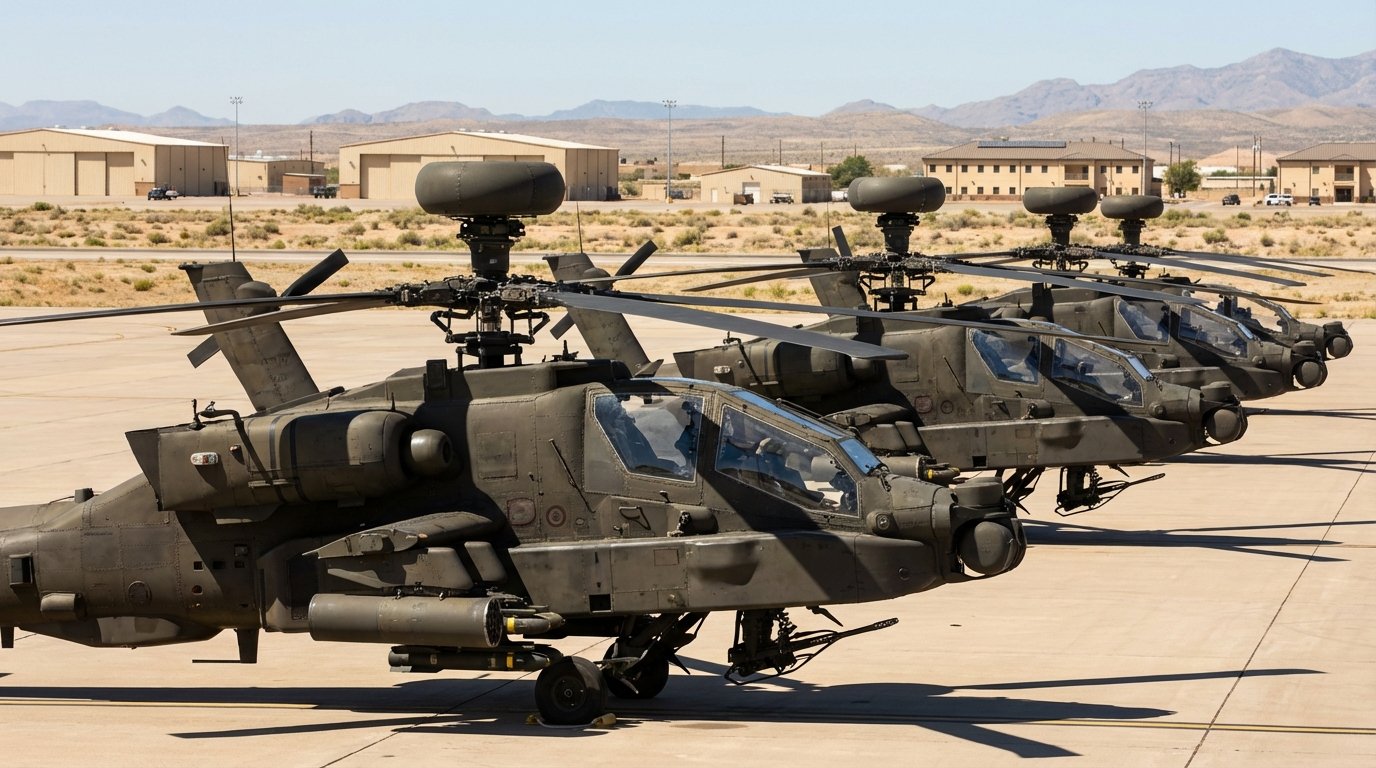
The U.S. Army has taken a significant leap forward by deploying the latest AH-64E Apache helicopters at Fort Bliss, showcasing advanced technology designed to dominate the modern battlefield.
The deployment of the AH-64E Apache helicopters at Fort Bliss signifies a crucial milestone in the U.S. Army’s ongoing modernization efforts. These multi-role attack helicopters are engineered for all-weather conditions, equipped with cutting-edge avionics and an enhanced weapons suite. Their arrival supports not only the 1st Armored Division’s capability boost but also highlights new missions, including counter-drone operations. As the landscape of warfare evolves, Fort Bliss becomes central to training with these powerful machines.
Next-generation technology reshapes frontline attack helicopters
The AH-64E Apache represents a monumental upgrade over previous versions thanks to its enhanced sensor suite and weaponry advancements. Key to its superiority is the AN/APG-78 Longbow radar, mounted above the rotor mast, granting the helicopter 360-degree surveillance and the ability to identify targets even in obscured or adverse weather conditions. This technology allows pilots to prioritize threats more effectively and engage with precision-guided missiles.
Powerful engines and avionics upgrade the Apache’s operational reach
The AH-64E’s twin turboshaft engines produce a robust 1,890 horsepower each, enabling greater speed and payload capacity—critical for extended combat missions. Enhanced digital cockpit displays and improved avionics ensure pilots maintain situational awareness day or night, no matter how challenging the environment. These upgrades mean the Apache can undertake longer-range operations and handle multiple targets with greater efficiency.
Fort Bliss as the nerve center for modern combat helicopter training
Strategically located in Texas, Fort Bliss serves as the hub for the 1st Armored Division’s modernization. The arrival of the AH-64E helicopters there underscores the base’s role in training pilots and crews for the complexities of 21st-century warfare. Alongside traditional attack roles, troops are mastering counter-uncrewed aircraft system (c-UAS) tactics to confront drone threats on future battlefields.
Integrating counter-drone capabilities into Apache missions
The rise of unmanned aerial systems on modern battlefields has necessitated new defense strategies. The AH-64E is fitted with advanced software—currently in its Version 6 upgrade—that enables detection, pursuit, and destruction of hostile drones. This marks a pivotal evolution of the Apache’s role, transforming it from a pure gunship to an agile drone-killing platform protecting troops and key assets from aerial swarms.
Retrofitting and expanding the Apache’s arsenal for modern combat needs
An extensive makeover accompanies the AH-64E deployment, with the inclusion of new munitions tailored to diverse mission profiles. From precision Hellfire missiles to Hydra rockets and Stinger air-to-air missiles, the helicopter’s armament is versatile enough to neutralize surface and aerial threats. These upgrades are integral to keeping the Apache relevant in rapidly shifting combat theaters with increasingly sophisticated adversaries.
Investment milestones solidify Apache’s future within U.S. military modernization
Recently awarded to Boeing, a massive contract valued at approximately €4 billion secures continued production of AH-64E helicopters and their supporting components. This investment reflects the Pentagon’s commitment to sustaining and expanding the US Army’s attack helicopter fleet, ensuring that next-generation technologies remain at the forefront of American air combat power.
Production numbers and delivery timelines
| Year | Planned Deliveries | Unit Features |
|---|---|---|
| 2025 | 48 | Version 6 software, counter-drone suite |
| 2026 | 52 | Enhanced engines, avionics upgrade |
| 2027 | 55 | Expanded weapons integration |
Training and readiness enhancements powered by advanced simulation
Besides physical deployments, Fort Bliss integrates state-of-the-art simulation systems to train crews on the AH-64E’s complex operational capabilities. These virtual environments allow realistic mission rehearsals, including c-UAS dogfights and multi-threat engagements. The training ensures pilots are combat-ready and able to harness the helicopter’s full potential when deployed.
Operational feedback drives future upgrades
Continuous feedback loops from pilots and ground crews at Fort Bliss provide vital data to improve the AH-64E platform. This dynamic upgrade cycle keeps the Apache adaptable and lethal, ready to face evolving threats on the global stage.
- Improved sensor packages enable all-weather target tracking.
- Counter-drone systems integrated for emerging battlefield threats.
- Robust engines increase speed and payload for mission flexibility.
- Advanced simulation for realistic pilot training at Fort Bliss.
- Multi-role armament to address diverse combat scenarios.
What makes the AH-64E Apache different from older variants?
The AH-64E features powerful engine upgrades, a 360-degree Longbow radar system, advanced avionics, and counter-drone capabilities, enhancing its combat performance and versatility.
How does the AH-64E handle drone threats?
Equipped with the latest Version 6 software, the AH-64E can detect, pursue, and destroy enemy drones, turning a traditional attack helicopter into a vital component of modern counter-unmanned aircraft system (c-UAS) tactics.
Why is Fort Bliss key to the AH-64E deployment?
Fort Bliss serves as the main training and operational base for the 1st Armored Division’s AH-64E units, providing an ideal environment to master advanced tactics including counter-drone operations in desert terrain.
What types of weapons are carried by the AH-64E?
The AH-64E carries a diverse arsenal including Hellfire missiles, Hydra 70 rockets, and Stinger missiles, allowing engagement of both ground and airborne targets effectively.
How does ongoing training influence the Apache’s effectiveness?
Continuous training using high-fidelity simulators and live exercises at Fort Bliss equips pilots with the skills to exploit the AH-64E’s advanced systems, ensuring mission success under diverse combat conditions.
