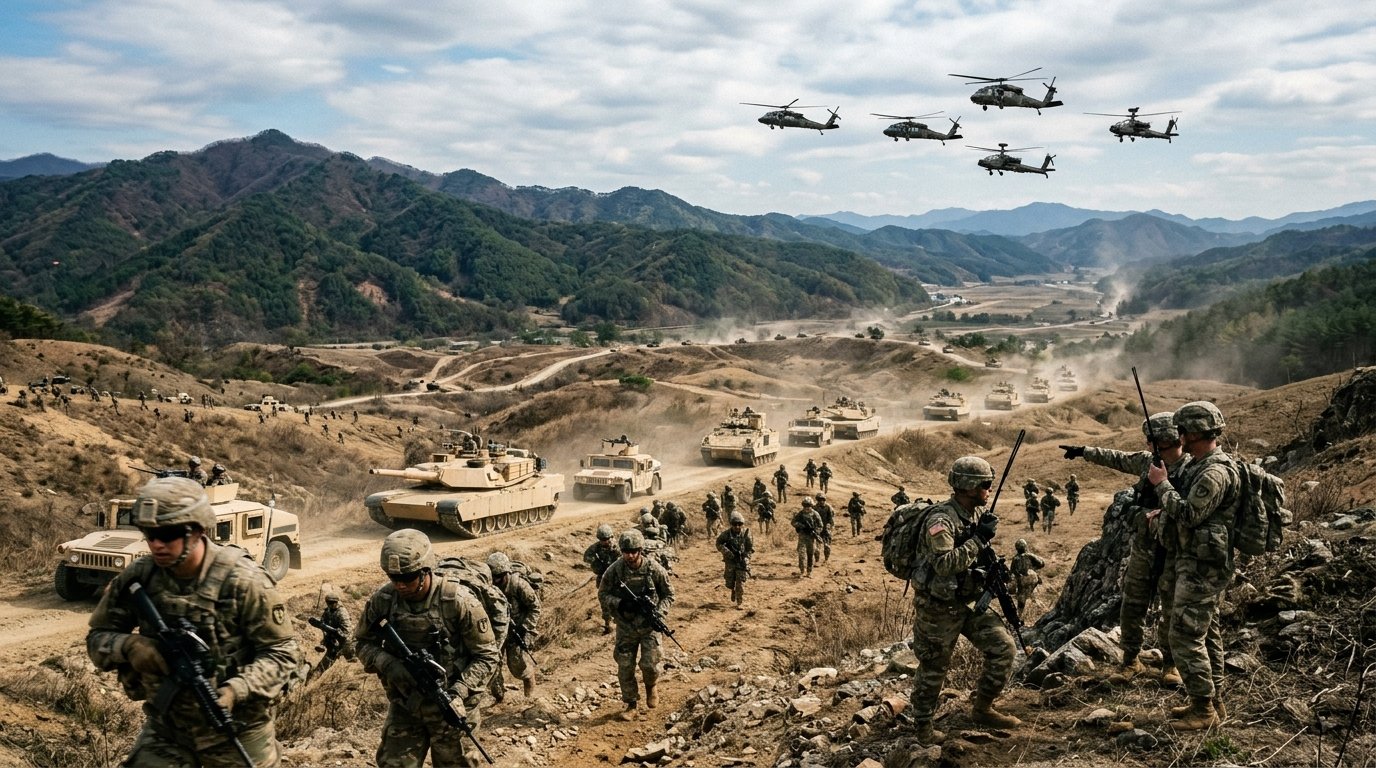
The U.S. Army has executed a massive 1,300-mile assault drill across the Korean Peninsula, signaling a significant strategic maneuver in response to regional tensions and showcasing advanced military coordination.
In a bold demonstration of military prowess and readiness, the U.S. Army completed an extensive assault operation drill covering 1,300 miles across the Korean Peninsula. This large-scale exercise not only highlights improved joint operations but also serves as a clear message to regional actors about the commitment and agility of U.S. forces in the area.
Strategic significance of the 1,300-mile assault exercise
The drill’s sprawling 1,300-mile range is a critical indicator of the U.S. Army’s focus on long-distance rapid mobility and deployment capabilities. Covering such a vast swath of the Korean Peninsula demands exceptional logistical planning and reinforces the Army’s ability to mobilize troops and equipment swiftly under combat conditions. This capacity is especially vital given the peninsula’s tense geopolitical environment and the constant threat posed by neighboring adversaries.
Enhancing operational readiness and joint coordination
Integral to the operation was the emphasis on interoperability between various branches of the military. The exercise featured synchronized movements involving infantry units, armored divisions, and air support, highlighting the enhanced command-and-control communication systems. Such coordination is essential for ensuring that complex mission objectives can be executed effectively, especially in scenarios that require rapid adaptation and precision strikes.
Implications for regional security dynamics
This high-profile drill sends a strong signal to regional players, particularly North Korea, that the U.S. continues to prioritize deterrence and defense capabilities on the peninsula. The scale and sophistication of the Operation underline the U.S. commitment to safeguard allies like South Korea and counteract any aggressive moves that could destabilize the area.
Response from neighboring countries and allied nations
South Korea and Japan have welcomed the operation, viewing it as a critical reassurance amid ongoing tensions in the region. These drills also provide an opportunity for allied forces to share intelligence and improve joint tactical approaches, thereby strengthening overall collective defense frameworks.
Technological advancements demonstrated during the exercise
The drill incorporated state-of-the-art technology such as real-time battlefield telemetry, autonomous drones for reconnaissance, and next-generation armored vehicles. These technological assets significantly enhance battlefield visibility and precision, reducing risks for personnel while increasing operational effectiveness.
Role of unmanned systems in modern combat drills
Unmanned aerial and ground vehicles played a crucial role in scouting ahead and providing crucial data streams that commanders used to adjust strategies on the fly. The integration of these systems marks a transformational shift in how the U.S. military approaches complex operations, leveraging technology to achieve superior situational awareness.
Logistical complexity of covering 1,300 miles in Korea
Transporting troops, equipment, and supplies over a 1,300-mile route across mountainous terrain and urban areas requires meticulous planning. The exercise prioritised multi-modal transport methods, including rail, road convoys, and airlift operations, showcasing the U.S. Army’s flexibility in diverse environments.
- Deployment of armored units via rail and road transport
- Use of helicopters for rapid aerial insertion and extraction
- Supply chain management through mobile field depots
- Coordination with local South Korean infrastructure for seamless movement
Overcoming environmental and infrastructural hurdles
Challenges such as harsh weather conditions and narrow mountain passes tested the resilience and adaptability of forces, proving their capability to maintain momentum despite physical obstacles. These experiences are invaluable for future operations where terrain and infrastructure limitations can significantly impact mission success.
Schedule and key milestones of the operation drill
| Date | Activity | Location | Duration |
|---|---|---|---|
| March 15, 2026 | Initial troop deployment and staging | South Korea – DMZ Area | 2 days |
| March 17, 2026 | Armored units movement and air support coordination | Central Korean Peninsula | 4 days |
| March 21, 2026 | Final offensive drills and joint command exercises | Southern Coastal Areas | 3 days |
Future outlook: how this drill shapes U.S. military posture in Asia
The success of this extensive assault drill is expected to influence future U.S. Army deployments and strategic priorities in the Asian theater. By demonstrating a powerful capacity for rapid, long-distance operations, the U.S. underscores its readiness to adapt to emerging threats and maintain stability in a region marked by complex alliances and rivalries.
Why is a 1,300-mile operation on the Korean Peninsula significant?
Covering 1,300 miles tests the U.S. Army’s long-range deployment and operational logistics, demonstrating a high level of readiness and flexibility crucial for rapid response in the region.
How do such drills impact regional security?
These drills act as a deterrent, reassuring allies and warning potential adversaries that the U.S. is prepared to defend its interests and partners on the Korean Peninsula.
What technologies were primarily used during the drill?
Advanced communication systems, autonomous drones, real-time battlefield telemetry, and next-generation armored vehicles were key technological assets integrated into the exercise.
How do allied countries participate or benefit from these exercises?
Allied countries like South Korea and Japan use these drills to enhance joint operational strategies, share intelligence, and strengthen military cooperation with U.S. forces.
What are the main logistical challenges of such a large-scale drill?
Managing troop movements, supply chains, and terrain challenges across 1,300 miles requires intricate planning and flexible transport solutions to maintain operational flow.
