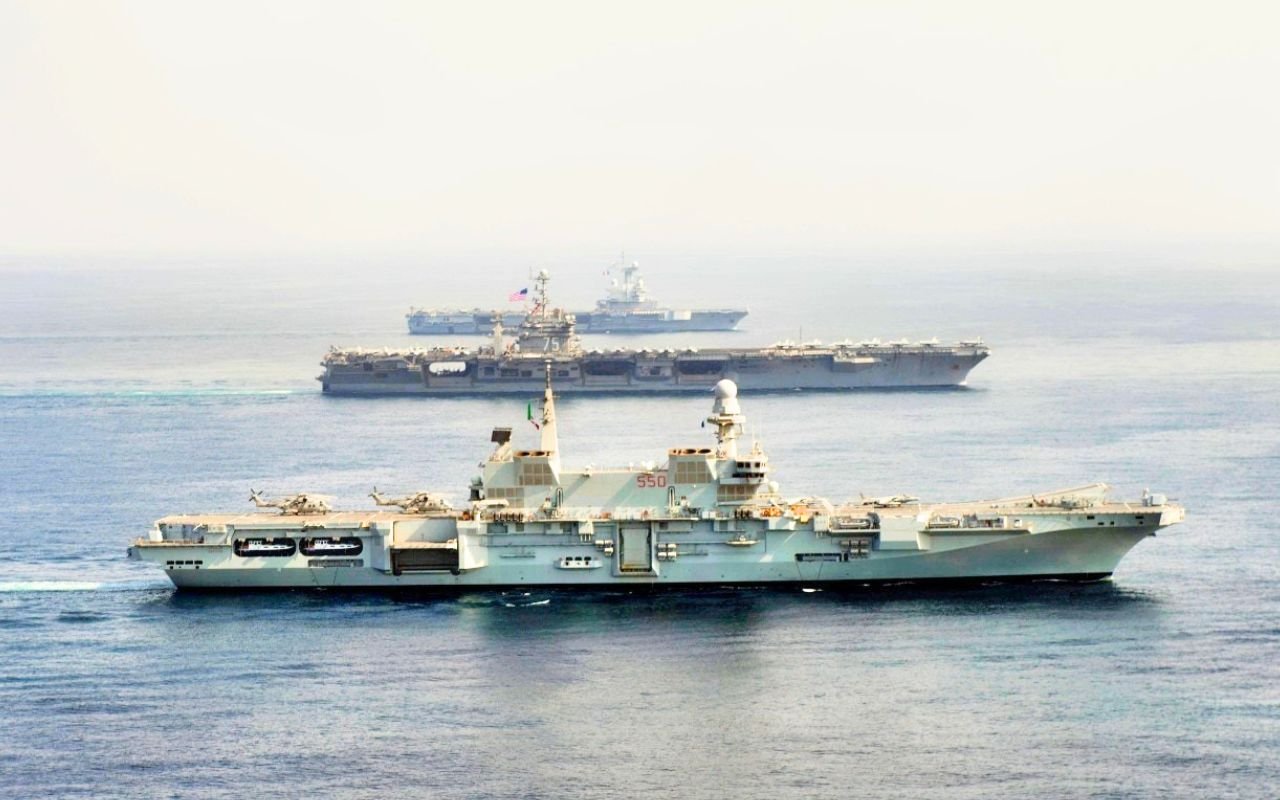
France deploys its only nuclear-powered aircraft carrier, the 42,500-ton Charles de Gaulle, to the Middle East, marking a significant move amidst escalating tensions with Iran.
Amid the intensifying conflict in the Middle East following US-Israeli air operations targeting Iran, France has redirected its most powerful naval asset, the nuclear-powered aircraft carrier Charles de Gaulle, to the eastern Mediterranean. This strategic deployment reflects France’s intent to secure maritime interests and assert its role in an increasingly volatile region. Commanded by President Emmanuel Macron, the vessel is poised to project French naval power with its formidable air wing and advanced weaponry.
France’s only nuclear aircraft carrier faces a critical mission in the Middle East
The Charles de Gaulle, weighing 42,500 tons and powered by two K15 nuclear reactors, is France’s singular carrier capable of global power projection. Operating under Flottille 12F from Landivisiau, it carries a complement of around 20 Dassault Rafale-M fighters along with airborne early warning E-2 Hawkeyes. This carrier’s nuclear propulsion grants it virtually unlimited endurance, enabling extended deployments without the need for frequent refueling – a significant advantage as it moves from the North Atlantic towards the Mediterranean to address rising instability around Iran.
Unmatched air power with Rafale-M fighters and advanced missiles
The Rafale-M jets onboard are not mere showpieces; they are highly versatile multirole fighters armed with SCALP cruise missiles for deep strike missions exceeding 500 km, AM39 Exocet anti-ship missiles, and the cutting-edge Meteor air-to-air missiles for air superiority. The carrier thus maintains a powerful offensive and defensive capability, enabling it to control the airspace surrounding the naval group and deliver precise strikes when necessary.
Strategic implications of redeploying Charles de Gaulle amid Middle East tensions
President Macron’s decision to send the Charles de Gaulle to the Mediterranean underscores France’s desire to protect vital maritime routes, especially around the Strait of Hormuz, which is critical for global oil trade. The ship’s presence there ensures France can contribute tangibly to maritime security and respond swiftly if conflict escalates further. This deployment also signals to allies and adversaries alike France’s commitment to maintaining regional stability and its unique naval prowess in Europe, which now arguably surpasses that of the British Royal Navy.
Nuclear propulsion enhances endurance and operational reach
Unlike conventional carriers, the Charles de Gaulle’s two Areva K15 nuclear reactors provide a top speed of around 27 knots and eliminate the need for conventional refueling stops. This endurance is a critical advantage for rapid redeployment and sustained operations far from home ports. It also highlights France’s deep expertise in integrating nuclear propulsion systems with naval vessels, a capability limited to a few nations worldwide.
A storied combat history boosts Charles de Gaulle’s credibility
The carrier’s combat record spans multiple major operations, including missions in Afghanistan, Libya’s NATO no-fly zone, and the campaign against ISIS in Operation Inherent Resolve. In each theater, Charles de Gaulle’s air wing effectively enforced air superiority and executed ground strikes. These engagements have solidified its reputation as not just a symbol of French naval prestige but a practical tool for power projection in critical global hotspots.
Recent deployments showcase interoperability and global reach
Notably, the Charles de Gaulle’s 2025 deployment to East Asia demonstrated the carrier’s ability to operate alongside US and Japanese forces, emphasizing France’s role as a key NATO ally with global naval capabilities. The striking displays of precision and coordination enhanced France’s standing and sent clear signals to potential adversaries in various geopolitical theaters.
Technical specifications that make Charles de Gaulle a formidable naval asset
| Specification | Details |
|---|---|
| Displacement | 42,500 tons |
| Length | 261 meters (856 feet) |
| Beam | 64 meters (211 feet) |
| Propulsion | Two Areva K15 nuclear reactors |
| Speed | Up to 27 knots |
| Main air wing | 20 Dassault Rafale-M fighters, 2 E-2 Hawkeye AEW aircraft |
| Missile systems | SCALP, Meteor, AM39 Exocet, Aster 15 SAM, Mistral missiles |
The carrier’s layered self-defense system
Beyond offensive firepower, Charles de Gaulle is equipped with multiple defensive layers, including Aster 15 surface-to-air missiles launched from Sylver launchers, Mistral short-range missiles, and several 20 mm autocannons aimed at intercepting incoming threats. These defensive systems ensure the carrier strike group maintains resilience against air and missile attacks.
What France’s Middle East deployment means for regional security and naval balance
The mobilization of the Charles de Gaulle serves multiple strategic purposes: projecting French influence, safeguarding international shipping lanes, and deterring potential adversaries in the Middle East. This decisive action reinforces France’s status as a maritime heavyweight and illustrates its readiness to engage in high-stakes geopolitical arenas with technological and operational superiority.
- Supports allied coalitions to secure maritime trade routes.
- Enhances deterrence against potential escalations involving Iran.
- Showcases French military technology with advanced aircraft and missile systems.
- Maintains freedom of navigation in an increasingly contested sea area.
- Boosts France’s leadership within NATO and European defense.
Why is the Charles de Gaulle unique among European aircraft carriers?
The Charles de Gaulle is the only nuclear-powered aircraft carrier built outside the United States, giving France unmatched endurance and operational flexibility at sea compared to conventional carriers.
What kind of aircraft does the Charles de Gaulle deploy?
The carrier operates about 20 Dassault Rafale-M multirole fighters along with E-2 Hawkeye airborne early warning aircraft, enabling offensive strike capabilities and superior airspace control.
How does the nuclear propulsion system benefit the carrier’s mission?
It allows the Charles de Gaulle to stay at sea for extended periods without refueling, reach top speeds of 27 knots, and quickly redeploy to global hotspots, enhancing its strategic reach.
What are the defensive systems onboard the carrier?
The carrier is armed with layered defenses including Aster 15 surface-to-air missiles, Mistral short-range missiles, and 20 mm autocannons to protect against aerial and missile threats.
What role has the Charles de Gaulle played in recent military operations?
It has participated in key operations such as enforcing the Libya no-fly zone in 2011, combat missions against ISIS, and more recent deployments showcasing interoperability with NATO and allied forces.
