
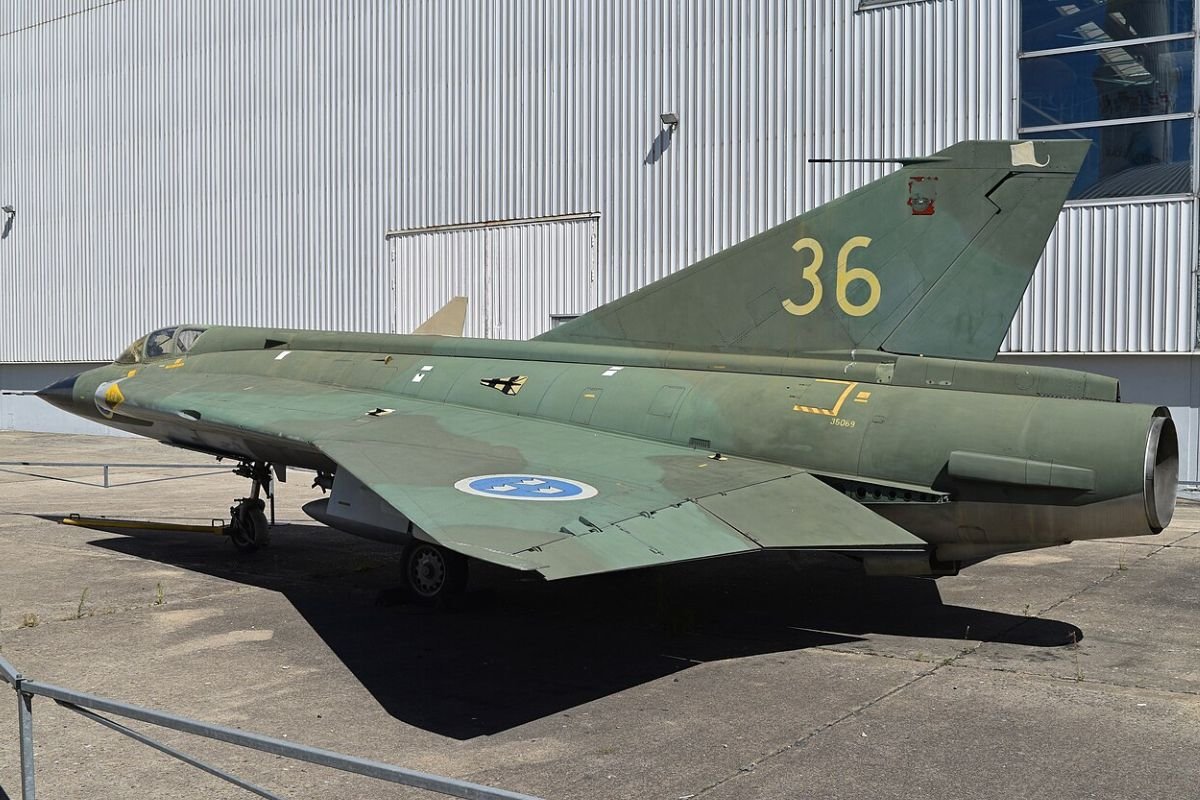
In the 1950s, Sweden’s ambition soared beyond neutrality with the Saab 36, a Mach 2 nuclear bomber project that could have reshaped the nation’s defense strategy and thrust it into the nuclear age.
During a tense Cold War era, Swedish aerospace engineers at Saab formulated the Saab 36, an avant-garde fighter-bomber designed to cruise at twice the speed of sound and deliver nuclear payloads from dizzying altitudes. This bold project reflected Sweden’s quest for total autonomy amidst superpower tensions. Although the aircraft never left the drawing board, its revolutionary concepts profoundly influenced Sweden’s subsequent military aviation advances, including the famed Draken, Viggen, and Gripen fighters.
how sweden’s cold war challenges sparked ambitious defense innovation
Sweden’s geographical position placed it precariously between NATO and Warsaw Pact powers, with its airspace frequently violated during the Cold War by superpowers’ surveillance flights. Despite its official neutrality status, Sweden realized the urgent need to strengthen its sovereignty and deter unauthorized incursions. This context fueled innovative thinking among Swedish engineers who aspired to establish a credible defense posture, sparking programs like the Saab 36. It symbolized a daring leap into developing a high-speed, nuclear-capable bomber, a role typically held by global superpowers.
saab’s mach 2 design: a mix of bold aerodynamics and nuclear deterrence
The Saab 36 was conceptualized as a sleek, delta-wing aircraft powered by twin engines, engineered to reach speeds surpassing Mach 2. This design was comparable to the American B-58 Hustler and Soviet Tu-22 bombers, combining speed, altitude, and payload capacity. Its primary mission was unambiguous: serve as a nuclear delivery platform capable of striking beyond Sweden’s borders to dissuade threats. This high-performance fighter-bomber would have placed Sweden among a rare group of countries wielding tactical nuclear forces during the Cold War.
technical hurdles that grounded sweden’s nuclear bomber dream
Despite Saab’s engineering prowess, the Saab 36 faced daunting technical challenges. Propulsion systems needed to generate immense thrust while maintaining structural integrity at supersonic speeds. The aircraft’s large radar profile and intense thermal emissions also increased its vulnerability to adversary air defenses. Moreover, Sweden’s modest industrial base struggled to envision mass production of such an advanced platform. These obstacles, coupled with escalating costs, cast doubt on the feasibility of taking the project beyond prototypes.
political and economic factors curtailing sweden’s nuclear ambitions
Cost overruns and shifting political winds further sealed the fate of the Saab 36. Sweden’s long-standing preference for neutrality and peaceful diplomacy made nuclear armament a controversial proposition domestically. Additionally, international trends favored nuclear deterrence through submarine-launched missiles and intercontinental ballistic missiles over manned bombers. As a result, government support waned, and the Saab 36 was quietly shelved, preventing Sweden from becoming a nuclear power while steering Saab’s focus toward more attainable fighter aircraft.
legacy of the saab 36: how its innovations shaped sweden’s air power
Although the Saab 36 never materialized as an operational bomber, its aerodynamic and engineering breakthroughs laid the groundwork for Sweden’s iconic jet fighters: the Draken, Viggen, and Gripen. These fighters embody many elements first explored with the Saab 36, such as advanced delta wings and supersonic capabilities. By pivoting from bombers to versatile fighters, Sweden secured a dominant air defense role while maintaining its non-nuclear stance—demonstrating a pragmatic adaptation to geopolitical realities and technological limits.
how the saab 36 influenced modern swedish defense technology
Key technological advancements driven by the Saab 36 project included:
- Supersonic aerodynamics refined for sustained high-speed flight.
- Advanced structural materials able to withstand intense thermal and mechanical stress.
- Engine performance innovations pushing the limits of twin-engine thrust efficiency.
comparing sweden’s rejected bomber to contemporary nuclear platforms
The Saab 36’s ambition to serve as a nuclear deterrent via a manned bomber contrasts sharply with other nations’ strategic pathways toward nuclear weapons deployment. The table below summarizes this comparison:
| Aspect | Saab 36 (Sweden) | B-58 Hustler (USA) | Tu-22 (Soviet Union) |
|---|---|---|---|
| Top Speed | Over Mach 2 | Mach 2.0 | Mach 1.5 |
| Range | Long-range (exact figures not finalized) | 4,400 km | 6,800 km |
| Primary mission | Nuclear strike | Nuclear delivery | Nuclear delivery |
| Production Outcome | Cancelled pre-production | Operational | Operational |
why sweden embraced fighter jets over bombers in the long run
The political tides and industrial realities nudged Sweden away from nuclear bombers to capable multirole fighters. This focus aligned better with Sweden’s defense needs, offering:
- Enhanced sovereignty through agile air defense
- Cost-effective manufacturing and maintenance
- Export potential supporting domestic aerospace industry growth
sweden’s stance on nuclear weapons and the broader cold war context
Sweden’s Cold War neutrality masked a complex defense calculus fueled by the looming superpower rivalry. While flirting momentarily with nuclear weapons capability, the nation ultimately prioritized non-proliferation and diplomatic solutions. The Saab 36 emerges as a striking “what if” in history—a vision that could have revved up Sweden’s military status but also risked entangling it deeper in global nuclear politics.
What made the Saab 36 unique compared to other Cold War bombers?
The Saab 36 was designed to achieve Mach 2 speeds with a large delta-wing platform specifically optimized for nuclear weapon delivery, combining cutting-edge aerodynamics with strategic autonomy unique for a neutral country like Sweden.
Why was the Saab 36 project ultimately cancelled?
The project was cancelled mainly due to rising costs, technical challenges, and Sweden’s political preference to remain a non-nuclear and neutral nation during the Cold War.
Did the Saab 36 influence other Swedish aircraft designs?
Yes. Though never produced, the Saab 36 provided aerodynamic and engineering principles that directly influenced the development of iconic Swedish fighters like the Draken, Viggen, and Gripen.
Could Sweden have become a nuclear power if Saab 36 entered service?
Had the Saab 36 been completed and deployed, Sweden would have joined a rare group of nations capable of strategic nuclear delivery, which could have significantly altered its defense posture and global standing.
Image: c/n 35069, former Swedish Air Force aircraft, was last operated by the F16 Uppsala Wing before being flown to Le Bourget in November 1978 for inclusion in the French national collection. It is now preserved at the Musée de l’air et de l’espace, located at Le Bourget Airport in Paris, where it was photographed on July 12, 2022. credit: Alan Wilson from Peterborough, Cambs, UK
