A quiet reform with strategic weight.
On March 24, 2026, the Department of War—through its Comptroller and Inspector General—announced a refined approach to achieve what has long remained out of reach: a clean audit opinion by fiscal year 2028.
At first glance, this reads like bureaucratic housekeeping. Adjust reporting structures. Streamline financial statements. Hire external auditors.
But if you look closer, you see something deeper.
For decades, the Pentagon has struggled to fully account for its own finances. Not because the money is missing in the conventional sense, but because the system itself—vast, layered, global—resists clarity.
This reform is an attempt to impose order on that complexity.
The long shadow of unfinished audits
The United States military operates on a scale that is difficult to grasp. Budgets measured in the hundreds of billions. Assets spread across continents. Contracts that stretch years into the future.
In such an environment, accounting becomes more than bookkeeping. It becomes a test of governance.
For years, the Department has failed to achieve a clean audit. Not once has it been able to present financial statements that fully meet federal standards.
That failure carries consequences:
- It raises questions in Congress
- It complicates oversight
- It erodes public trust, slowly but persistently
The 2028 objective is not new. What is new is the recognition that the previous approach was not sufficient.
A shift in method: start smaller, build upward
The core of the new strategy is deceptively simple.
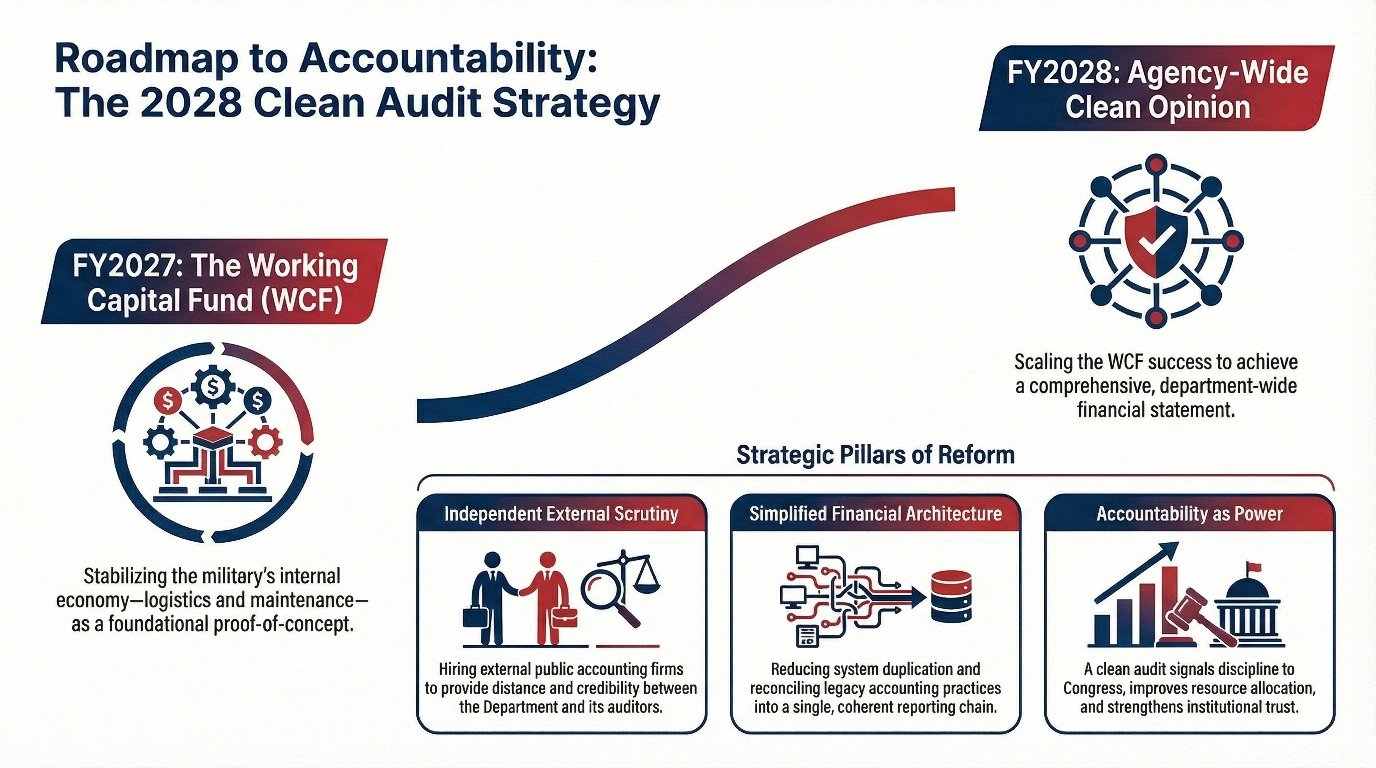
Instead of attempting to fix everything at once, the Department will focus first on a narrower target: the Working Capital Fund (WCF).
This fund is the operational backbone of the military’s internal economy. It finances logistics, maintenance, supply chains—the daily machinery that keeps forces functioning.
The plan is to achieve a clean audit for the WCF in FY2027, and then use that success as a foundation for a department-wide clean opinion in FY2028.
As Michael T. Powers, Deputy Under Secretary of War (Comptroller), put it:
“This milestone will lay the foundation for a clean audit opinion on the FY28 agency-wide financial statements.”
There is a certain pragmatism here. You stabilize one part of the system, prove it works, and then extend the model outward.
It is less ambitious in appearance—but more realistic in execution.
Bringing in external scrutiny
Another key element of the reform is the decision by the Office of Inspector General (OIG) to contract an independent public accounting firm.
This may seem procedural. It is not.
The Pentagon has long been both the subject and the manager of its own audit processes. Introducing an external firm creates distance—distance between those who produce the numbers and those who validate them.
According to Inspector General Platte B. Moring III, this “composite approach” reflects real progress while preserving institutional independence.
In practical terms, it means:
- Audits aligned with federal statutory requirements
- Greater standardization of financial reviews
- Increased credibility in the eyes of Congress and oversight bodies
It is, in essence, an admission that internal mechanisms alone were not enough.
Restructuring the financial architecture
Behind the announcements lies a more technical, but equally important, change: the revision of the Department’s financial reporting structure.
This is where the real difficulty resides.
The Pentagon is not a single entity. It is a network of commands, agencies, funds, and programs—each with its own accounting practices, legacy systems, and operational constraints.
To produce a clean audit, all of that must be reconciled into a coherent whole.
The refined approach seeks to:
- Simplify reporting chains
- Reduce duplication across systems
- Align financial data with audit requirements
- Accelerate the consolidation of statements
This is not a quick fix. It is structural work—slow, often invisible, but necessary.
Accountability as strategy
There is a tendency to see financial audits as administrative exercises, detached from strategy. That view misses the point.
In modern defense systems, financial transparency is a form of power.
It affects how budgets are allocated, how programs are evaluated, how allies perceive reliability, and how adversaries interpret sustainability.
A military that cannot fully account for its resources risks:
- Misallocating funds
- Delaying critical programs
- Weakening political support at home
Conversely, a clean audit signals discipline. It tells Congress—and by extension the public—that the institution can manage what it has been given.
As Jules “Jay” W. Hurst III, performing the duties of Under Secretary of War (Comptroller), noted, this effort is about building a “culture of accountability and trust.”
That phrase may sound abstract. In reality, it is tied to very concrete outcomes.
What success would actually mean
If the Department reaches its FY2028 clean audit objective, it will mark a turning point.
Not because the Pentagon will suddenly become simpler—it will not—but because it will have demonstrated that complexity can be governed.
The implications are tangible:
- Stronger congressional confidence in defense spending
- More efficient allocation of resources
- Improved oversight of large-scale programs
- Greater institutional credibility, both domestically and internationally
And yet, the path remains uncertain.
Large bureaucracies rarely change quickly. Systems resist reform. Data does not always align. And timelines, even carefully constructed ones, tend to slip.
Still, there is a sense—quiet but noticeable—that something has shifted.
Not a transformation, not yet. But a recognition that accountability is no longer optional.
In Washington, that alone can be a strategic development.
Sources:
U.S. Department of Defense, Coordinated Changes to DoD Financial Statement Presentation and DoD OIG (March 24, 2026),
https://media.defense.gov/2026/Mar/24/2003902290/-1/-1/1/COORDINATED-CHANGES-TO-DOW-FINANCIAL-STATEMENT-PRESENTATION-AND-DOW-OIG.PDF
Official document outlining coordinated updates to the Department of Defense’s financial statement presentation, including alignment with oversight requirements from the Office of Inspector General (OIG), with the aim of improving transparency, auditability, and consistency in financial reporting across DoD entities.
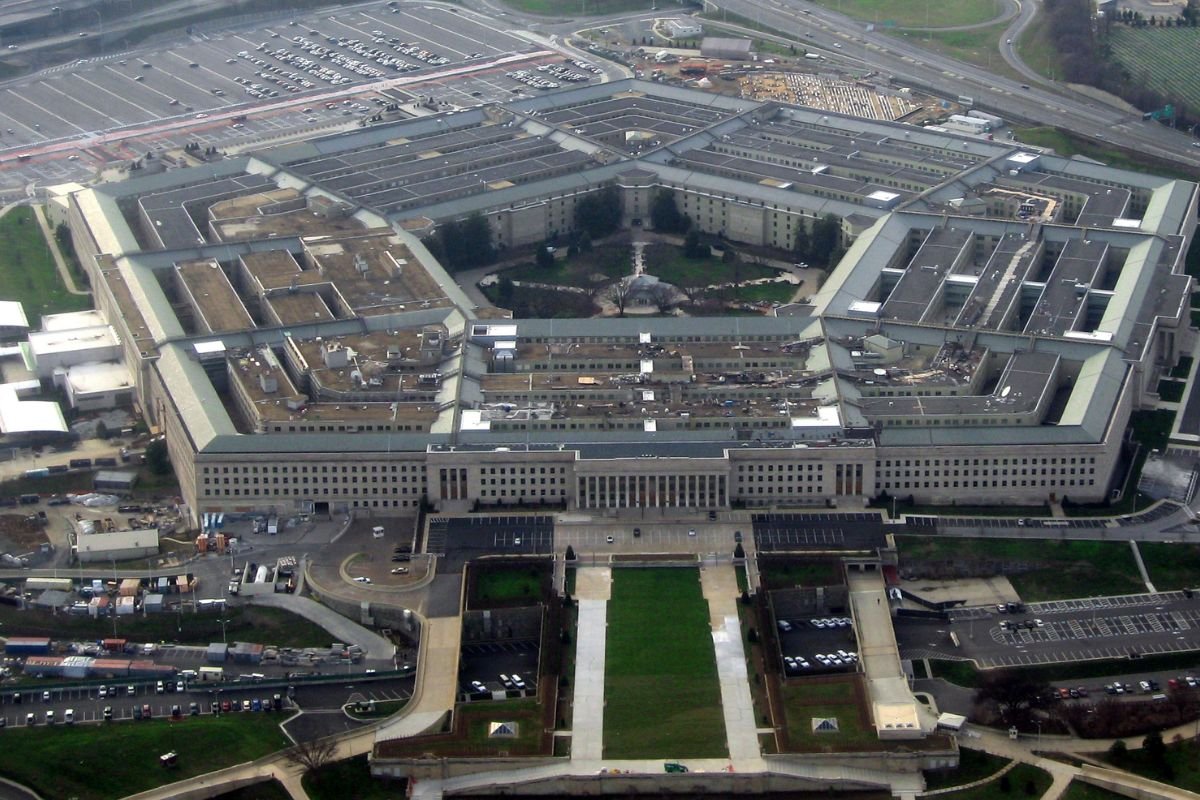
Image: The Pentagon, headquarters of the United States Department of War, taken from an airplane in January 2008 – credit: David B. Gleason from Chicago, IL
