A cold theater, a new reality.
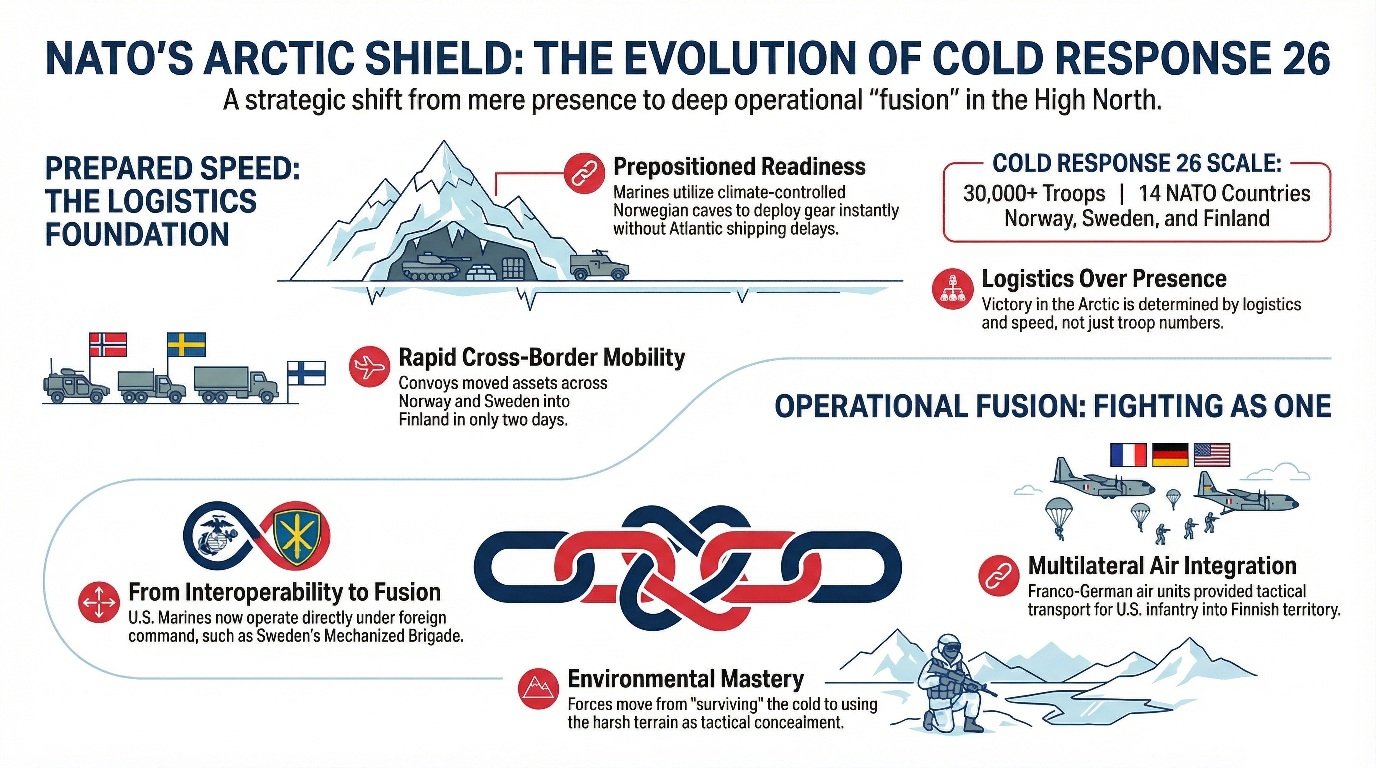
On March 19, 2026, U.S. Marines wrapped up their participation in Exercise Cold Response 26, a Norwegian-led operation that brought together more than 30,000 troops from 14 NATO countries.
At first glance, this was another large-scale exercise in freezing conditions. But something had changed.
For the first time, Finland and Sweden participated as full NATO members, transforming what used to be a regional drill into a rehearsal for collective defense across the entire High North.
And quietly, the Marines tested a new role—one that reflects how NATO expects to fight in the Arctic.
In the Arctic, distance kills speed—and speed decides everything
For decades, U.S. Marines trained in Norway. They learned how to survive the cold, how to move across snow and ice, how to operate far from traditional supply lines.
That phase is over.
What Cold Response 26 demonstrated is a shift from presence to integration.
Instead of operating alongside allies, Marine units were inserted directly into NATO command structures—sometimes under foreign command, sometimes sharing logistics, sometimes merging entirely with allied formations.
As Maj. Gen. Farrell Sullivan put it:
“In crisis, we don’t have the luxury of time; we have to be ready.”
That sentence captures the logic of the exercise. In the Arctic, there is no time to assemble forces after a crisis begins. Everything must already be in place—units, equipment, command relationships.
Logistics first, everything else second
If you want to understand Arctic warfare, you start with logistics.
The Marines have known this for decades. Since 1982, the United States has stored equipment in prepositioned caves across Norway—vehicles, ammunition, supplies, all kept in controlled environments, ready for immediate use.
It sounds simple. In reality, it changes everything.
Instead of shipping equipment across the Atlantic in a crisis, Marines can fly in and fall in on gear that is already there—fueled, maintained, and protected from the cold.
During Cold Response 26, that system was tested again.
- Equipment was drawn from the caves
- Moved by sea to the port of Narvik
- Then pushed inland through coordinated logistics operations
From there, the scale widened.
A long-range convoy, escorted by Norwegian and Swedish forces, moved assets across Norway and Sweden into Finland in just two days.
This is what readiness looks like in the Arctic: not speed alone, but prepared speed.
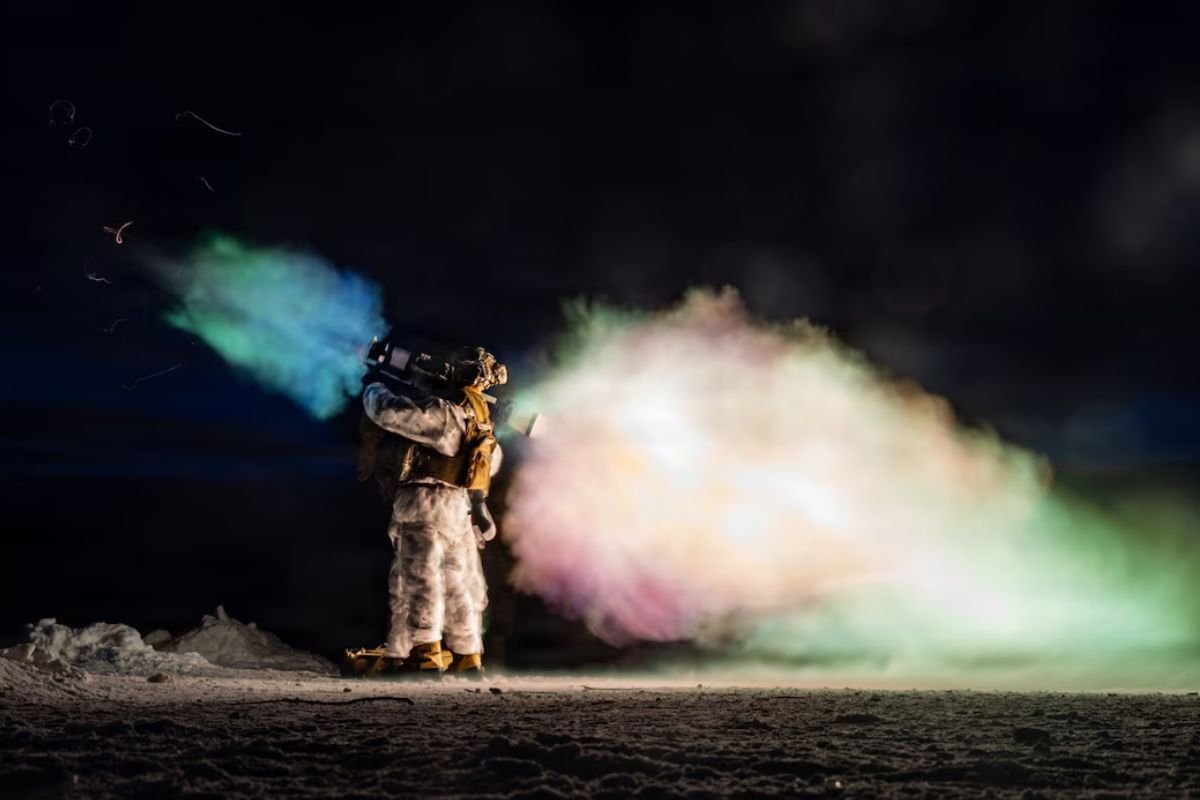
Marine Corps Cpl. Judith Ann Lazaro VIRIN: 260216-M-FC877-1934
Fighting as one force, not many
Once logistics were in place, the exercise shifted to combat operations—and here, NATO crossed another threshold.
In a first-of-its-kind operation:
- U.S. Marines were airlifted aboard a KC-130J Super Hercules
- Alongside Franco-German air transport units
- Deployed from Norway into Finland
- Then placed under the command of Sweden’s 4th Mechanized Brigade
This is more than interoperability. It is fusion.
American Marines fighting under Swedish command. European air units transporting U.S. infantry. Logistics shared across multiple nations without pause.
At the same time, other Marine units in Norway integrated with Norwegian forces, using Bandvagn 206 tracked vehicles—machines designed for snow, swamp, and terrain where wheels fail.
They maneuvered through harsh conditions to engage Spanish mountain infantry acting as the opposing force.
The message is clear: NATO is no longer training to coordinate. It is training to function as a single organism.
Learning the Arctic the hard way
There is a difference between operating in cold weather and mastering it.
For many Marines, Cold Response was not just an exercise—it was an education.
Working alongside Norwegian units, they adapted to a different way of fighting:
- Moving silently across snow-covered terrain
- Managing extreme cold that degrades weapons and equipment
- Using the environment as concealment rather than obstacle
As one Marine squad leader put it, the goal is not just survival.
It is to “thrive in the terrain and then use that to our advantage.”
That mindset matters. In the Arctic, the environment is not neutral. It favors those who understand it—and punishes those who do not.
A region that is no longer peripheral
For years, the Arctic was treated as a secondary theater—remote, difficult, strategically important but rarely urgent.
That perception is fading.
With ice retreating, sea lanes opening, and great-power competition intensifying, the High North is becoming a space where presence must be backed by capability.
Norway’s role reflects this shift. As Brig. Gen. Nina Berg noted, its geography—ice-free ports, open sea lanes, and access corridors into the Arctic—makes it a critical entry point for allied forces.
And NATO is responding accordingly.
The presence of Secretary General Mark Rutte during the exercise was not symbolic. It was a signal.
Deterrence, built in the cold
Cold Response 26 was not designed to simulate a specific conflict. It was designed to send a message.
As Lt. Col. Chase Bradford stated:
“The only way you can deter is if you have a credible threat.”
Credibility, in this context, does not come from declarations. It comes from demonstration.
From showing that:
- Forces can deploy rapidly into the Arctic
- Logistics can sustain them across vast distances
- Units from different nations can fight as one
- Command structures can adapt in real time
If you look closely, you see what NATO is trying to build.
Not just a presence in the Arctic—but a system.
A system where geography is no longer a barrier, where alliances translate into immediate action, and where the cold itself becomes part of the strategy.
You will not see that system on a map.
But it is there—moving quietly across snow, beneath low light, preparing for a crisis that, if it comes, will leave little room for hesitation.
Source:
U.S. Department of the Army (War.gov), Marines forge new role for collective Arctic defense during NATO exercise (2026),
https://www.war.gov/News/News-Stories/Article/Article/4440824/marines-forge-new-role-for-collective-arctic-defense-during-nato-exercise/
Official article describing how U.S. Marines are adapting their operational role for Arctic warfare within a NATO framework, highlighting joint training, extreme environment readiness, and the growing strategic importance of the Arctic in collective defense planning.
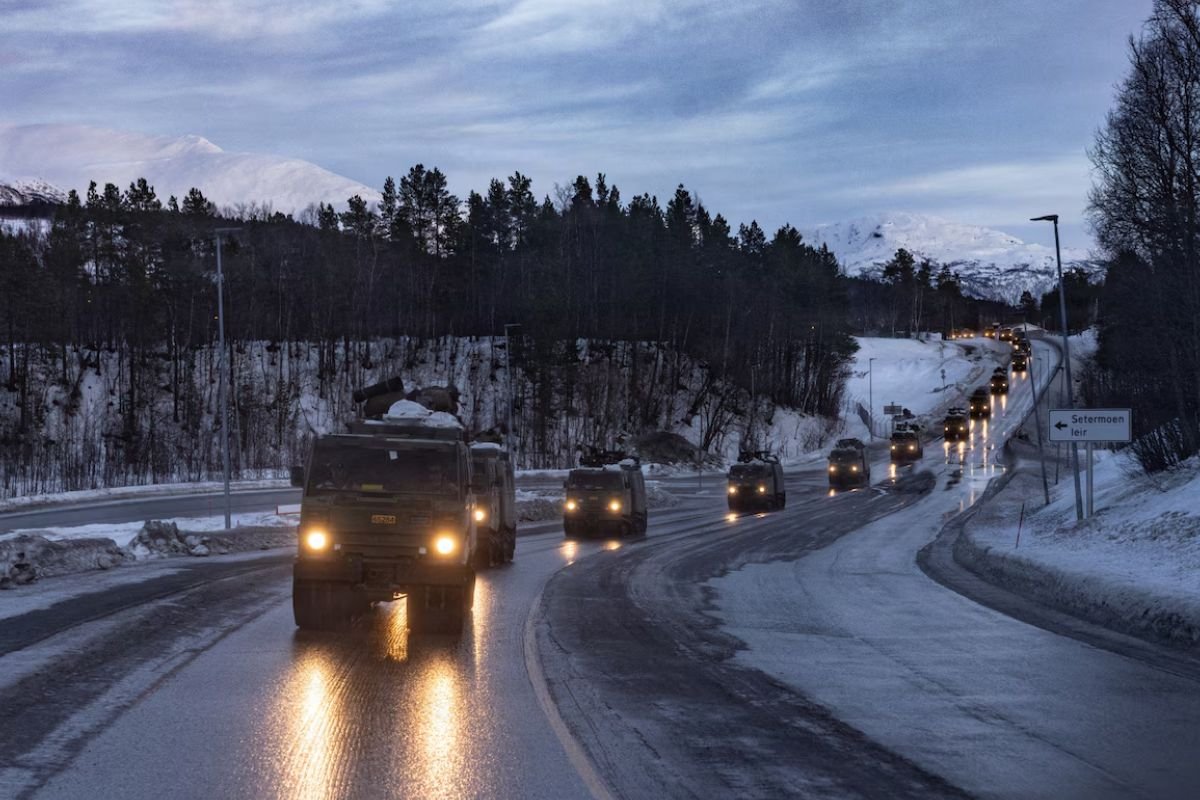
Image: Marines from the 2nd Battalion, 6th Marine Regiment, 2nd Marine Division, convoy in all-terrain carriers during Exercise Cold Response 26 in Setermoen, Norway, on March 11, 2026. U.S. forces and allied partners took part in a full-scale, force-on-force exercise combining simulation and live operations to test readiness, enhance coordination, and synchronize joint capabilities – Credit: Marine Corps Cpl. Judith Ann Lazaro VIRIN: 260311-M-FC877-1006
