
Signing deals with prime contractors is one thing. Locking in the critical components they depend on is something else entirely — and that’s exactly what the Pentagon just did.
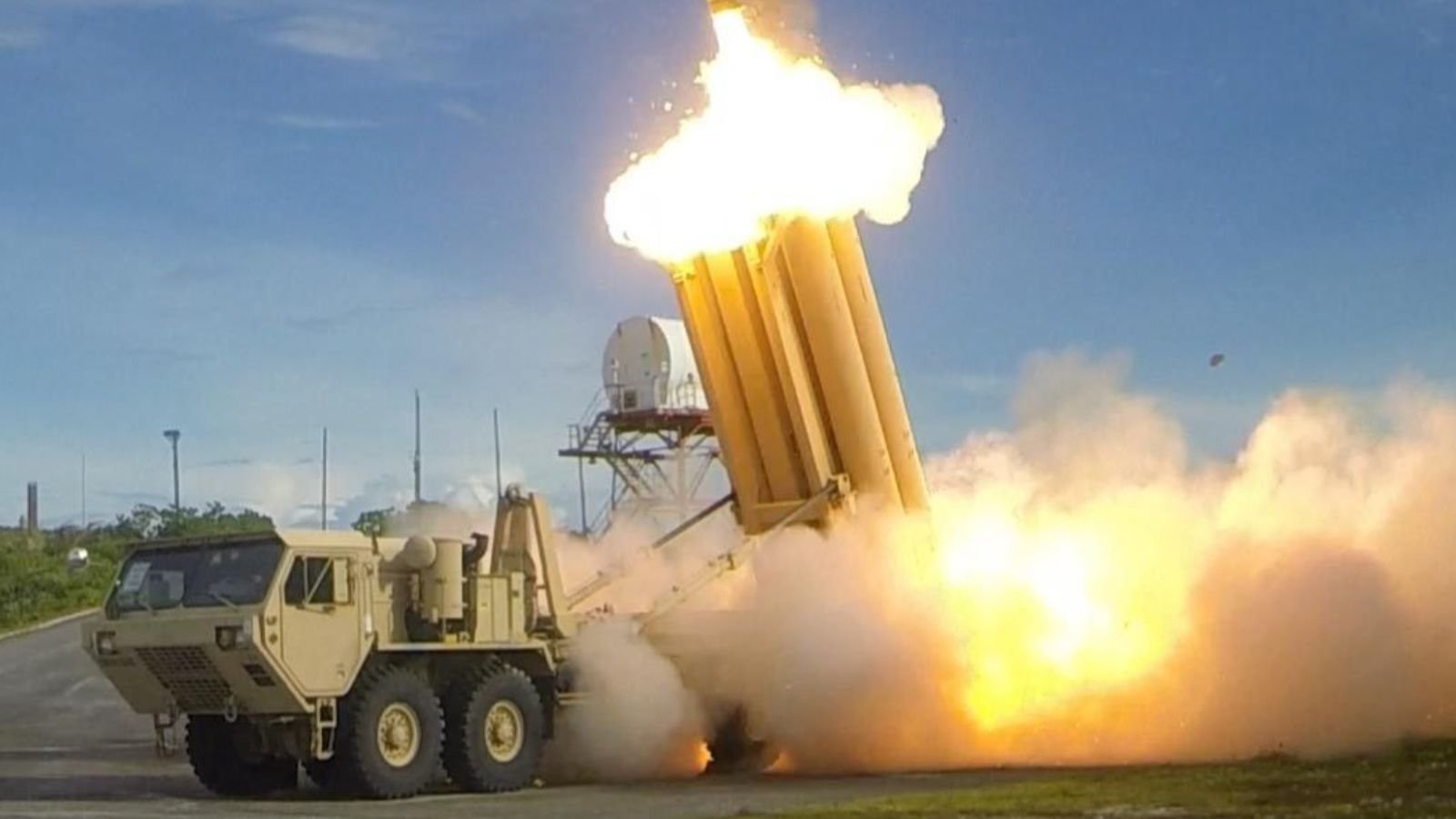
The Terminal High Altitude Area Defense system didn’t become America’s most relied-upon missile shield by accident. Capable of picking off ballistic missiles at altitudes above 40 miles — well before they begin their terminal plunge — THAAD sits at the top of a layered defense architecture that took decades and billions of dollars to assemble. On March 25, 2026, the Department of War announced a framework agreement with BAE Systems and Lockheed Martin to quadruple production of the interceptor’s seeker. It’s a decision that, on the surface, looks like a straightforward procurement move. Look closer, and it reads as something more urgent.
America Is Quadrupling Its THAAD Interceptor Output — And This Time, It Starts at the Factory Floor
There’s a version of this story where the headline is simply “Lockheed Martin gets more THAAD business.” That version misses the point entirely.
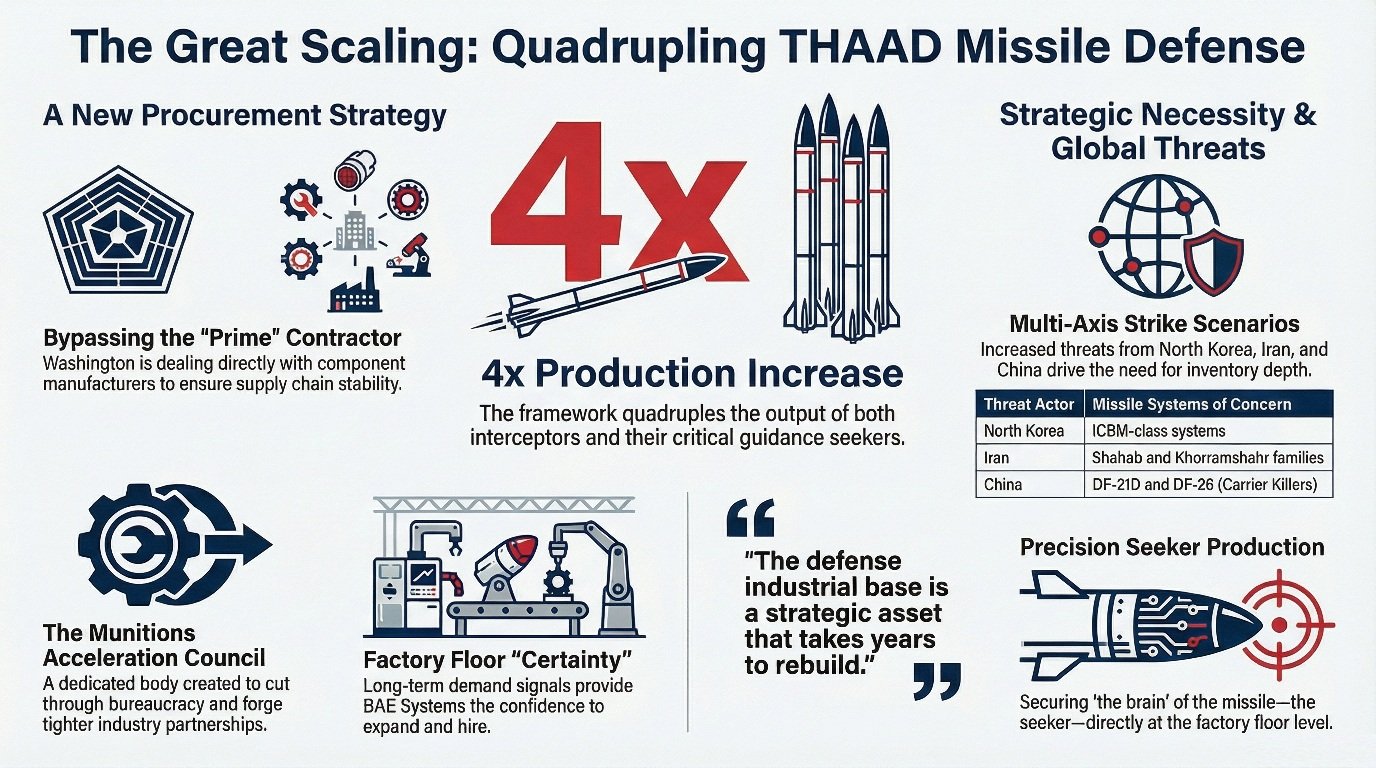
The seeker is the brain of the interceptor — the precision guidance unit that actually homes in on an incoming ballistic missile. No seeker, no kill. BAE Systems builds it, and until now, their production capacity wasn’t sized for a world where multi-front ballistic threats have become the baseline planning assumption rather than the worst-case scenario.
What the Department of War has done here is go around the usual logic of defense acquisition. Normally, you sign with the prime and trust them to manage their own supply chain. This time, Washington went directly to the component manufacturer and made the long-term demand signal explicit. It’s a subtle but consequential shift — the kind that rarely makes headlines but determines whether a weapon system can actually be produced at scale when it matters.
This agreement also follows a separate deal, announced just weeks prior, to quadruple overall THAAD interceptor output with Lockheed Martin. The sequencing is deliberate: lock in the finished-weapon rate first, then lock in the parts that make it possible. Someone in the acquisition office is thinking two steps ahead.
What It Takes to Put Industry on a Wartime Footing
Defense manufacturers are not, by nature, gamblers. They’ve seen enough procurement cycles — waves of urgency followed by budget cuts and canceled contracts — to know that expanding factory capacity on the basis of political rhetoric is a good way to end up holding expensive equipment and empty order books.
Michael Duffey, Under Secretary of War for Acquisition and Sustainment, addressed this directly: “This agreement with BAE Systems sends a clear, stable, long-term demand signal. We are providing the certainty our partners need to invest, expand, and hire.”
That word — certainty — is doing a lot of work. The framework agreement isn’t just a purchase order. It’s a commitment structured to give BAE Systems the financial confidence to add floor space, train workers, and build out capacity that will take years to fully materialize. Defense industrial investment doesn’t happen overnight, and it doesn’t happen without contractual cover.
The body overseeing this push is the Munitions Acceleration Council, a DoW body stood up specifically to cut through the bureaucratic friction that normally slows defense production to a crawl. Its mandate is blunt: remove barriers, forge tighter industry partnerships, and build production capacity that outlasts any single administration’s priorities.
The Threat Picture That’s Driving All of This
THAAD batteries are currently deployed in Guam, South Korea, the UAE, and on the continental United States. That footprint tells you something about the geography of American deterrence — and about how many simultaneous threats Washington is now expected to manage.
North Korea has conducted more ballistic missile tests in the past few years than in the preceding decade, including ICBM-class systems that put the U.S. mainland within theoretical range. Iran’s Shahab and Khorramshahr missile families can reach American allies and regional bases across the Middle East. In the Pacific, China’s DF-21D and DF-26 missiles — purpose-built to threaten carrier groups and forward-deployed forces — have forced defense planners to think about simultaneous, multi-axis strike scenarios that would have seemed alarmist not long ago.
Against any one of those threats, a well-positioned THAAD battery is a credible answer. Against a coordinated salvo from multiple directions, inventory depth stops being a budget line and starts being a strategic variable. That’s the math driving this production push.
An Old Idea, Newly Urgent
There’s a historical echo worth noting here. During World War II, the United States government pre-purchased raw materials, machine tools, and factory capacity before it fully knew how those resources would be used. The bet paid off in the fastest military-industrial mobilization the modern world has ever seen.
Today’s framework agreements aren’t the same thing — the regulatory environment is different, labor markets don’t work the same way, and no one is converting automobile plants to interceptor production overnight. But the underlying logic is identical: if you wait until the crisis is fully upon you to start building capacity, you’ve already lost time you can’t get back.
The BAE Systems deal is, at its core, an acknowledgment of that reality. The defense industrial base isn’t a vendor network you call when you need something. It’s a strategic asset — one that atrophies without sustained investment and takes years to rebuild once it does.
Locking in THAAD seeker production at four times current output, directly with the manufacturer rather than through a prime contractor, is a small story with large implications. Whether adversaries read the signal the way Washington intends is the test that ultimately matters. The Arsenal of Freedom is only as credible as the factory floor behind it.
Sources: U.S. Department of War press release, March 25, 2026. THAAD system specifications via Missile Defense Agency.
Image: Terminal High Altitude Area Defense (THAAD) – credit: The U.S. Army Ralph Scott/Missile Defense Agency/U.S. Department of Defense
