

Tax season, for most people, is an administrative chore. For military families, it feels closer to a logistical operation.
Every spring, millions of Americans gather their documents, open their software, and file. The process is rarely pleasant, but it is predictable.
For military households, predictability is a luxury.
You are dealing with frequent moves, deployments, split households, and overlapping state rules—all layered onto a tax system designed for civilians who tend to stay in one place. The result is not chaos, but something close to it.
Addresses change. Income streams shift. Documents arrive late or in different locations. And somewhere in that complexity, you are expected to produce a clean, accurate return.
The system does not bend easily. So the burden falls on those navigating it.
There is, at least, one advantage: time.
A tax system that doesn’t quite fit the uniform
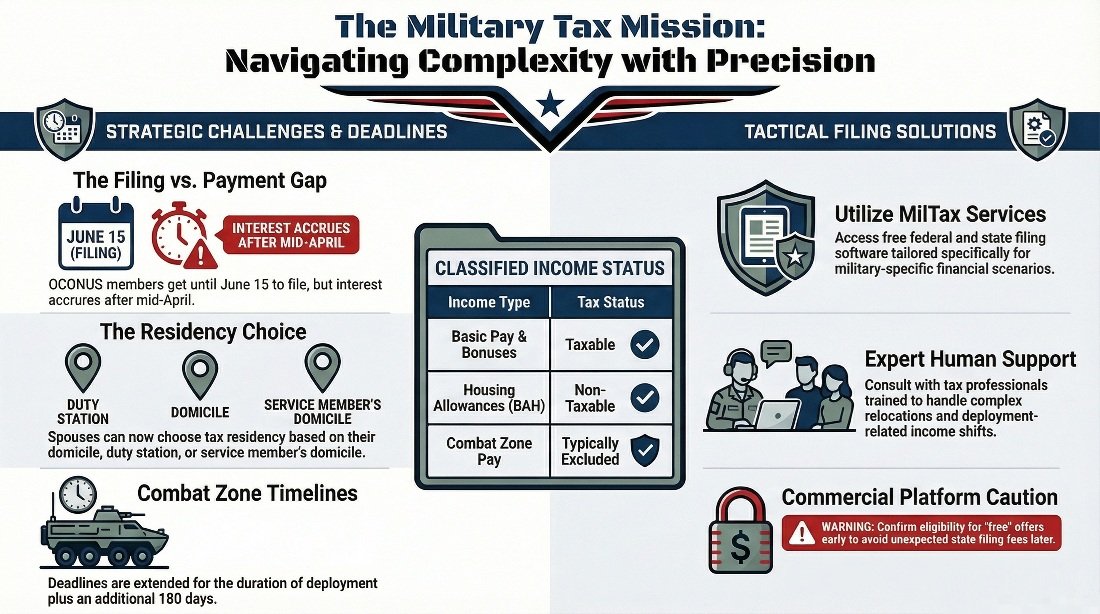
Service members stationed outside the United States typically receive an automatic extension until June 15 to file and pay federal taxes. On paper, that seems generous.
In practice, it is simply necessary.
Mail delays, scattered paperwork, and the reality of coordinating finances across continents make the standard April deadline unrealistic for many military families.
But the extension comes with a caveat that matters.
Interest still accrues on unpaid taxes after mid-April.
So you are given time to file—but not truly time to pay.
That distinction forces many families into a careful calculation:
- Estimate what is owed
- Pay by April to avoid interest
- Use the extension window to finalize the return
For those who need more time, an additional extension to October 15 is available. And for those deployed in combat zones, the timeline shifts further—covering the duration of the deployment plus 180 days.
These policies acknowledge reality. They do not eliminate pressure.
Filing without friction—or at least less of it
Recognizing the complexity, the military ecosystem has built its own support structures.
At the center of that system is Military OneSource and its tax service, MilTax.
It is, in many ways, a tailored solution to a tailored problem.
MilTax offers:
- Free federal and state filing
- Software designed for military-specific scenarios
- Access to tax professionals familiar with deployments and relocations
Eligibility extends beyond active-duty personnel to include family members, survivors, and recently separated service members.
That matters, because military life rarely affects just one individual.
Still, “free” does not mean effortless.
The system can guide you, but it cannot reconstruct missing documents or interpret incomplete information. Accuracy still depends on what you provide.
And in military households, gathering that information can be the hardest part.
The quiet complexity of military pay
One of the subtler challenges lies in understanding what is actually taxable.
Military compensation is not structured like civilian income. It includes allowances, incentives, and special payments—some taxable, some not.
For example:
- Housing allowances are generally not taxable
- Combat-zone pay is typically excluded from taxable income
- Certain bonuses and special payments may be treated differently depending on context
Then there are specific rulings—like the IRS determination that certain “Warrior Dividend” payments are not taxable—which can quietly alter how income is reported.
The result is a system where two service members with similar roles can have very different taxable incomes.
And unless you are paying close attention, it is easy to misunderstand what belongs on your return.
The geography problem
If there is one area where military taxes become particularly intricate, it is state residency.
Under federal law, service members are not required to change their legal residence simply because they move under orders. That principle provides stability.
But it also creates complexity.
For spouses, the rules are even more flexible. Under updated legislation, they may choose to align their tax residence with:
- Their own domicile
- The service member’s domicile
- The service member’s duty station
That flexibility can reduce tax burdens—but it also introduces decision-making.
Consider a household where:
- One spouse is stationed in one state
- The other works remotely in another
- Their legal residence is tied to a third
In that scenario, the question is not just where you live.
It is which state has the right to tax you—and which one you choose to recognize.
Handled correctly, this can reduce taxes or simplify filings.
Handled poorly, it can lead to duplicate taxation, corrections, and months of administrative friction.
The tools—and their limits
Beyond MilTax, commercial platforms like TurboTax and TaxSlayer offer military-specific deals.
Some provide free federal and state filing for enlisted personnel. Others offer free federal returns but charge for state filings.
At first glance, these offers seem interchangeable.
They are not.
The differences often emerge late in the process:
- Eligibility restrictions based on rank or status
- Additional fees for state returns
- Limited support for complex multi-state situations
The risk is subtle. You begin filing under the assumption that the process is free, only to discover constraints once your data is already entered.
A more deliberate approach tends to work better:
- Identify your filing needs first
- Confirm eligibility and coverage
- Then choose the platform
It is a small step that prevents larger problems.
What this reveals about the system
There is a broader lesson in all of this.
The U.S. tax system, like many large institutions, assumes stability. A fixed address. A consistent employer. A predictable flow of documents.
Military life does not offer that.
It is mobile, fragmented, often uncertain. It operates across jurisdictions, time zones, and legal frameworks that were not designed to align neatly.
The adaptations—extensions, specialized software, residency rules—are attempts to bridge that gap.
They help. But they do not fully resolve the underlying tension.
Stability, built quietly
In the end, most military families file their taxes successfully. The system holds, even under strain.
But the process reveals something about the nature of service.
Responsibility does not stop at the operational level. It extends into administrative life, into financial decisions, into the quiet work of maintaining order in a system that does not always make it easy.
A clean return, filed on time, with the right state and the right numbers, may seem unremarkable.
In reality, it reflects something more.
Adaptation. Discipline. And a familiarity with complexity that, like much of military life, often goes unnoticed.
Sources:
- AAFMAA (American Armed Forces Mutual Aid Association), “Military Tax Guide” (published 2026),
https://www.aafmaa.com/resource-center/military-tax-guide
practical guide outlining the specific tax rules, benefits, and filing considerations applicable to U.S. service members, including combat zone exclusions, special deadlines, deductions, and financial planning advice tailored to military personnel and their families. - U.S. Department of Defense (War.gov), “Service Members Have Options Leading Up to Tax Day” (published 2026),
https://www.war.gov/News/News-Stories/Article/Article/4446394/service-members-have-options-leading-up-to-tax-day/
official communication detailing the different support programs and filing options available to U.S. military personnel ahead of tax deadlines, including free assistance services, extensions, and resources designed to simplify tax compliance for active-duty members and their dependents.
