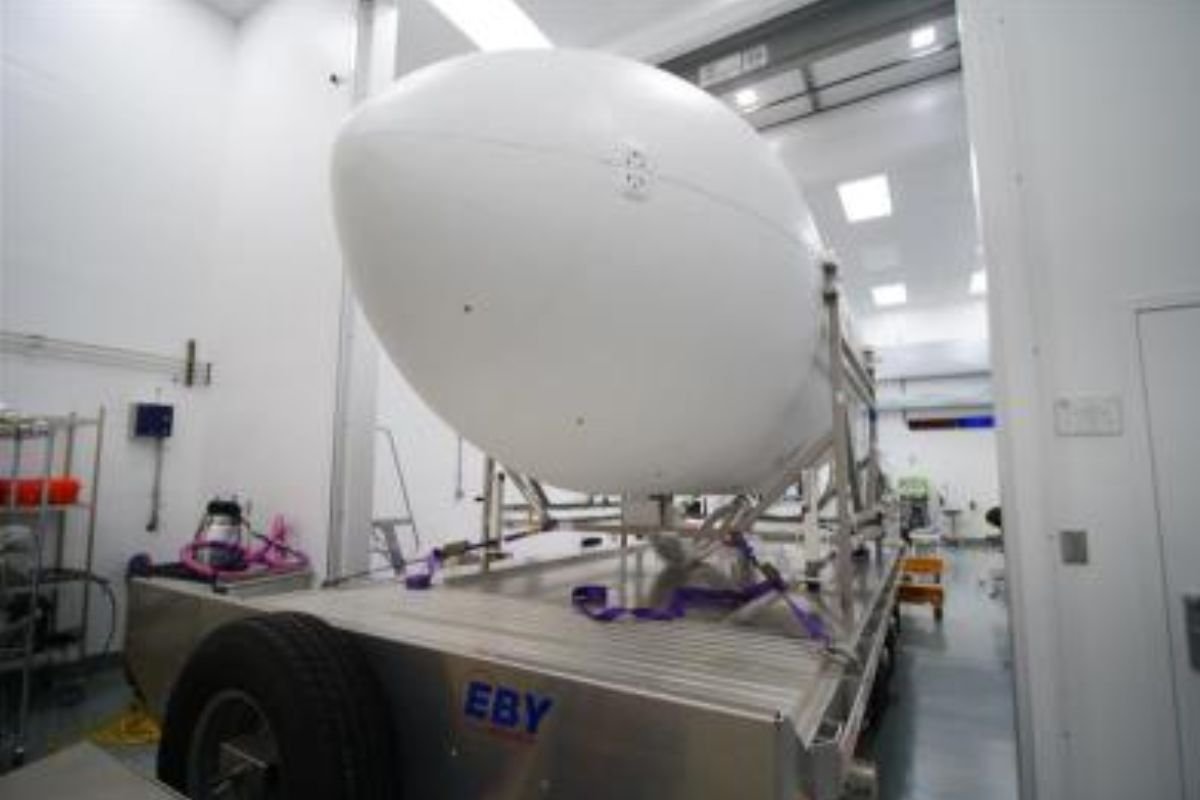
Lockheed Martin and the U. S. Space Force used the VICTUS DIEM exercise to stress-test a simple idea with high stakes, get a national security payload processed and ready at a speed that looks more like emergency response than traditional space operations.
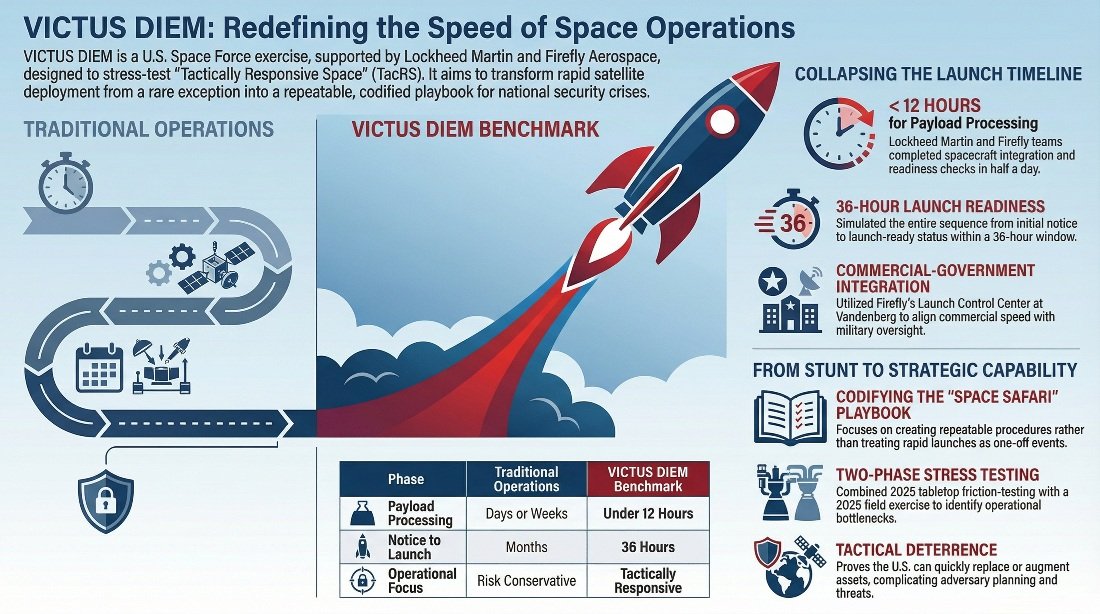
At Vandenberg Space Force Base in California, the teams ran a rapid payload processing demonstration that finished in less than 12 hours, a benchmark meant to show what “responsive space” can look like when timelines collapse.
The event also included a rapid launch simulation that compressed the sequence from notice to launch readiness into 36 hours. The work brought together government operators and commercial partners, with Firefly Aerospace supporting the effort. Space Force leaders framed the exercise as a way to refine and codify repeatable procedures for tactically responsive space missions, the kind of playbook you want written before a crisis, not during it.
Related articles:
- European missile maker MBDA has doubled its production in two years, and with a $6.3 billion investment, it’s only the beginning
- The United States loses the torpedo contract for the future Dutch Orka-class submarines to France and its F21 torpedo
VICTUS DIEM tests Space Safari rapid-launch playbook
The VICTUS DIEM activity sits inside the Space Force’s push for tactically responsive space, where the goal is not just launching satellites, but doing it on timelines that match real-world threats. The exercise was led under Space Safari, the organization associated with fast-turn mission execution. The practical aim was to refine processes that can be repeated, not treated as a one-off stunt. That distinction matters because “responsive” only counts if it can be done again under pressure.
Space Force officials have described the exercise as a way to strengthen the service’s ability to respond to urgent warfighter requirements and evolving threat scenarios. That language is broad by design, but the operational implication is concrete, a shorter loop between demand and capability. If a satellite is lost, degraded, or needs reinforcement, the question becomes whether a replacement or augmentation can get to orbit before the window closes. TacRS is the umbrella concept, and VICTUS is the set of drills meant to keep it real.
The structure of VICTUS DIEM was split into two phases, a tabletop exercise in late 2025 and a field training exercise in early 2026. The tabletop phase is where friction usually shows up first, unclear authorities, mismatched checklists, missing interfaces between teams. The field phase is where you discover what paperwork can be cut, what safety steps cannot, and what equipment becomes a bottleneck at 2 a. m. when the clock is running.
One Space Force acquisition leader, Col. Eric Zarybnisky, described the effort in blunt terms, launch is a team sport, and the base, rocket, and mission elements need to be aligned before the customer is ready. That is a reminder that speed is not only about hardware. It is about permissions, procedures, and rehearsed coordination across units that do not always operate on the same cadence during routine operations.
British Army regiment gunners become the first “drone aces” after intercepting Iranian drones
Lockheed Martin and Firefly finish payload processing in under 12 hours
The headline metric from the exercise was the rapid payload processing demonstration, completed in less than 12 hours by teams from Lockheed Martin and Firefly Aerospace. Payload processing is an umbrella term that can include integration activities, checks, and the disciplined sequencing that makes sure a spacecraft is safe and mission-ready before it ever gets near a rocket. In normal conditions, those steps can stretch out because schedules allow it and risk tolerance is conservative.
Compressing that work into half a day is a deliberate stress test. It forces teams to pre-stage tools, standardize interfaces, and remove ambiguity about who signs off on what. It also exposes where “speed” is just a slogan. If a single test requires a specialist who is not available, or a part that is not on hand, the timeline breaks. The exercise was designed to surface those points before a real contingency does.
Kate Watts, vice president of enterprise strategy at Lockheed Martin Space, said speed in space operations has never been more critical, and framed the exercise as a demonstration that also generated feedback from the government customer. That feedback loop is a quiet but central output. A fast demo is useful, but a fast demo that changes future requirements, checklists, and contracting expectations is what turns practice into institutional capability.
There is also a nuance worth keeping in view, “less than 12 hours” is a powerful number, but it is a number achieved inside an exercise environment designed for learning. Real crises add noise, staffing constraints, competing priorities on a busy range, and the possibility that infrastructure is itself under strain. The point of the drill is not to claim every mission will hit that mark, but to prove the process can be tightened and then improved again.
Space Force simulates 36-hour launch operations after notice
Beyond payload processing, the teams conducted a rapid launch simulation that compressed launch operations tasks into 36 hours after receiving a simulated notice to launch. The Space Force described it as part of a field training exercise, rehearsing emergency launch protocols used in real-life responsive space missions. The key word is “protocols,” because the Space Force is trying to turn rapid launch from an exception into a governed pathway with defined steps.
In practical terms, a 36-hour clock pressures everything that sits between intent and execution, mission assurance reviews, range coordination, final readiness activities, and the choreography between payload and launch provider. The exercise implicitly asks which steps are essential for safety and mission success, and which steps are legacy habits built for a different era. That sorting is hard, because cutting time can also cut margin, and margin is where aerospace programs traditionally live.
Lt. Col. Cliff Johnson, Space Safari’s director of operations, called the mission a powerful demonstration of what is achievable through swift collaboration and strategic use of commercial partners to meet critical government needs. He also said it provides insight into the future of responsive space. The emphasis on commercial partners is not just rhetoric. It reflects a reality that the industrial base and the service have to practice together, not meet for the first time during a contingency.
There is a second-order implication for deterrence. If an adversary believes the United States can replace or augment capabilities quickly, the incentive to target space assets changes. That does not eliminate the threat, but it complicates planning. Still, it is fair to question how quickly “simulation speed” translates to “on-demand launch” at scale, because range availability, supply chains, and competing national priorities can all slow execution when multiple missions stack up.
Vandenberg operations highlight commercial-government integration
The exercise took place at Vandenberg Space Force Base, a site that already supports frequent launches and has the infrastructure to host both government and commercial activity. Firefly highlighted its Launch Control Center at Space Launch Complex 2 within the base, underscoring that responsive space is not only about rockets on a pad, but also about command-and-control facilities, trained teams, and repeatable workflows that can be activated quickly.
Firefly Aerospace described its role as supporting Lockheed Martin in two responsive space exercises for the Space Force as part of the VICTUS DIEM mission. That phrasing matters because it points to iteration. A single drill can be impressive, but a series of exercises is what hardens the system. Each run can tighten timelines, clarify responsibilities, and test the seams between organizations, especially where commercial speed meets government oversight.
For Lockheed Martin, participation also fits a broader narrative, getting new technology on orbit faster and demonstrating that mission integration can keep pace with accelerated launch concepts. The company’s public messaging focused on speed and customer feedback, which aligns with how defense primes increasingly position themselves, not just as hardware providers, but as partners in operational concepts. In this case, the concept is “launch fast when it matters,” and the proof is measured in hours.
Still, integration is where friction tends to hide. Commercial companies optimize for cadence and cost, while government customers optimize for assurance, documentation, and accountability. Exercises like VICTUS DIEM are meant to reconcile those instincts into a shared process. The risk is that the process becomes so tailored to a specific base, a specific set of teams, and a specific set of assumptions that it loses portability. Repeatability across locations and partners is the real test.
National security goals drive repeatable TacRS procedures
The Space Force has tied VICTUS DIEM outcomes to the ongoing development of the TacRS program, with the stated intent of enabling faster deployment of critical space capabilities and maintaining advantage in contested environments. That is a strategic goal, but the exercise outputs are more procedural, checklists, roles, timelines, and decision points that can be executed under pressure. The emphasis on “codifying” a process is an acknowledgment that speed without governance can become improvisation.
From an operational perspective, responsive space is about options. If an urgent requirement appears, commanders want choices that do not require months of lead time. VICTUS DIEM’s 12-hour processing demonstration and 36-hour launch simulation are benchmarks that help define what those options might look like. They also create a yardstick for future exercises, whether the service can do it faster, do it with different partners, or do it under more complex conditions.
The exercise also reinforces a trend in national security space, leaning on commercial capability while keeping government control of mission priorities. That balance is delicate. Commercial partners bring agility and capacity, but the government still carries the burden of mission assurance and strategic risk. When Space Force leaders talk about leveraging commercial partners, they are also talking about building a marketplace of readiness, where multiple providers can plug into a government-led process.
One critique often raised in the responsive space conversation is that speed metrics can dominate the story while other constraints get less attention. Launch timelines are only one piece. Sustaining a responsive posture also requires resilient supply chains, trained personnel who can surge, and a range ecosystem that can handle short-notice operations. VICTUS DIEM shows progress on the drill floor, but it also raises the next question the Space Force will have to answer, how often can it repeat this tempo without burning out people and infrastructure.
Sources:
- Lockheed Martin, “Victus Diem” (published 2026),
https://news.lockheedmartin.com/victusdiem
official corporate communication outlining Lockheed Martin’s role in the U.S. Space Force’s Tactically Responsive Space (TacRS) missions, focusing on the Victus Diem program and its objective to demonstrate ultra-fast satellite development and launch timelines to respond to emerging threats in orbit. - U.S. Space Systems Command (U.S. Space Force), “USSF sharpens rapid tactically responsive space launch capabilities through Victus program” (published 2026),
https://www.ssc.spaceforce.mil/Newsroom/Article-Display/Article/4440288/ussf-sharpens-rapid-tactically-responsive-space-launch-capabilities-through-vic
official U.S. Space Force communication detailing the evolution of the Victus program, including Victus Nox, Haze, and Diem, and explaining how these missions are designed to validate rapid launch concepts, reduce response timelines to days, and strengthen U.S. resilience in contested space environments.
