
The U. S. Department of War has signed a framework agreement with Northrop Grumman to produce and supply the M1147 AMP 120mm tank round, with a potential ceiling of $885 million.
The announcement, dated March 27, sets up a contracting vehicle that can be used for future production orders rather than a single, fully funded buy. No money was obligated at the time of signing, a detail that matters for both budgeting and delivery expectations.
The agreement allows orders to be placed through March 2031, and it can be used by the U. S. Army or through Foreign Military Sales channels for international customers. The M1147 AMP is built for the 120mm guns used across the M1 Abrams family, and it is meant to replace four older ammunition types with one programmable round. That consolidation pitch is straightforward, but the real test will be whether production capacity and training keep pace with demand.
War Department sets $885 million M1147 AMP framework through 2031
The central fact is the structure, not just the headline number. The War Department’s framework agreement with Northrop Grumman establishes a maximum potential value of $885 million, but it does not automatically trigger deliveries. It creates a pathway for the government to place production orders over time, up to March 2031, depending on appropriations, priorities, and operational demand.
That “no funding obligated” line can be easy to gloss over, but it’s the difference between a promise and a purchase. A framework deal can speed ordering later, since terms and conditions are pre-baked, but it can also create public confusion when people assume an immediate surge in output. Think of it as a pre-approved menu, not a meal already served, and not every year’s budget will treat tank ammunition as the top item.
The agreement also anticipates multiple buyers. The War Department said the ammunition may be procured by the U. S. Army or via Foreign Military Sales, which can pull allied demand into the same production ecosystem. That matters because international orders can stabilize production lines, but they also add scheduling complexity when domestic readiness and export timelines collide.
There’s a broader pattern here. Recent Pentagon and War Department contracting has leaned on multi-year arrangements and framework-style vehicles to reduce lead times and encourage industrial investment. Separate announcements in other areas, from command-and-control work to munitions-related production pushes, show the same instinct, lock in a contracting lane first, then place orders as budgets and urgency allow.
M1147 AMP replaces four Abrams rounds with one programmable fuze
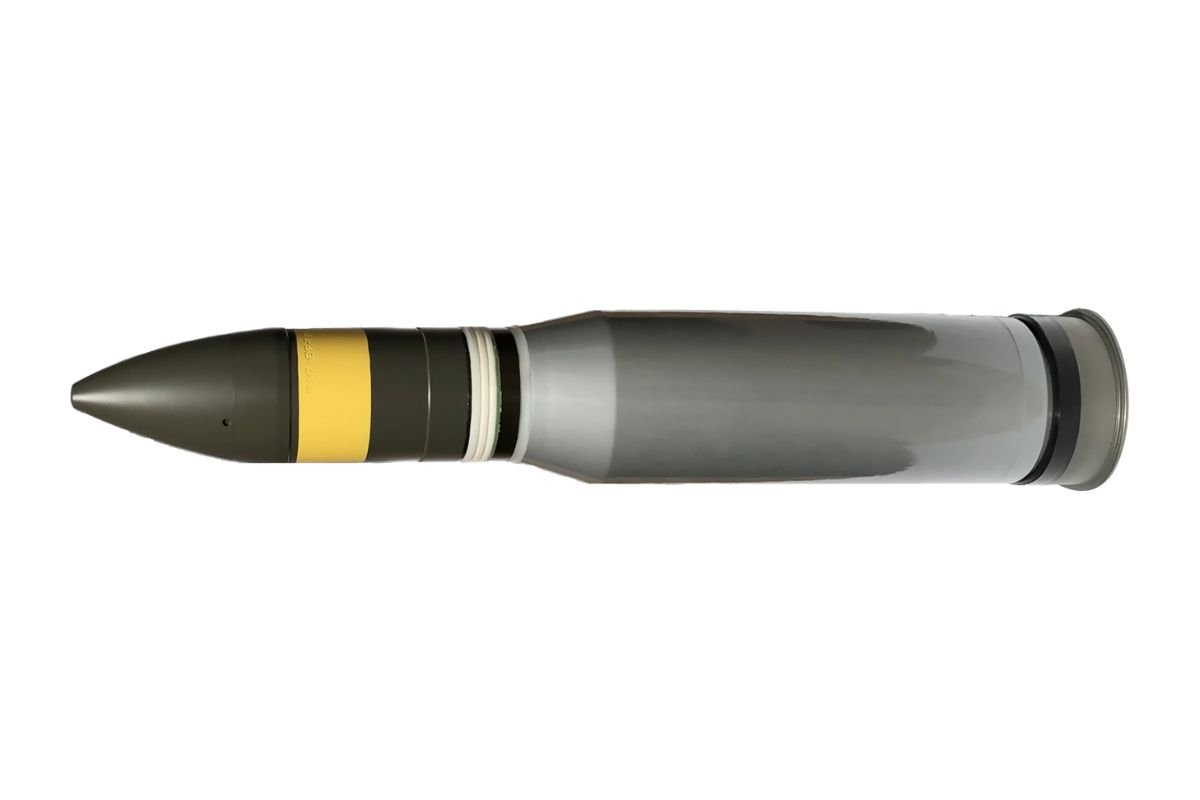
The M1147 AMP is designed for 120mm tank guns used by the M1 Abrams family, and its mission is consolidation. Officials describe it as a single munition intended to replace four legacy rounds, the M830, M830A1, M908, and M1028. Instead of loading different rounds for different target sets, crews can rely on one round with selectable effects.
Technically, the AMP is built around a multi-mode programmable fuze. It can operate in point-detonate, point-detonate delay, and airburst modes, giving tank crews a way to tailor the same projectile to different battlefield problems. For a crew under time pressure, fewer ammunition types can mean fewer chances to load the wrong round, and fewer resupply headaches when units are moving fast.
The airburst feature is one of the most emphasized capabilities. The round can detonate at a programmed distance from the target, a function meant to improve effectiveness against exposed personnel or teams operating near cover. In practical terms, that’s about forcing effects into spaces where a direct-impact detonation would waste energy on the wrong side of a wall or berm.
Officials also cite obstacle and structure defeat. The M1147 AMP is described as able to penetrate reinforced concrete walls up to roughly 20 centimeters. The numbers come with obvious caveats, concrete varies, angles matter, and real-world construction is messy, but the intent is clear. The round is meant to give Abrams units a more flexible tool against light fortifications and certain urban barriers without swapping to a specialized legacy type.
Northrop’s AMP timeline runs from XM1147 in 2013 to 2024 service
The AMP story didn’t start this spring. The U. S. Army began development of the XM1147 in 2013, with requirements aimed at engaging anti-tank guided missile teams, dismounted infantry, and reinforced concrete walls. The program was structured around a common-sense logistics goal, merge four rounds’ roles into one, but it took years of engineering and testing to reach production maturity.
In 2015, development continued under Orbital ATK, which later became part of Northrop Grumman through the formation of Northrop Grumman Innovation Systems. Early contracting included a $16 million award that kicked off initial phases focused on mission versatility and a multi-mode programmable fuze. That kind of figure is modest compared with today’s ceiling, but it shows the long runway typical for modern munitions.
The XM1147 did not reach Low Rate Initial Production until December 2020. That gap, from initial development in 2013 to LRIP in 2020, is a reminder that “new round” does not mean “fast program.” Integration with a tank’s fire control system, fuze reliability, safety certification, and consistent manufacturing quality all have to line up before large-scale buys become realistic.
Service entry is listed as 2024-present, which frames the framework agreement as a scaling mechanism rather than a science project. Still, there’s room for a sober critique. A single multi-purpose round can simplify logistics, but it also concentrates risk. If a production issue or fuze defect emerges, the force is less buffered by alternate legacy types, and that puts pressure on quality assurance and on maintaining adequate stockpiles during the transition.
Abrams gunnery gains airburst effects from the Ammunition Data Link
For the AMP concept to work, the tank has to talk to the round. The M1147 integrates with the Abrams fire control system through an Ammunition Data Link, which allows the crew to program the fuze for the desired mode. That’s the enabling technology behind airburst and delayed detonation, and it shifts part of lethality from the projectile alone to the combined projectile-plus-platform system.
The round’s published performance details help explain why the Army values that flexibility. The M1147 is a 120570mm NATO round with a listed muzzle velocity of about 1,150 m/s, and it carries a reported explosive fill of 2.3 kg of PAX-3. Those figures are not just trivia, they shape how the round behaves across distances and how predictable its effects can be when programmed correctly.
Range bands are also described in ways that match the target sets the Army talks about. Against ATGM teams and light armor, the effective range is listed as 50 meters to 2,000 meters, while against massed infantry it is listed out to 5,000 meters. Airburst at longer distances is where programming precision and crew training become inseparable, because small errors in fuze timing can mean large misses in effect.
In training terms, the AMP pushes crews to think in modes, not just in round types. That can be a net benefit, but it also adds cognitive load in high-stress situations, especially for less experienced crews. If the Army wants the promised “one round replaces four” simplicity, it will need gunnery tables, simulators, and fire control procedures that make mode selection feel automatic rather than like a menu buried in a system.
Foreign Military Sales and logistics drive demand for a single 120mm round
The War Department explicitly left the door open for international procurement through Foreign Military Sales. That matters because the Abrams is operated by multiple countries, and a single standardized multi-purpose round can appeal to partners that want simpler inventories and fewer specialized ammunition lines. If allied customers buy AMP through FMS, the production base can benefit from steadier demand, which can support workforce retention and supplier stability.
From a logistics perspective, replacing four legacy rounds with one is the kind of change planners like. Fewer stock numbers, fewer storage and transport rules to manage, and fewer opportunities for the wrong pallet to show up at the wrong unit. In large-scale exercises, even small reductions in variety can reduce friction, because ammunition forecasting is often a mess of assumptions about what targets units will face.
But consolidation has tradeoffs, and it’s worth stating them plainly. If the AMP becomes the default “do-everything” round, commanders may be tempted to treat it as a universal answer even when a specialized option would be better. The framework agreement’s long ordering window, through 2031, suggests the Army expects evolving requirements, and it would be a mistake to assume the legacy portfolio disappears cleanly overnight.
There’s also an industrial policy angle. Framework agreements can encourage manufacturers to plan for capacity, but they do not guarantee that sub-tier suppliers can expand without bottlenecks. Recent munitions initiatives across the defense sector, including other framework-style pushes tied to production increases, show how much the Pentagon is trying to align demand signals with factory investment. The AMP deal fits that pattern, and its success will be measured in delivered rounds, consistent quality, and predictable lead times, not in the ceiling number alone.
Sources:
- Defence Industry Europe, “U.S. Department of War signs framework agreement with Northrop Grumman for M1147 AMP tank ammunition” (published 2026),
U.S. Department of War signs framework agreement with Northrop Grumman for M1147 AMP tank ammunition
defence industry news article detailing the structure of the $885 million framework agreement between the U.S. Department of War and Northrop Grumman for the M1147 Advanced Multi-Purpose (AMP) 120 mm round, including contract ceiling, timeline through 2031, and its role in consolidating multiple legacy tank munitions into a single programmable solution. - U.S. Department of Defense (War.gov), “Contracts for Aug. 25, 2025” (published August 25, 2025),
https://www.war.gov/News/Contracts/Contract/Article/4285329/contracts-for-aug-25-2025/
official U.S. government contract announcement providing formal details on awarded defense contracts, including funding structures, contracting authorities, and procurement updates relevant to U.S. military programs such as advanced munitions and armored systems.
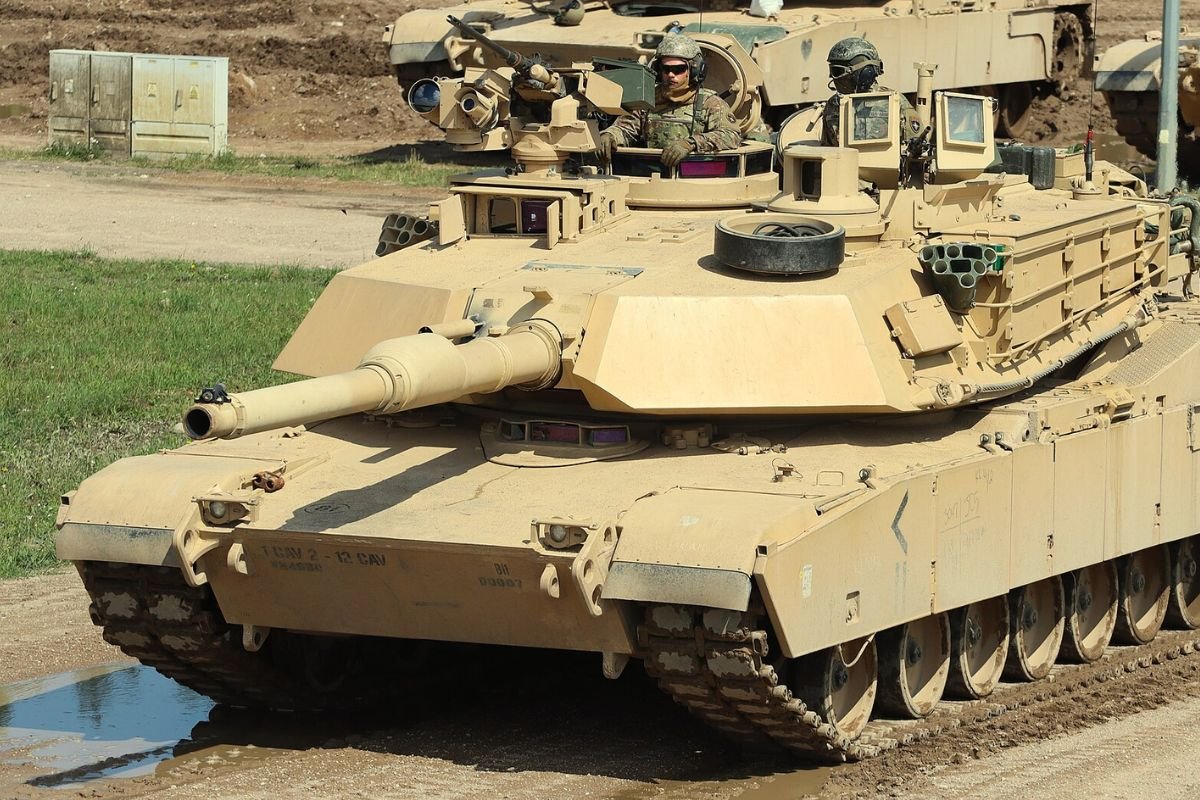
Image: The M1 Abrams sits at the center of this ammunition shift, not just as a platform but as a system built around adaptability. First fielded in 1980 and continuously upgraded through variants like the M1A1 and M1A2 SEPv3, the Abrams has evolved into one of the heaviest and most technologically advanced main battle tanks in service, weighing up to nearly 67 metric tons. Its design blends a 120mm smoothbore gun, advanced composite armor derived from Chobham technology, and a turbine engine capable of delivering 1,500 horsepower. Over decades of combat, from the Gulf War to Iraq and more recently Ukraine, the Abrams has demonstrated a consistent pattern, incremental upgrades rather than wholesale replacement. That matters for the M1147 AMP program, because the tank’s architecture, digital fire control systems, and modular upgrade path are precisely what allow a single programmable round to replace multiple legacy munitions without redesigning the platform itself.
