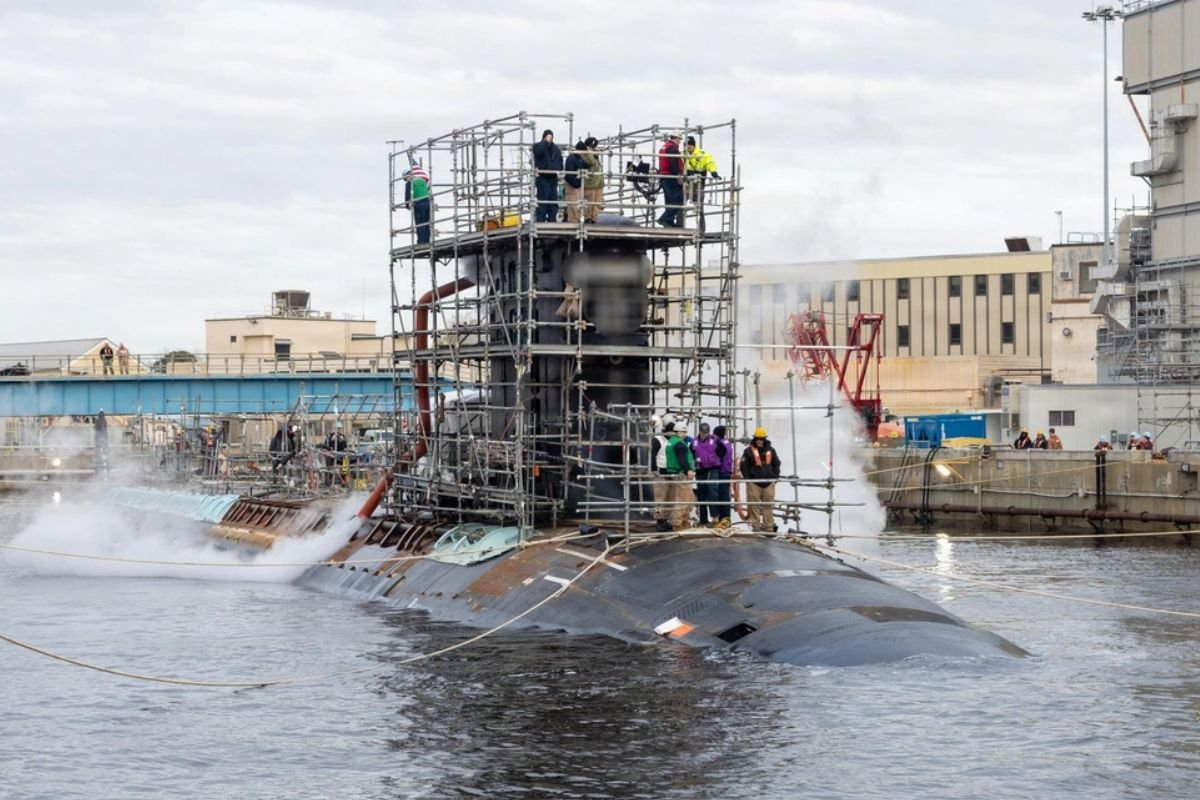
The U. S. Navy has undocked the Virginia-class attack submarine USS John Warner (SSN 785) from Norfolk Naval Shipyard, marking a major step in a deep maintenance period designed to keep the boat ready for frontline missions.
The undocking comes after a demanding package of hull, propulsion, and modernization work carried out during an Extended Drydocking Selected Restricted Availability, a mouthful that translates to, “take the submarine apart, fix what matters, and put it back together better.”
What makes this moment stand out is the combination of milestones achieved before the submarine left dry dock, crew re-embarkation, mast and periscope installation, and the start of command-and-control system testing. Norfolk Naval Shipyard says that three-part benchmark has not been pulled off during a submarine availability there since 2001. It’s a concrete datapoint in a broader story, the Navy is trying to reduce maintenance friction while still modernizing a fleet that is asked to do more every year.
Related articles:
- The United States loses the torpedo contract for the future Dutch Orka-class submarines to France and its F21 torpedo
- US Navy signs €14 billion deal to build Columbia-class nuclear submarines
Norfolk Naval Shipyard hits a 2001 benchmark with SSN 785
Undocking USS John Warner is not just a ceremonial “float it out and take pictures” moment. It signals that major dry-dock-limited work is complete and that the submarine can transition to the next phase, pier-side testing, finishing work, and the long grind toward returning to operational status. In practical terms, the shipyard has moved from heavy structural access to a more system-focused schedule, where deadlines live or die on coordination.
The shipyard highlighted a “trifecta” completed before undocking, the crew moved back aboard, the mast and periscope were installed, and initial command-and-control testing began. That combination matters because it compresses the timeline between dry dock and sea trials, at least on paper. It also reduces the risk of discovering late surprises after the submarine is already back in the water, when some fixes become more time-consuming.
Cmdr. Nicholas Tuuk, the submarine’s commanding officer, described the result as the most materially ready submarine he has undocked, pointing to the collaboration between the crew and the shipyard workforce. That kind of quote is standard in Navy public messaging, but the underlying claim is measurable in one way, the boat left dry dock with more “done” than has been typical at Norfolk for this kind of availability. It is less about hype and more about sequencing.
One nuance worth keeping in mind, a milestone is not the finish line. Undocking does not mean the availability is over, and it definitely does not mean the submarine is immediately deployable. Submarines can spend months in post-undocking workups, testing, and certification steps. The Navy’s public shipyards have been under pressure for years, so any progress is real, but it is still progress inside a system where schedule risk never disappears.
Extended Drydocking availability modernizes hull, propulsion, and combat systems
The overhaul for SSN 785 took place under an Extended Drydocking Selected Restricted Availability, a maintenance package that combines deep inspection with repairs and modernization. Norfolk Naval Shipyard described the work in broad categories, hull work, propulsion work, and modernization upgrades intended to sustain the submarine’s operational capability across its service life. The key point is that this is not routine upkeep, it is the kind of maintenance window you plan around.
From a readiness perspective, hull and propulsion work are the backbone. If those pieces slip, everything else becomes academic because the boat cannot safely operate at the performance levels expected of a Virginia-class submarine. Modernization, on the other hand, is where the Navy tries to make an older platform relevant against newer threats, without waiting for an entirely new class of submarine to arrive in large numbers.
The undocking announcement also called out initial testing of the command-and-control system. That detail is easy to skim past, but it’s central to how a submarine fights, navigates, communicates, and integrates with broader maritime operations. Starting that testing before undocking suggests the shipyard and crew were able to get far enough along to power up, verify, and begin checking key functions while still in a controlled maintenance environment.
There is a tension here, pushing modernization into a tight maintenance window can create schedule stress, especially when the shipyard is also dealing with workforce constraints and competing priorities. The Navy wants upgrades and speed at the same time. That is a tough combination, and it is why milestones like this get emphasized, they show an attempt to do more work earlier, when access is easiest, instead of pushing tasks into later phases where delays can stack up fast.
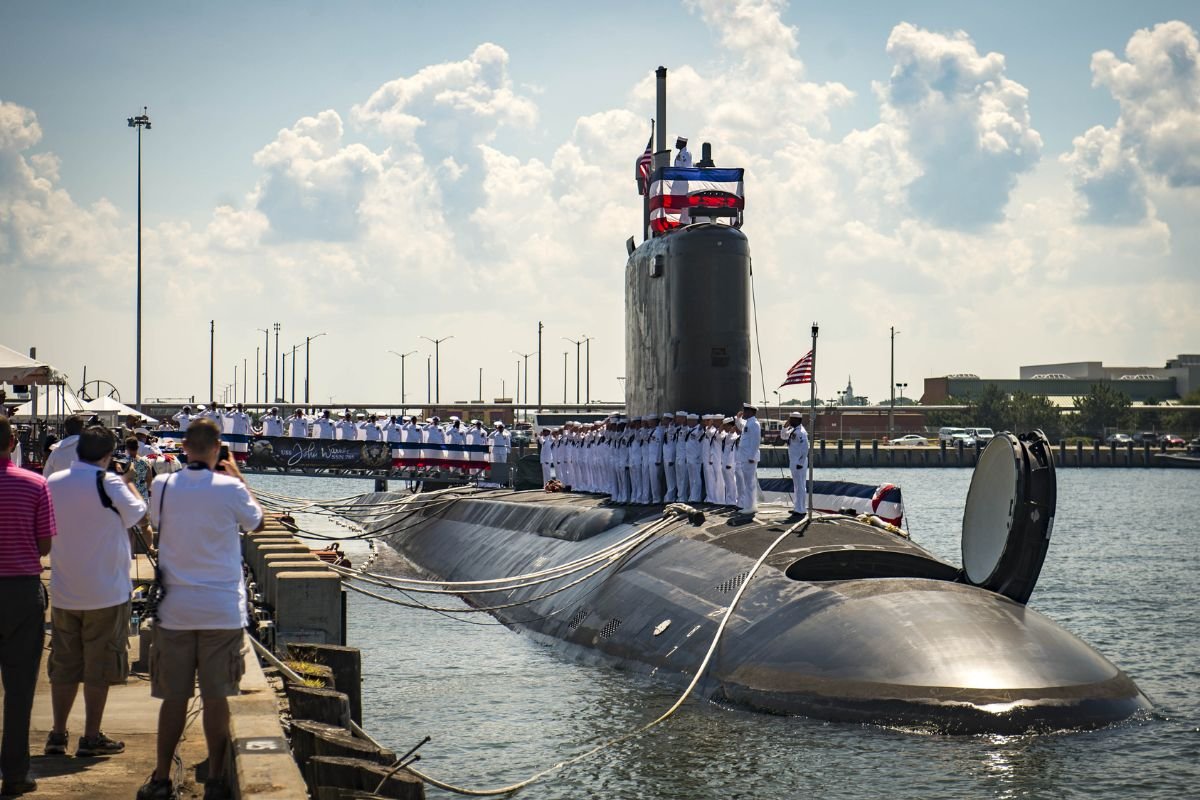
Credit: U.S. Navy / Photo by Casey Hopkins
Block III Virginia-class first drydocking at a public shipyard
USS John Warner is part of the Virginia-class Block III group, a redesign within the broader Virginia program that came out of the third acquisition contract for the class. Norfolk Naval Shipyard described this availability as the first Block III drydocking at any of the nation’s four public shipyards. That “first” matters because first-time work almost always carries learning curve penalties, planning assumptions get tested, tooling and procedures get refined, and teams have to adjust in real time.
Public shipyards operate differently than private yards. They are government-run industrial sites with long histories, complex infrastructure, and mission sets that span multiple classes of ships. When a new variant of a submarine class hits a public shipyard for the first time, it is not just the submarine that must be ready. Facilities, documentation, training, and the supply chain have to be aligned, and alignment is where projects often stumble.
Norfolk’s messaging emphasized setting aggressive goals with specific dates and keeping support aligned to what was needed and when it was needed. That framing reflects a project management reality, maintenance availabilities fail when dependencies are vague. A mast installation is not just “install the mast.” It is staging, quality checks, workforce availability, and the right parts showing up at the right time, with no surprises buried in the integration steps.
There is also a strategic subtext. The Navy is trying to prove that its public shipyards can execute complex Virginia-class work at pace, because the demand signal is not going away. Attack submarines are central to U. S. deterrence and intelligence missions, and the fleet cannot afford a world where advanced boats sit idle due to maintenance bottlenecks. A first-of-its-kind Block III drydocking that reaches a 2001-style milestone is a useful data point, but it is still one availability, not a full trend line.
Knowledge sharing with Portsmouth and Pearl Harbor supports the milestone
Norfolk’s preparation for John Warner included coordination with Portsmouth Naval Shipyard and Pearl Harbor Naval Shipyard and Intermediate Maintenance Facility, two organizations with prior experience executing Virginia-class maintenance availabilities. That cross-yard learning is not glamorous, but it can be decisive. When a shipyard tackles a “first,” borrowing proven playbooks from other yards can prevent avoidable mistakes and shorten the learning curve.
In practical terms, knowledge sharing can cover everything from sequencing work packages to anticipating which inspections tend to uncover extra repairs. It can also include lessons about workforce loading, what specialties become chokepoints, and how to stage major events like moving a crew back aboard without disrupting ongoing industrial work. The Navy’s public shipyards are separate commands with their own cultures, so making them act like a network takes deliberate effort.
The Navy has reasons to push this approach. Submarine maintenance has been criticized for delays and capacity constraints, and the broader industrial base has had to absorb long, complicated availabilities that stretch well beyond original schedules. One widely discussed example in recent years has been the prolonged overhaul of USS Boise, a case that became shorthand for how maintenance backlogs can lock up a valuable platform for years longer than intended.
That is why this Norfolk milestone is being framed as more than a local win. If shipyards can transfer lessons quickly, the Navy can reduce variance between availabilities and avoid repeating the same painful mistakes. Still, it is fair to be skeptical about how scalable this is. Knowledge sharing helps, but it does not magically create more dry-dock space or instantly solve workforce shortages. It improves execution inside existing constraints, which is valuable, but not a total fix.
Undocking signals progress, but submarine maintenance bottlenecks remain
The Navy’s decision to spotlight a milestone “not achieved since 2001” is revealing. It implies that for more than two decades, Norfolk Naval Shipyard has not undocked a submarine with this exact set of major tasks already completed. That does not mean the shipyard failed for 24 years, it means the bar being celebrated is specific and hard. Still, the fact that it is news tells you something about how challenging submarine maintenance has become.
Across the submarine enterprise, delays are often tied to capacity and infrastructure. Analysts and Navy leaders have discussed the need for shipyard improvements, including renovations, expansions, and changes that improve the flow of workers and materials. Those are not quick projects. They require funding stability, long-term planning, and the ability to modernize facilities while still doing day-to-day maintenance on operational platforms.
There is also a human factor. Even with the best facilities, submarine maintenance depends on skilled trades, planners, engineers, and quality assurance specialists who can work in tight spaces under strict standards. When the workforce is stretched, schedules slip. When schedules slip, the fleet has fewer deployable submarines. That is the strategic risk hiding behind the technical language, the gap between how many submarines the Navy wants ready and how many it can realistically generate.
For USS John Warner, the near-term story is about what comes next, completing remaining work, continuing system testing, and eventually moving toward sea trials and fleet return. The broader story is whether this kind of milestone becomes routine or stays exceptional. If it becomes routine, it suggests the public shipyard system is adapting. If it stays rare, it suggests the Navy is still fighting the same structural bottlenecks, just with a few bright spots along the way.
Source:
Image: The USS John Warner (SSN-785) has reached a key milestone as Norfolk Naval Shipyard successfully completed its undocking following an Extended Drydocking Selected Restricted Availability (EDSRA) – Credit: U.S. Navy / Photo by Daniel DeAngelis
