France abruptly redirects a key naval mission as global tensions spike: inside the Jeanne d’Arc 2026 pivot.
It was supposed to be a long, carefully planned deployment stretching all the way to the Indo-Pacific.
Instead, within days, the mission changed direction.
The French Navy didn’t just adjust a route — it rewrote the purpose of an entire operation mid-flight.
And at the center of it all: a single ship that can do almost everything.
Related articles:
- France sends its only nuclear aircraft carrier, Charles de Gaulle, to the Middle East as tensions with Iran raise the stakes at sea
- France to build $13,8 billion nuclear aircraft carrier to replace Charles de Gaulle
Jeanne d’Arc: a mission built for training suddenly becomes operational
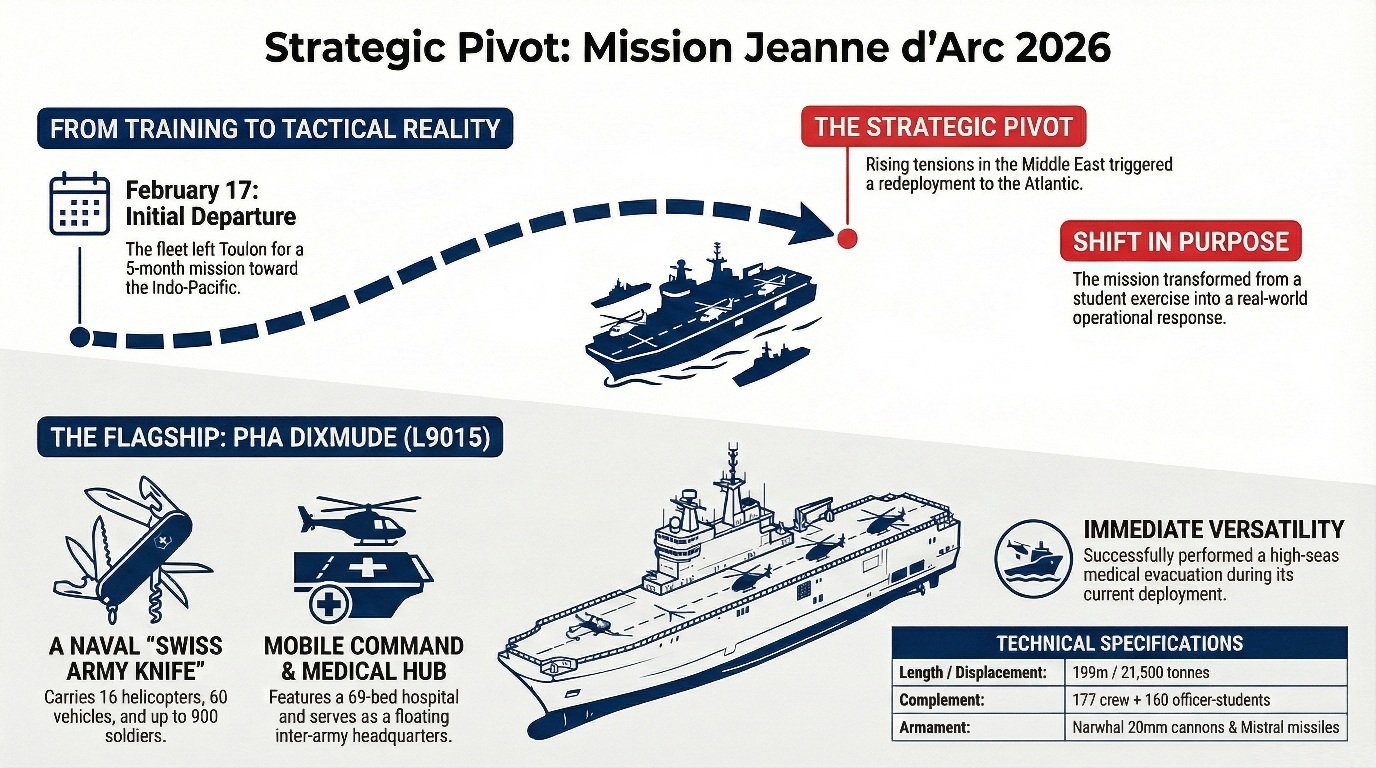
When the Jeanne d’Arc 2026 mission left Toulon on February 17, the objective was clear: train the next generation of French naval officers through a five-month deployment across multiple theaters.
Mediterranean, Red Sea, Indian Ocean, Pacific — a classic “show the flag” mission, mixed with real-world exercises.
On board, around 160 officer cadets, including international students, were meant to gradually build experience in controlled but realistic conditions.
Then, reality intervened.
By February 28, a joint U.S.–Israeli strike on Iran triggered a rapid escalation in regional tensions. The Red Sea — a key transit zone — suddenly became unpredictable.
Instead of pushing forward, the French amphibious group was held in the northern Red Sea.
That pause didn’t last long.
A strategic pivot toward the Atlantic
According to reporting relayed in your source , the French Navy made a decisive call: redirect the entire task group toward the Atlantic.
That’s not a minor adjustment — it’s a full strategic reorientation.
Three priorities drove that decision:
- Protect immediate NATO and French interests
- Maintain rapid-response capability closer to Europe
- Avoid prolonged exposure in an unstable theater
In other words, France chose readiness over symbolism.
Instead of demonstrating presence in distant waters, it prioritized being able to act fast where it matters most right now.
That trade-off says a lot about the current strategic climate.
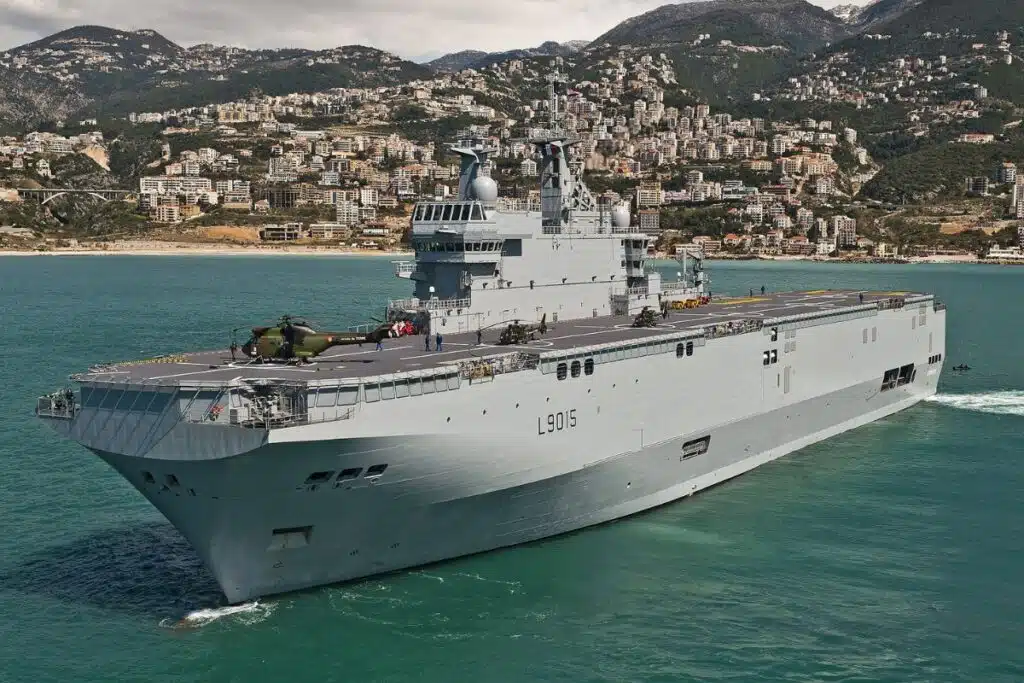
Designed for versatility, they can rapidly conduct crisis response, troop transport, medical evacuation, and humanitarian missions, while also serving as command platforms. A typical ship measures about 199 meters in length, displaces around 21,500 tons, reaches speeds of 19 knots, and carries a core crew of roughly 177 sailors along with up to 900 embarked troops.
Credit: French Navy
The ship that makes this flexibility possible
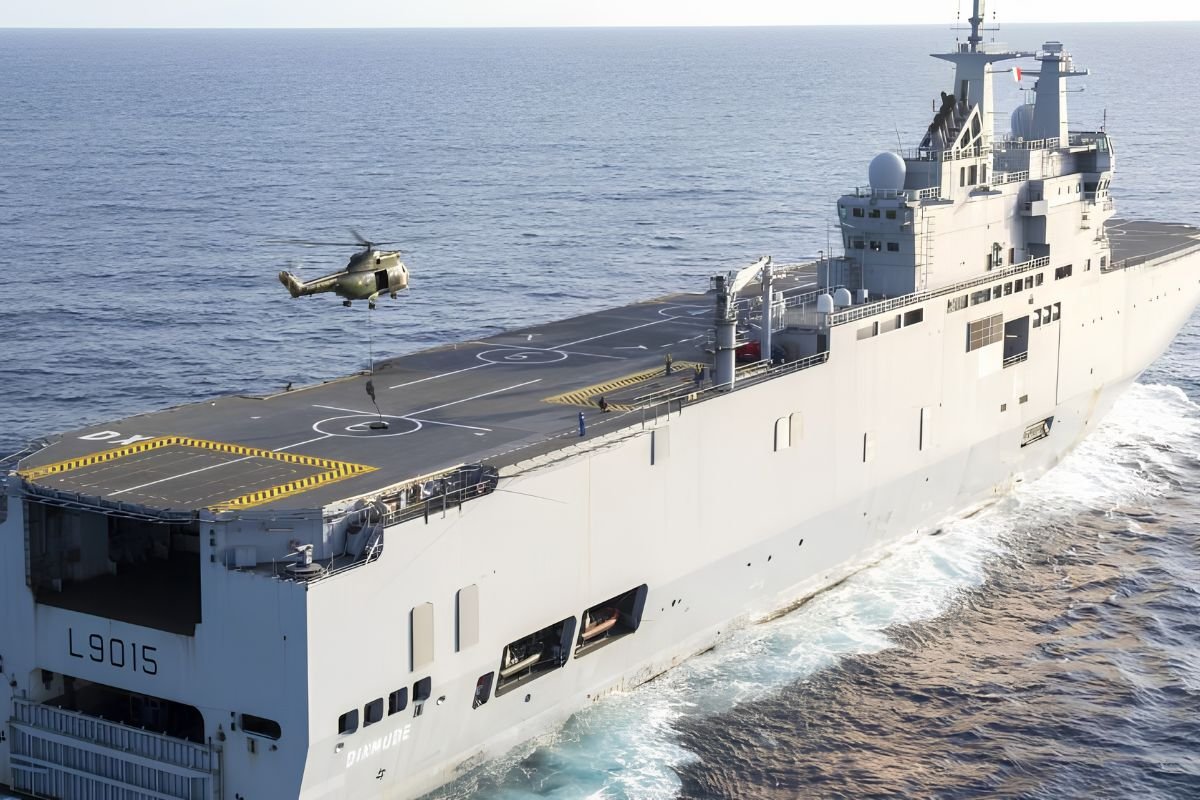
At the center of this maneuver is the Dixmude — a Mistral-class amphibious assault ship that functions as a floating command base, logistics hub, and aviation platform all in one.
Let’s put it simply: this is not just a ship, it’s a mobile projection system.
- Up to 16 helicopters (Tigre, NH90, Caracal)
- Capacity for hundreds of troops
- A floating hospital with up to 119 beds
- Amphibious landing capabilities via landing craft
- Full command-and-control infrastructure
It can deploy forces, coordinate joint operations, provide medical support, and sustain missions — all from the sea.
That’s why France can pivot this fast.
A real-world test… in the middle of the ocean
And this wasn’t just a theoretical exercise.
On March 29, near Réunion Island, the task group was called into action for a real emergency.
A distressed sailor aboard a commercial vessel required evacuation.
Within minutes:
- A helicopter launched from the Dixmude
- A doctor was deployed on-site
- A complex hoist operation was conducted at sea
- The injured sailor was evacuated to a hospital in Saint-Denis
This is where the concept becomes tangible.
The same ship training future officers one day becomes a life-saving asset the next.
That dual-use capability — military and humanitarian — is exactly what modern navies are built around.
Training under pressure: the unexpected benefit
For the cadets onboard, this mission just changed completely.
What was designed as a structured learning journey is now something much more intense.
They are suddenly dealing with:
- Real geopolitical instability
- Rapid decision-making cycles
- Operational constraints and uncertainty
- Coordination in a shifting allied environment
That’s not classroom learning anymore.
That’s immersion.
And historically, that’s how military leaders are actually forged.
A signal about modern naval strategy
This episode highlights something deeper than a simple redeployment.
Modern naval power is no longer about being everywhere — it’s about being able to adapt instantly.
The Jeanne d’Arc mission shows:
- Planning cycles can collapse in days
- Strategic priorities can shift overnight
- Flexibility matters more than long-term scripting
And platforms like the Dixmude are built exactly for that world.
Because in today’s environment, the real question is no longer where you planned to go.
It’s how fast you can change course when everything shifts.
Sources:
- Ministry of the Armed Forces (France), “Amphibious helicopter carrier (PHA)” (published 2026),
https://www.defense.gouv.fr/marine/forces-surface/porte-helicopteres-amphibie
official French Navy presentation page detailing the capabilities, missions, and technical characteristics of amphibious helicopter carriers (PHA), including their role in power projection, crisis response, and joint operations. - Ministry of the Armed Forces (France), “Jeanne d’Arc 2026 mission departs from Toulon” (published February 23, 2026),
https://www.defense.gouv.fr/operations/actualites/mission-jeanne-darc-26-appareille-toulon
official article announcing the departure of the Jeanne d’Arc 2026 mission, outlining the training objectives for officer cadets, planned deployment areas, and the naval assets involved in this long-duration operational training cruise.
