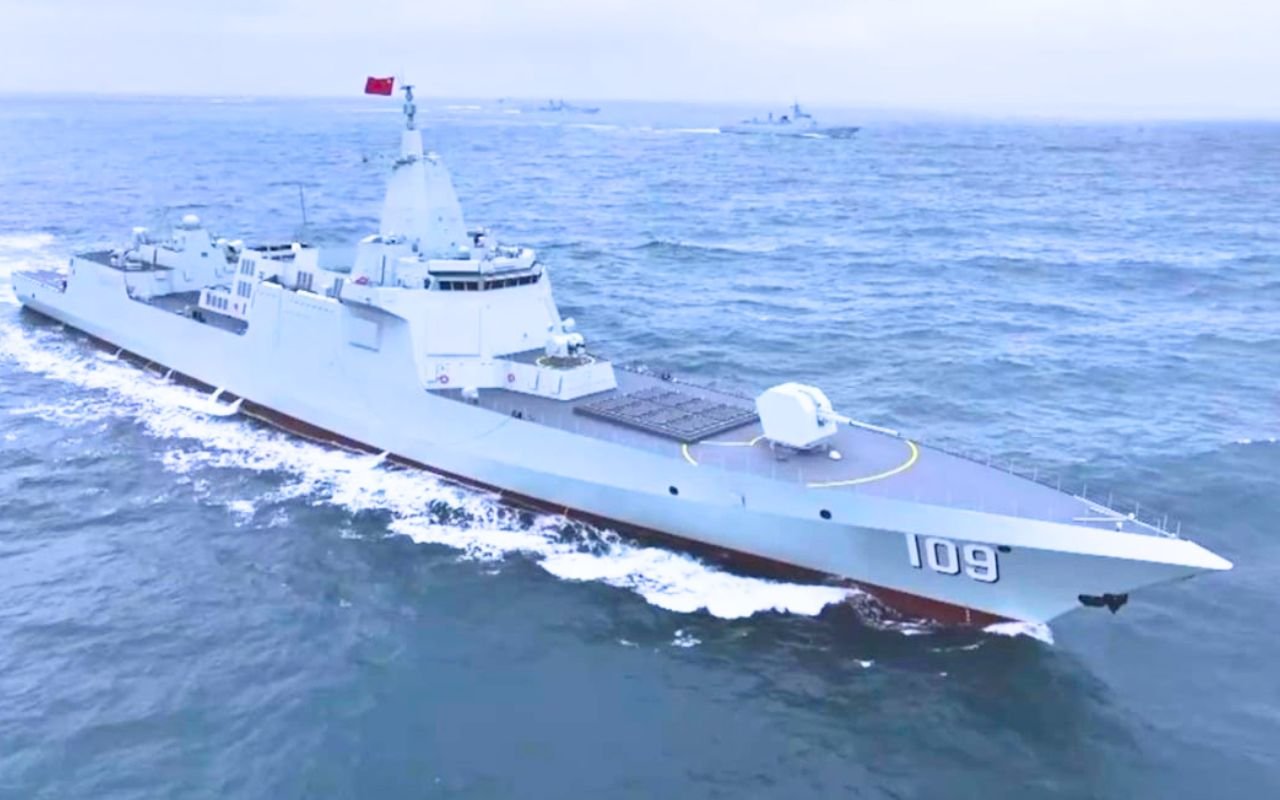
China’s navy takes a giant leap with two new Type 055 super destroyers, signaling a sharp rise in maritime power and strategic reach.
The unveiling of two advanced Type 055 destroyers, Dongguan and Anqing, marks a pivotal moment in China’s naval ambitions. These warships represent the cutting edge of the People’s Liberation Army Navy’s (PLAN) surface combatant capabilities, reinforcing China’s ability to project power far beyond its shores. The rising fleet underscores Beijing’s commitment to modernizing its naval forces as tensions escalate in key maritime regions.
Unmatched multi-role capabilities of the Type 055 large destroyers
The Type 055 destroyers, displacing roughly 10,000 tons, stand out for their impressive versatility, able to take on air defense, anti-ship, anti-submarine, and land attack missions. Unlike traditional destroyers, they approach cruiser-level combat power with a sophisticated sensor suite and advanced weaponry, making them a formidable asset in China’s maritime arsenal. These warships feature a stealthy superstructure equipped with the latest phased array radars and combat management systems, enabling simultaneous detection and engagement of multiple targets. The vertical launch system (VLS) cells allow them to deploy a range of missiles including surface-to-air, cruise missile, and anti-ship variants, accentuating their multi-role nature. In practical terms, this means a single Type 055 destroyer can escort aircraft carriers, conduct fleet air defense, support amphibious assaults, or launch precision strikes against land-based objectives far inland. It significantly elevates the PLAN’s operational flexibility, allowing China to operate independently or as the spearhead of a larger naval task force across the vast expanses of the Pacific and South China Sea. China has already deployed a fleet of ten such destroyers, with more under construction, reflecting an aggressive expansion plan aimed at controlling sea lanes and asserting regional dominance. The operational range, coupled with potent multi-domain weapon systems, makes these vessels key players in upcoming maritime scenarios.
Strategic implications for regional and global naval balance
The induction of Dongguan and Anqing into service doesn’t just represent an expansion in numbers; it signifies a profound strategic shift in naval balance, especially in Asia-Pacific waters. These super destroyers empower China with enhanced blue-water naval capabilities, challenging the longstanding maritime superiority of regional neighbors and Western navies. In disputed waters like the South China Sea, the presence of multiple Type 055 destroyers can serve as a powerful deterrent against rival states and influence freedom of navigation operations. Their ability to conduct simultaneous air and sea defense greatly boosts defensive postures around critical maritime claims, unsettling the status quo. Moreover, these vessels are instrumental in forming the backbone of carrier strike groups, enhancing China’s capacity to protect its aircraft carriers and maintain prolonged high-seas military presence. This capability forces navies such as the US Navy and Japan Maritime Self-Defense Force to reconsider tactical planning, given the advanced electronic warfare and anti-ship systems aboard Type 055 ships. The Type 055 destroyers’ long-range missile capabilities enable China to threaten military and logistical targets at distances previously unattainable for surface combatants of this class. This increases China’s leverage in regional disputes and potentially shifts the strategic calculus in broader Indo-Pacific security frameworks.
Technological innovations fueling PLAN’s maritime edge
One cannot understate the technological leaps embedded in the Type 055 destroyers compared to earlier Chinese vessels. Incorporating cutting-edge sensors, propulsion, and weapons systems, these ships embody the PLA Navy’s rapid modernization ethos. The integrated power system allows for efficient propulsion and energy management, boosting range and maneuverability without compromising performance. Their radar arrays provide robust 360-degree coverage, detecting targets at extended ranges while resisting electronic countermeasures, an increasingly vital advantage in modern naval warfare. Further, the modular design simplifies upgrades and the integration of future technologies such as directed-energy weapons or next-gen missiles. The ships employ advanced electronic warfare suites capable of jamming or deceiving enemy sensors, giving the PLAN a distinct advantage in contested environments. China is notably the only country in Asia currently fielding destroyers with VLS cells numbering over 120, indicating firepower rivaling the largest Western cruisers and destroyers. The balance of offensive and defensive systems means these ships can engage threats in multiple domains: air, surface, and undersea. Development of these capabilities is supported by extensive research from Chinese defense manufacturers with backing from state agencies, reflecting a national commitment to surpassing global naval benchmarks.
Deployment patterns and regional training exercises highlight PLAN’s ambitions
The operational deployment of Type 055 destroyers reveals a calculated effort by China to showcase growing naval power and command over vital sea lanes. Three ships—Nanchang, Zunyi, and Yan’an—have been observed conducting separate training exercises in different maritime theaters including the Yellow Sea, South Pacific, and South China Sea. These deployments demonstrate China’s commitment to ensuring readiness across a range of operational environments, from littoral zones to open ocean waters. Multi-domain drills involving anti-submarine warfare, missile defense, and fleet coordination are designed to bolster the PLAN’s ability to conduct complex missions independently or within joint task forces. Such training also serves as a signal to regional and global actors about China’s growing confidence and capability to disrupt or respond to challenges swiftly. The East Sea Fleet’s anticipation of receiving its first batch of Type 055 destroyers also indicates a strategic distribution of these vessels to cover key maritime fronts.
This tactical dispersion alongside continuous upgrades emphasizes a doctrine pivot toward long-range maritime dominance and power projection, rather than just coastal defense—challenging historical naval paradigms in the region.
- Different regional fleet assignments maximize patrol coverage and stratify response capabilities.
- Advanced integration with carrier groups enhances force multiplication.
- Iterative training boosts crew proficiency in modern naval warfare tactics.
Type 055 destroyer class compared internationally: power and perception
Compared to Western equivalents, the Type 055 occupies a unique position. Although American Arleigh Burke-class destroyers and British Type 45 vessels boast advanced Aegis and Sea Viper systems respectively, the Type 055’s sheer size, combined with its missile cell count and multi-mission roles, elevate it near cruiser status in operational terms. International navies tend to view the Type 055 as a powerful deterrent, prompting strategic recalibrations especially for countries reliant on naval defense. The U.S. Navy classifies it technically as a cruiser, underscoring its large displacement and extensive combat systems. Besides sheer firepower, the Type 055’s advanced electronic warfare and sensor fusion capabilities offer China an edge in gathering intelligence and electronic dominance during combat. This forces potential adversaries to innovate countermeasures, accelerating a naval arms race focused on information superiority. Beyond military comparisons, the psychological impact of China fielding modern, multipurpose super destroyers alters regional diplomatic negotiations by demonstrating a credible force behind China’s maritime claims and ambitions.
| Feature | Type 055 Destroyer | Arleigh Burke-class Destroyer | Type 45 Destroyer |
|---|---|---|---|
| Displacement (tons) | ~10,000 | ~9,200 | ~8,500 |
| Vertical Launch System Cells | 112-128 | 96 | 48 |
| Main roles | Multi-role (Air, surface, subsurface, land attack) | Multi-role (Air, surface, subsurface) | Air defense focus |
| Radar systems | Advanced phased array radar | Aegis SPY-1D(V) | Sea Viper |
What sets the Type 055 apart from other destroyers?
The Type 055 stands out due to its large 10,000-ton displacement, extensive missile capacity exceeding 120 VLS cells, and multi-mission combat capabilities including advanced radar and electronic warfare systems, pushing it near cruiser-level performance.
How many Type 055 destroyers does China currently operate?
As of 2026, China operates a fleet of ten Type 055 destroyers, with additional vessels under construction to further expand their strategic reach.
What is the strategic importance of the Type 055 in Asia-Pacific?
The Type 055 significantly enhances China’s ability to project power across disputed regions like the South China Sea and beyond, complicating naval operations for rival regional forces and promoting Chinese maritime dominance.
Are there any similar ships in other navies?
Compared to Western counterparts like the U.S. Arleigh Burke-class and the British Type 45, the Type 055 is larger with more missile cells and broader mission roles, often being classified as a cruiser by naval analysts.
What future developments might enhance the Type 055’s capabilities?
Ongoing upgrades could include integration of directed-energy weapons, enhanced electronic warfare technology, and new missile types, maintaining the Type 055’s edge in multi-domain naval warfare.
