
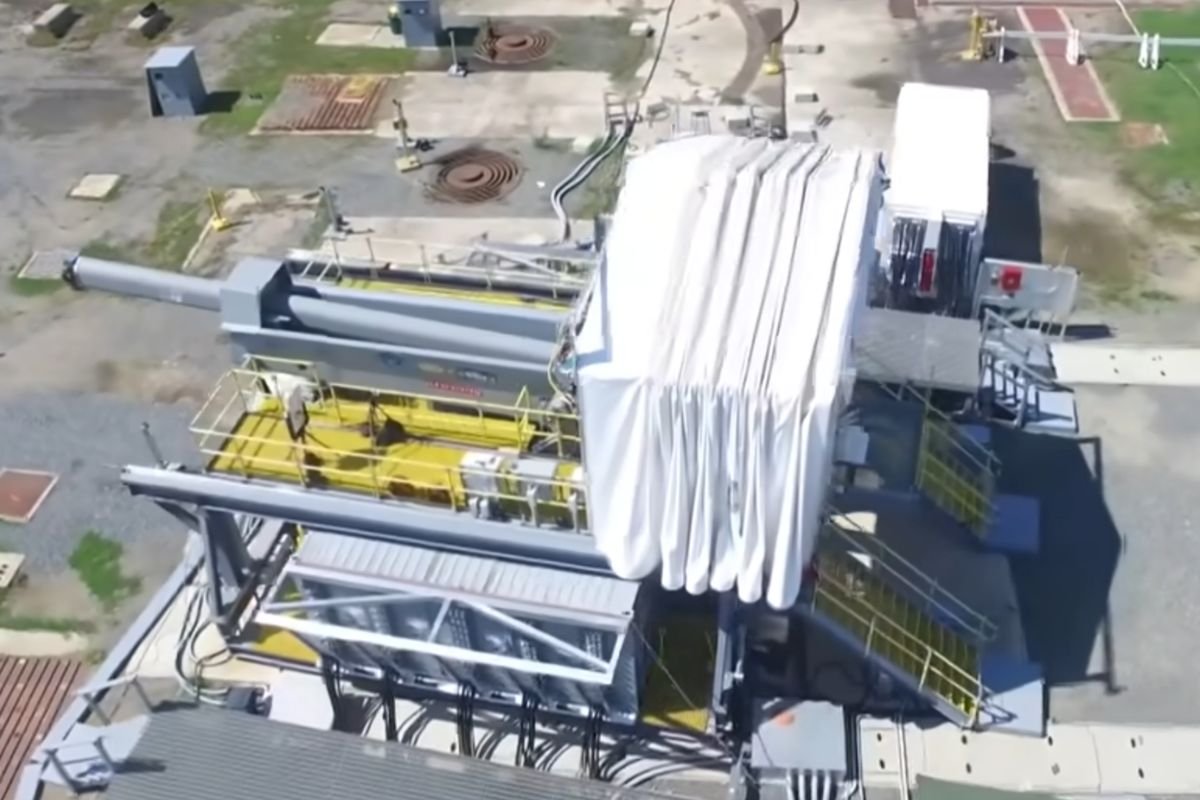
The U.S. Navy quietly reignites trailblazing railgun experiments at White Sands, New Mexico, signaling a possible renaissance in electromagnetic weaponry that could shift naval combat paradigms.
After years apparent dormancy, the U.S. Navy has resumed live-fire testing of its electromagnetic railgun at the White Sands Missile Range in New Mexico. This development emerges amid global naval powers’ pursuit of ultra-fast, long-range projectile technologies capable of enhancing fleet defense and offensive capabilities. The renewed efforts highlight the Navy’s persistent drive to overcome former obstacles, leveraging cutting-edge advancements in materials science and energy storage to eventually field a weapon system promising unprecedented range and impact speeds without traditional explosive propellants.
The technological revival of the U.S. Navy’s electromagnetic railgun at White Sands
The electromagnetic railgun is a revolution in naval artillery, employing powerful magnetic fields generated by electrical currents to accelerate a conductive projectile along a pair of rails. Unlike traditional guns relying on chemical propellants, railguns achieve muzzle velocities exceeding Mach 7, translating to projectile speeds over 8,575 km/h. This immense speed offers the potential to strike targets stationed over 160 km away with remarkable precision and dramatically reduced flight times.

After extensive foundational research, the U.S. Navy shifted railgun testing to White Sands Missile Range in New Mexico, where conditions and infrastructure support rigorous live-fire trials. This site, ideal for controlled testing due to its expansive space and controlled airspace, allows the Navy to refine the gun’s components and firing protocols. Test phases now incorporate innovative barrel materials to mitigate erosion caused by immense electrical currents and heat, along with advances in capacitors and pulsed power systems ensuring stable, repeated shots.
Resuming testing here reflects the Navy’s renewed confidence in addressing the longstanding challenges that sidelined the railgun program despite an investment exceeding €450 million. Early trials at White Sands focus on validating the endurance of system components under multiple high-energy firings and assessing projectile aerodynamics and guidance in high-velocity settings. These results will determine whether the railgun moves beyond experimental stages into active fleet deployment concepts.
Overcoming the historical barriers that stalled the railgun development
Despite its promise as a game-changing naval weapon, the railgun confronted several near-insurmountable technical and operational obstacles over the past decade. Chief among these were the intense wear on the barrel rails, which degraded rapidly from repeated firings due to extreme electrical and thermal stresses. This limited the number of shots achievable before costly rail replacement was necessary, undermining the weapon’s practical viability for sustained combat operations.
Power supply was another critical bottleneck. Delivering the massive pulsed electrical energy—on the order of tens of megajoules—required bulky capacitors and specialized power infrastructure on ships. Integrating such systems without compromising space, weight, or other onboard capabilities remained a major engineering hurdle. Additionally, thermal management posed challenges since the system generated considerable heat requiring effective cooling solutions to maintain operational reliability.
These difficulties coincided with shifting naval priorities and budgeting decisions. Some critics questioned the railgun’s cost-effectiveness compared to missiles, noting the inert projectiles’ smaller warheads. Nonetheless, the theoretical advantages of railguns—such as lower per-shot cost, extended range, and extreme projectile speed complicating enemy defenses—kept interest alive. Recent advances in materials technology, high-density power storage, and smart projectiles show promise in overcoming these historical pitfalls.
Retooling the program at White Sands enables the Navy to methodically tackle these issues, experimenting with novel rail coatings, modular power units, and improved projectile designs to balance performance with durability. This iterative process is crucial for transforming the railgun from costly experimental technology into a reliable asset suitable for the complexity of modern naval warfare.
Implications of railgun technology for future naval defense and offensive strategies
The strategic impact of operational railguns would be profound, reshaping both defensive and offensive naval doctrines. On defense, railguns could offer a rapid-response, cost-effective layer against incoming threats like anti-ship missiles and aircraft by firing high-velocity projectiles which are difficult to detect and intercept due to their speed and ballistic flight path. This capability contrasts with expensive missile interceptors, providing a potential volume-of-fire advantage during saturation attacks.
Offensively, railguns enable precise, long-range attacks against surface ships, shore installations, and potentially even airborne targets, all while carrying non-explosive projectiles accelerated purely by electromagnetism. This eliminates the risks associated with explosive warheads onboard ships and may simplify logistics by standardizing munitions storage. Moreover, the high projectile velocity significantly reduces enemy reaction time, improving survivability and increasing the chances of mission success.
As rivals such as China and Japan pursue their own electromagnetic weapon programs, the U.S. Navy must advance railgun development to maintain technological leadership. For instance, China claims successful naval railgun test firings on destroyers, raising concerns about a strategic imbalance. The renewed tests in New Mexico reflect the Navy’s intent to integrate cutting-edge offensive systems that complement evolving multi-domain warfare concepts, including networked targeting, artificial intelligence-assisted firing solutions, and hybrid missile-railgun batteries.
The role of materials science and energy storage breakthroughs in progressing railgun technology
Critical to the viability of the railgun are recent innovations in materials science, specifically metals and composites that can endure the extreme conditions present during electromagnetic acceleration. Engineers are testing specialized alloys and ceramic coatings that enhance the durability of rails and barrels, drastically extending service life beyond previous limitations. These materials reduce wear and thermal degradation, which historically curtailed firing rates and overall weapon reliability.
Parallel advancements in energy storage have been transformative. The railgun demands rapid release of massive energy bursts, necessitating compact, high-capacity capacitors or alternative pulsed power systems. New generations of supercapacitors and power electronics now enable faster charging cycles and safer storage, allowing shipboard systems to manage repeated shots without extensive downtime. Furthermore, support systems for heat dissipation using advanced cooling technologies ensure thermal stability during sustained operations.
These scientific breakthroughs dovetail with evolving projectile technology, including smart guided rounds that stabilize trajectory and improve hit probability despite the extreme velocities involved. Combining these elements points toward a railgun system capable of integrated deployment aboard modern warships, poised to revolutionize naval weaponry with highly autonomous, rapid-fire electromagnetic artillery.
Challenges ahead and the strategic timeline for shipboard railgun deployment
While the Biden administration’s renewed funding and focus have accelerated development, multiple milestones remain before railguns can join active naval arsenals. Testing at White Sands is a critical step to validate endurance and reliability, yet integration aboard ships entails additional design challenges. Warships must accommodate not only the gun system but the immense power supply and cooling mechanisms, all within limited space and weight budgets.
Experts estimate this integration will take several years, with at-sea tests expected to follow successful ground trials. Different classes of rails may be experimented with to optimize performance under maritime conditions where saltwater corrosion and vibrations complicate maintenance. The feedback from these trials will influence final design decisions and suitability for various operational roles.
Moreover, tactical doctrine must evolve to leverage railguns effectively within combined arms approaches, synchronizing with missile systems, electronic warfare, and unmanned platforms. The Navy’s future fleets could feature hybrid weapon systems, combining the railgun’s kinetic advantages with missile versatility for layered defense and destructive power.
| Year | Testing Location | Milestone | Expected Outcome |
|---|---|---|---|
| 2023 | White Sands Missile Range | Resumption of live-fire railgun tests | Validate system components and firing protocols |
| 2024-2025 | White Sands Missile Range / Pacific Northwest | Extended endurance and at-sea testing | Assess multi-shot endurance, begin ship integration trials |
| 2026-2028 | US Navy fleet vessels | Operational deployment trials | Finalize integration and tactical doctrine |
Challenges staying ahead of competing technologies and navigating budget constraints remain persistent hurdles, but the Navy’s strategic commitment ensures that railgun technology continues progressing towards practical utility in naval warfare.
The critical advantages of electromagnetic railguns summarized in key points
- Ultra-high projectile speeds: Muzzle velocities surpassing Mach 7 enable rapid target impact and short reaction times for enemies.
- Extended engagement ranges: Potential to hit targets over 160 km away, far exceeding conventional naval guns.
- Reduced ammunition logistics: Non-explosive projectiles simplify storage and eliminate explosive hazards aboard ships.
- Cost-effective firepower: Lower cost per shot compared to missiles enhances fleet fire volume and sustainability.
- Multi-role capability: Effective against missiles, aircraft, ships, and shore targets with kinetic energy alone.
- Innovative energy and materials synergies: Advances in capacitors and rail materials improve rate of fire and durability.
What is the main advantage of the Navy’s railgun?
The railgun delivers projectiles at extremely high speeds (Mach 7+), allowing for long-range, precise strikes with faster impact times than traditional artillery or missiles.
Why has railgun development been delayed for years?
Technical challenges such as rapid barrel erosion, massive power requirements, and thermal management issues caused delays despite heavy investment.
Are other countries developing similar railgun technologies?
Yes, nations like China and Japan have ongoing programs testing electromagnetic railguns, sometimes aboard naval vessels.
When is the railgun expected to be deployed on U.S. Navy ships?
After ongoing tests at White Sands and at-sea trials in the next several years, the railgun could see limited operational deployment between 2026 and 2028.
How does the railgun improve naval defense?
By firing high-speed projectiles that are challenging to detect and intercept, railguns offer a cost-effective method to defend fleets against missile and aircraft attacks.
