The complex interplay of U.S. military deployments in the Middle East and Asia is sending powerful deterrent signals that may be restraining China’s ambitions regarding Taiwan.
With multiple crises unfolding globally, the attention of major powers like the United States is more divided than ever. But rather than tempting China to strike Taiwan amid perceived U.S. distractions, recent analyses suggest that Beijing remains cautious. This caution reveals much about how ongoing conflicts, especially in Iran, influence Chinese strategic calculations and the delicate balance of power in the Indo-Pacific region.
How U.S. Multitheater engagements shape China’s military calculus in Asia
The United States presently juggles several critical military commitments, most prominently the complex operations in Iran, alongside activities in Venezuela and Cuba. This broad dispersion of forces has raised questions about Washington’s ability to maintain robust regional deterrence in Asia.
For instance, the redeployment of the USS Abraham Lincoln aircraft carrier strike group from East Asia to the Middle East underscores Washington’s military stretching. One might assume such a shift weakens U.S. naval presence near Taiwan and the wider Indo-Pacific, potentially inviting Beijing to consider an invasion.
Yet, several key factors complicate this view. Notably, allied Asian nations like Japan, Australia, and the Philippines have dramatically expanded their military capabilities over the past decade. Japan, for example, operates over 150 advanced F-35 fighters, including the carrier-capable F-35B variant, along with upgraded F-15 squadrons, making its air power formidable.
Aside from aircraft, Japan also fields two light aircraft carriers, the JS Kaga and JS Izumo, which enhance its maritime presence and the protection of regional interests. These forces are complemented by Japanese troops stationed in the Philippines and other complex joint defense arrangements that bolster deterrence.
The combined effect creates a layered defense network. Beijing knows any large-scale Taiwanese invasion would encounter a coalition of modern weaponry backed by well-trained forces. This diminishes the appeal of a reckless gamble, despite U.S. forces being partially tied up elsewhere.
Adding to this, South Korea’s substantial stockpiles of fighter jets and indigenous aircraft manufacturing capabilities further complicate potential Chinese calculations. Their involvement could escalate any conflict, tipping the regional balance toward the defenders.
Technological edge and allied integration as deterrents
Japan’s embrace of fifth-generation fighter jets, combined with Australia’s and the Philippines’ enhancements, create a technological cushion that Beijing cannot ignore. These advancements not only improve defense capabilities but enable swifter and more precise joint responses.
The recent exercises integrating Marine Corps F-35Bs and amphibious assault ships demonstrate the capability to rapidly launch mobile operations across the Pacific. Exercises such as Noble Fusion highlight the ability of U.S. and allied forces to coordinate lethal sea-denial operations, protect critical maritime territories, and project air power from forward-deployed amphibious vessels. This integration intimates what form resistance might take in a cross-strait conflict.
Impact of precise U.S. strikes on China’s willingness to initiate conflict
The ongoing Iran conflict has exposed a new era of American military precision and effectiveness. U.S. air-launched weapons used against Iranian targets have demonstrated unprecedented accuracy, which has understandable psychological impact on Beijing’s military strategists.
Iran’s air-defense systems, roughly analogous in capability to parts of China’s radar and missile network, have proven largely ineffective against these strikes. Such a demonstration casts doubt on China’s confidence in defeating Taiwan’s defenses swiftly—especially under the watchful eye of U.S. and allied forces equipped with comparable technologies.
This “accuracy shock” serves as a powerful deterrent. If China’s leadership perceives that their own air defenses and missile systems could be outmatched or neutralized quickly, the risk calculus alters significantly. Washington’s operational success in a heavily fortified environment like Iran signals that Beijing needs to carefully weigh the enormous costs of a cross-strait invasion.
Moreover, current U.S. munitions stockpiles and supply chain resilience play into China’s calculation. Only if American munitions stocks were to run perilously low, or if U.S. operations bogged down, might Beijing feel emboldened. But as things stand, China’s military commanders are watching closely and appear inhibited from launching large-scale offensive operations.
Upcoming political summits and arms deals influencing Chinese strategies
The political landscape ahead will profoundly influence Beijing’s future decisions. A highly anticipated summit between Chinese President Xi Jinping and former U.S. President Donald Trump is scheduled for the end of March. The tone and outcomes of their talks—especially regarding Taiwan’s defense posture—will be scrutinized for signals of future policy shifts.
The delayed approval of a vital U.S.-Taiwan arms deal is another critical piece in this unfolding scenario. This deal, once ratified, could significantly enhance Taiwan’s military capability, making Chinese aggression even less attractive due to increased resistance capacity.
Japan’s ongoing post-election discussions about boosting defense budgets will also factor into Beijing’s threat assessment. Should Japan opt to accelerate arms acquisitions and deepen alliance integrations with the U.S., China may perceive increasing costs outweigh any potential benefits from aggressive moves.
The confluence of these political and military developments forms a multi-layered deterrence web. It ensures Beijing’s decisions are not made in isolation but in anticipation of prolonged strategic responses involving multiple actors. The complexity reflects efforts by regional and global players to maintain stability amid tensions.
Japan’s military transformation and its implications for Taiwan’s defense
Japan’s defense modernization is a game-changer in the Indo-Pacific’s security dynamic. Its expanding fleet of F-35s, progress in developing light aircraft carriers, and increased troop deployments in strategic locations like the Philippines enhance regional deterrence significantly.
JS Kaga and JS Izumo aircraft carriers provide Japan with flexible power projection capabilities. The deployment of these ships, combined with a commitment to integrating advanced carrier-capable fighters, means that Japan can rapidly support Taiwan or impose sea-denial operations in critical waterways.
Japan also maintains nine military bases with forces stationed in the Philippines, reinforcing both countries’ defense cooperation and readiness. This unprecedented force posture fills gaps that the U.S. might face when stretched thin, emboldening regional alliances and complicating Chinese military calculus.
Some defense experts suggest that Japan’s light carriers and air combat fleet provide the foundation for a credible rapid-response force in any Taiwan Strait contingency. This complements U.S. naval operations and expands the zone of resistance beyond American direct involvement.
Such capabilities are not merely theoretical; recent joint exercises have demonstrated the ability to conduct complex amphibious and air operations, increasing interoperability and deterring potential aggression through visible alliance strength.
List: Key military assets strengthening Indo-Pacific deterrence against China
- 150+ F-35 fighter jets operated by Japan (including carrier-capable F-35Bs)
- Two Japanese light aircraft carriers: JS Kaga and JS Izumo
- Troop deployments and military bases in the Philippines supporting rapid regional response
- Significant South Korean fighter jet stockpiles and domestic aircraft production
- U.S. Marine Corps amphibious assault ships equipped to deploy F-35B fighters
- Ongoing U.S.-Taiwan arms sale pending approval to boost Taiwan’s defenses
- Advanced American air-launched munitions demonstrating unprecedented precision in Middle East conflicts
Table: timeline of critical events impacting China’s Taiwan strategy
| Date | Event | Potential influence on China |
|---|---|---|
| March 2026 | Xi Jinping – Donald Trump summit | Could signal U.S. resolve on Taiwan defense, affecting China’s strategic calculus |
| Mid-2026 | Resolution of U.S.-Taiwan arms sale | Strengthening Taiwan’s military may deter any Chinese invasion plans |
| Post-2026 Japanese election | Possible defense budget increase and force expansion | Enhanced Japanese capabilities raise invasion costs for China |
Why hasn’t China invaded Taiwan despite perceived U.S. distractions?
China’s calculations take into account the strong regional deterrence built by U.S. allies like Japan and Australia, as well as the demonstrated precision and military readiness of U.S. forces, which diminish the appeal of an invasion.
How do U.S. allies contribute to deterring Chinese aggression?
Allies in Asia have significantly modernized their militaries, fielding advanced fighter jets, aircraft carriers, and forward-deployed troops. Their combined efforts create a multi-layered defense that challenges any large-scale Chinese military action.
What role do upcoming political events play in Taiwan’s security?
The Xi-Trump summit, the U.S.-Taiwan arms deal, and Japan’s defense budget decisions will collectively influence the strategic environment, either reinforcing deterrence or signaling shifts that could prompt new actions from Beijing.
How has the Iran conflict influenced Chinese strategic thinking?
The Iran conflict showcased the effectiveness of U.S. precision strikes against air defense systems similar to China’s. This ‘accuracy shock’ discourages China from initiating risky military operations such as invading Taiwan.
Could a depletion of U.S. munitions stocks affect China’s choices?
If the U.S. military’s munitions supplies were severely exhausted, making it appear weaker in ongoing conflicts, China might reassess and consider taking more aggressive actions. Currently, this scenario is unlikely.
Source: https://www.taiwannews.com.tw/news/6316631
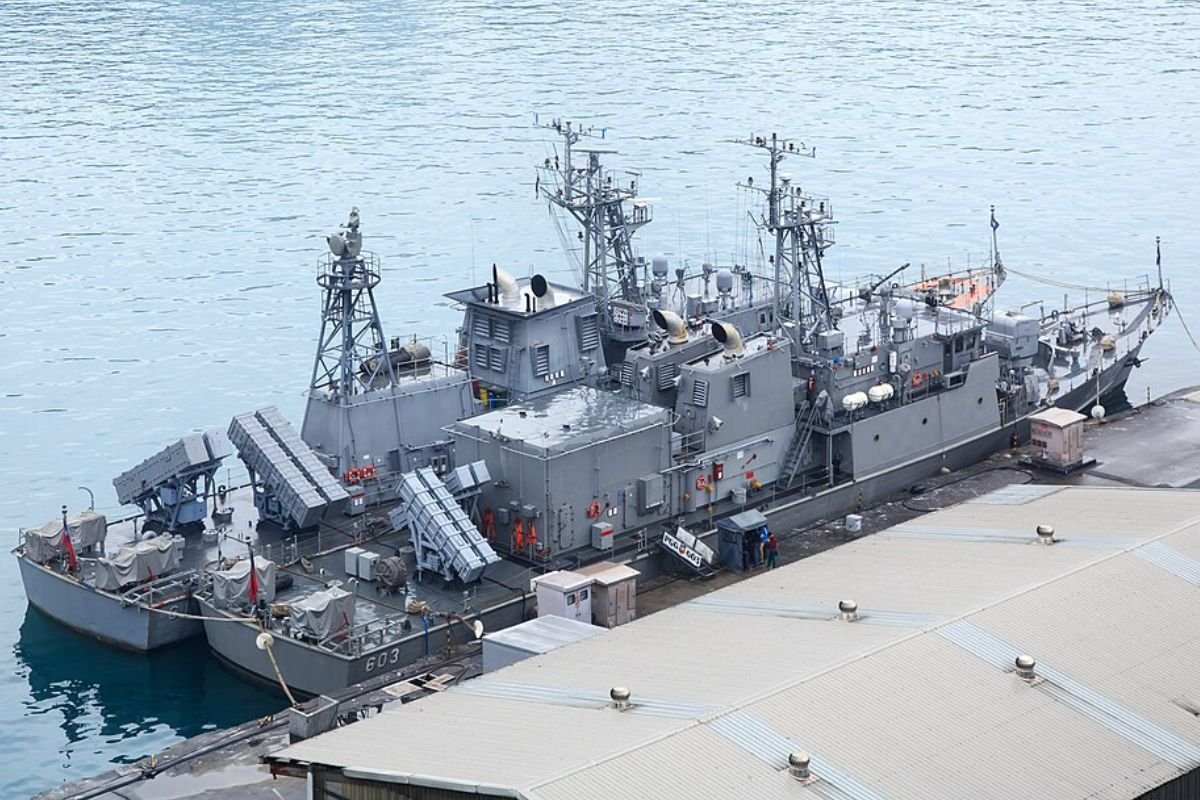
Image: Two Ching Chiang-class patrol ships of the Republic of China Navy—including ROCN Ching Chiang (PGG-603)—moored at the Port of Keelung, Taiwan.
The vessels are part of Taiwan’s coastal defense fleet tasked with patrol, surveillance, and maritime security operations.
