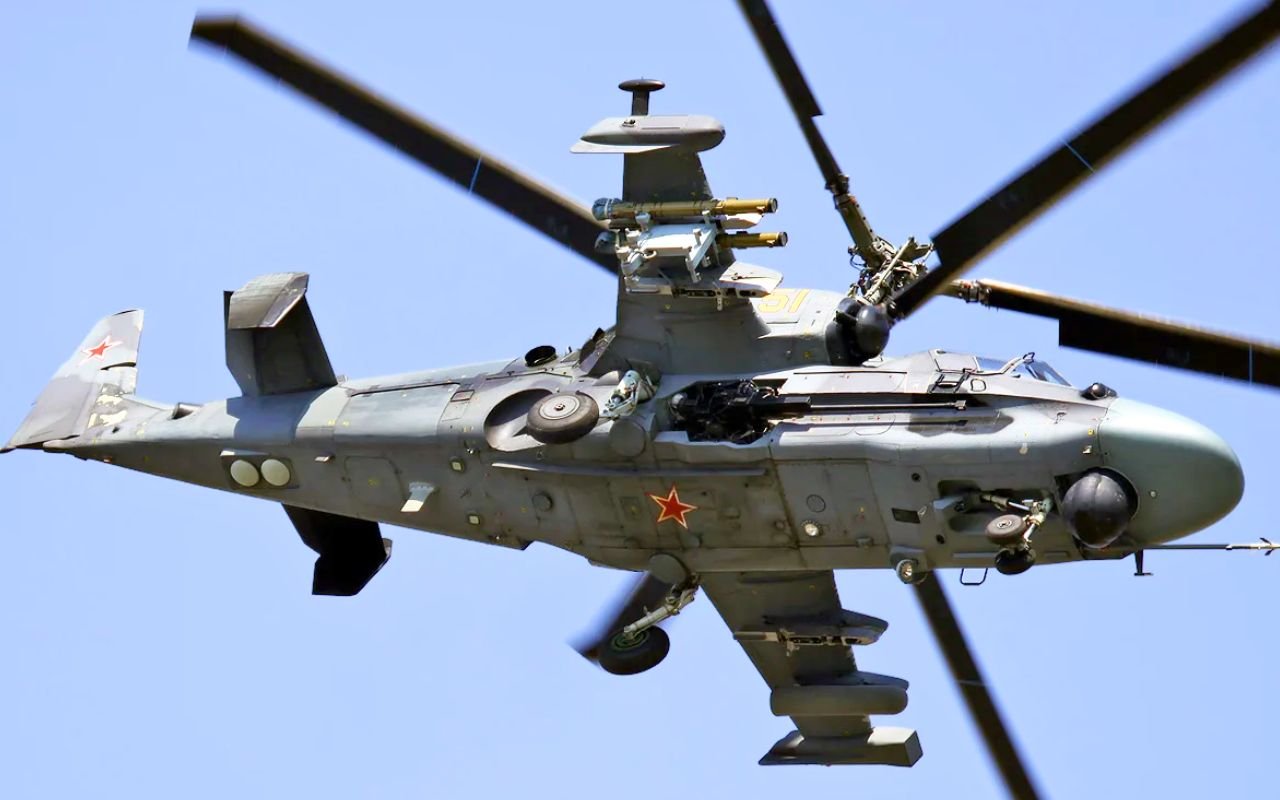
China’s growing fascination with the Russian Ka-52 attack helicopter signals a significant shift in its military strategy, especially in the context of potential conflicts in the Taiwan Strait and the broader South China Sea region.
Recent leaks from Russia’s military-industrial complex have unveiled a surge in Russian-Chinese cooperation focused on the Ka-52 “Alligator” attack helicopters. This collaboration, encompassing equipment deliveries, training, and technology transfers, reflects the strategic urgency behind China’s push to bolster its rapid response and amphibious warfare capabilities. The Ka-52’s combat performance in Ukraine has particularly captivated Chinese military thinkers, who are eager to harness the helicopter’s multi-role capabilities for use in their own operational theaters.
How the Ka-52 fits into China’s amphibious assault and air support strategy
The Chinese military’s interest in the Ka-52 is deeply rooted in its unique operational roles across Taiwan and potential hotspots in the South China Sea. Helicopters, especially attack variants like the Ka-52, constitute a critical component of China’s envisioned amphibious warfare tactics. These machines can deliver precise firepower, provide air cover to landing forces, and rapidly transport troops and materiel inland, overcoming natural and man-made obstacles that would slow conventional mechanized units.
The Ka-52 is renowned for its advanced navigation and targeting systems, allowing it to engage targets with high accuracy under all weather conditions and at night. This feature is invaluable for supporting amphibious landings where swift, exact strikes can turn the tide of battle. Moreover, China’s regional rivals, such as the Philippines and Malaysia, are upgrading their defenses with awareness of these evolving threats, pushing China to acquire superior assets.
Chinese strategists see these helicopters as force multipliers that can quickly establish aerial dominance in contested zones. Importantly, the Ka-52’s versatility complements China’s vast fleet of amphibious landing vessels like the Type 075 LHD. The ability to deploy the Ka-52 from sea platforms dramatically increases the PLA Navy’s reach and impact during island assault operations. This synergy between air and sea power is at the heart of China’s intensified focus on modern attack helicopters to alter the calculus in any future Taiwan conflict.
Leaked documents reveal intense Russia-China military cooperation on Ka-52 deliveries and local production
Behind the scenes, Russia has accelerated arms delivery to China, with leaked military-industrial documents disclosing plans to supply almost 50 Ka-52M attack helicopters. This extends beyond mere sales: Moscow is actively training Chinese specialists and aiding the establishment of local production lines. This industrial collaboration aims to ensure that China not only acquires cutting-edge helicopters but can also produce and maintain them indigenously over time.
Such a partnership is unprecedented in scale and scope. Russia, despite facing its own operational setbacks with the Ka-52s in Ukraine, touts the helicopter as one of the most advanced attack platforms globally. Recent upgrades have focused on boosting power, avionics, and weaponry to enhance combat capabilities. By transferring these improved versions to China, Russia is both deepening military ties and helping Beijing leapfrog certain technological bottlenecks.
This technology transfer is significant as it includes weapon integration, pilot training, and maintenance protocols, effectively jumpstarting China’s own attack helicopter industry. For Beijing, this could reduce dependence on foreign suppliers long-term and solidify military readiness. It also dovetails with China’s ambition to compete on a global military technology stage.
Comparing the Ka-52 to China’s indigenous helicopter programs: Strengths and gaps
China has been actively developing its own heavy attack helicopter platforms, including the Z-21 and variants of the Z-10, aiming for a blend of firepower and multirole capabilities. However, experts recognize that the Ka-52’s combat-proven platform — especially the maritime Ka-52K version designed for naval operations — offers advantages that China’s homegrown models still strive to achieve.
The Ka-52’s tandem-seat configuration with advanced crew coordination systems enables superior situational awareness, which is critical in fast-paced combat environments. Chinese versions, while improving rapidly, grapple with challenges in avionics maturity and integration of advanced missile systems equivalent to the Ka-52’s armament. Notably, the Ka-52 excels in night operations and electronic warfare environments, areas where China is seeking substantial advancements.
Moreover, the recent appearance of the Z-21, a heavily modified variant, hints at China’s attempt to incorporate key Ka-52 features while tailoring operational parameters to its specific strategic needs. Still, the direct combat feedback from Russia’s Ka-52 deployments in Ukraine offers irreplaceable insights for Beijing that its indigenous programs cannot replicate solely through development effort.
These gaps explain Beijing’s dual-track approach: accelerate indigenous innovation while leveraging Russian expertise and hardware to build a more versatile, battle-ready helicopter force capable of rapid deployment and high survivability in hostile zones.
Strategic implications for Taiwan and regional power dynamics in the South China Sea
The growing Chinese investment in Ka-52 helicopters has profound implications for regional security. Taiwanese defense planners closely watch these developments, interpreting them as a clear message of Beijing’s intent to enhance amphibious and air assault capabilities in a possible Taiwan invasion scenario. The precise strike capabilities and battlefield versatility of the Ka-52 could rapidly challenge Taiwan’s current air defense and force posture, demanding a reassessment of deterrence strategies.
Furthermore, nations bordering the South China Sea — including the Philippines, Malaysia, and Vietnam — are recalibrating their defense planning in response to China’s enhanced aviation assets. These countries could face significantly escalated aerial threats, forcing them to invest more in counter-air systems, early warning radars, and integrated regional defense collaborations.
China’s strategic moves reveal a focus not only on quantity but quality of military assets capable of projecting power beyond its shores. The Ka-52’s role extends into shaping the complex balance of power in these contested waters, acting as both a deterrent and an enabler of force projection.
This helicopter expansion underscores the evolving nature of modern warfare in Asia, where rapid mobility, precision strikes, and integrated naval-air capabilities define tactical and strategic superiority.
Why the Ka-52’s combat performance in Ukraine informs Chinese military doctrine and procurement
One of the most striking elements driving China’s interest in the Ka-52 is its operational history in Ukraine’s conflict. Despite heavy losses, the Ka-52 has demonstrated remarkable resilience and effectiveness in providing ground troops with close air support, reconnaissance, and engaging armored vehicles. Chinese analysts are dissecting these combat lessons to refine doctrine, tactics, and helicopter design adaptations for their own forces.
For instance, the repeated engagements against sophisticated anti-aircraft systems, as seen on the Ukrainian front, reveal critical survivability factors and necessitate electronic warfare enhancements. China’s focus on replicating and improving these features speaks to a determination to avoid the vulnerabilities exposed in Ukrainian combat scenarios, integrating more robust countermeasures and pilot training for all-weather, high-threat environments.
While the losses experienced have raised questions about rotorcraft vulnerability, Beijing is absorbing these insights to optimize helicopter deployment strategies, tactical maneuvering, and support integration with other branches. This real-world combat data fuels a pragmatic approach to acquiring, modifying, and deploying Ka-52s or Ka-52-derived platforms in future conflicts that may differ drastically from static war zones.
| Year | Event | Significance for China |
|---|---|---|
| 2021 | China signs contract for 36 Ka-52K naval helicopters | Marked a major step towards integrating Russian designs for naval operations |
| 2022 | Russia starts delivering upgraded Ka-52M helicopters | Boosted China’s capability to acquire advanced versions with enhanced weaponry |
| 2023 | Leaked documents reveal plans for 50+ Ka-52M deliveries and technology transfer | Signified deep military-industrial cooperation and potential indigenous production |
| 2024 | Russia publicizes Ka-52E upgrade at Army-2024 forum | Introduced new features China could incorporate in future helicopters |
Key challenges and opportunities for China’s evolving Ka-52 helicopter program
As China ramps up acquiring and localizing the Ka-52 helicopter platform, it faces several critical hurdles and opportunities. A major challenge lies in transferring sophisticated production knowledge while maintaining strict quality control, especially on avionics and weapon systems. Integrating these systems into PLA’s existing infrastructure requires extensive coordination and long-term investment.
Another hurdle is piloting and maintenance training. The Ka-52’s complex systems demand adept crews, and China must nurture specialists capable of operating these advanced helicopters in diverse, combat-like conditions. Investing in simulation, live-fire exercises, and joint drills becomes essential.
On the flip side, China’s ability to incorporate lessons from Ukraine’s battlefield — coupled with Russian technical support — paves the way for rapid advancement in helicopter warfare capability. This state-of-the-art attack helicopter will serve as a cornerstone asset underpinning China’s power projection and regional deterrence in coming decades.
Eventually, the Ka-52 collaboration could stimulate an ecosystem for innovation where Chinese engineers evolve the platform beyond its Russian roots, crafting tailored versions that fit unique operational demands. Such transformations can place China among the few nations worldwide capable of producing world-class attack helicopters.
- Establishment of local Ka-52 production lines advancing Chinese aerospace industry
- Rising training programs for pilots to optimize combat effectiveness
- Integration of advanced weapons systems tailored to regional conflicts
- Strategic use of Ka-52s for rapid deployment in amphibious and air assault modules
- Enhanced cooperation with Russia ensuring access to latest tech upgrades
What makes the Ka-52 particularly suitable for China’s military ambitions?
The Ka-52’s combination of maritime adaptability, advanced targeting systems, and robust firepower is precisely what aligns with China’s needs for rapid amphibious assault and territorial control, especially regarding Taiwan.
How significant is Russia’s role in China’s helicopter modernization?
Russia’s supply of Ka-52M helicopters and transfer of production knowledge represent one of the largest military technology collaborations between the two nations in recent years, dramatically accelerating China’s capability growth.
In what ways has the Ukraine conflict influenced Chinese helicopter strategy?
The combat use of Ka-52s in Ukraine has provided invaluable lessons on helicopter survivability, electronic warfare, and pilot training that China meticulously analyzes to improve its own programs.
Are China’s indigenous helicopters competitive with the Ka-52?
While China’s Z-21 and Z-10 helicopters have made strides, they still lag behind the combat-proven Ka-52 in terms of electronics, maritime capability, and combat experience.
What future developments might arise from China’s Ka-52 program?
China is likely to develop customized variants based on the Ka-52 platform, incorporating additional advanced sensors, electronic countermeasures, and weaponry tailored for Asia-Pacific operational environments.
