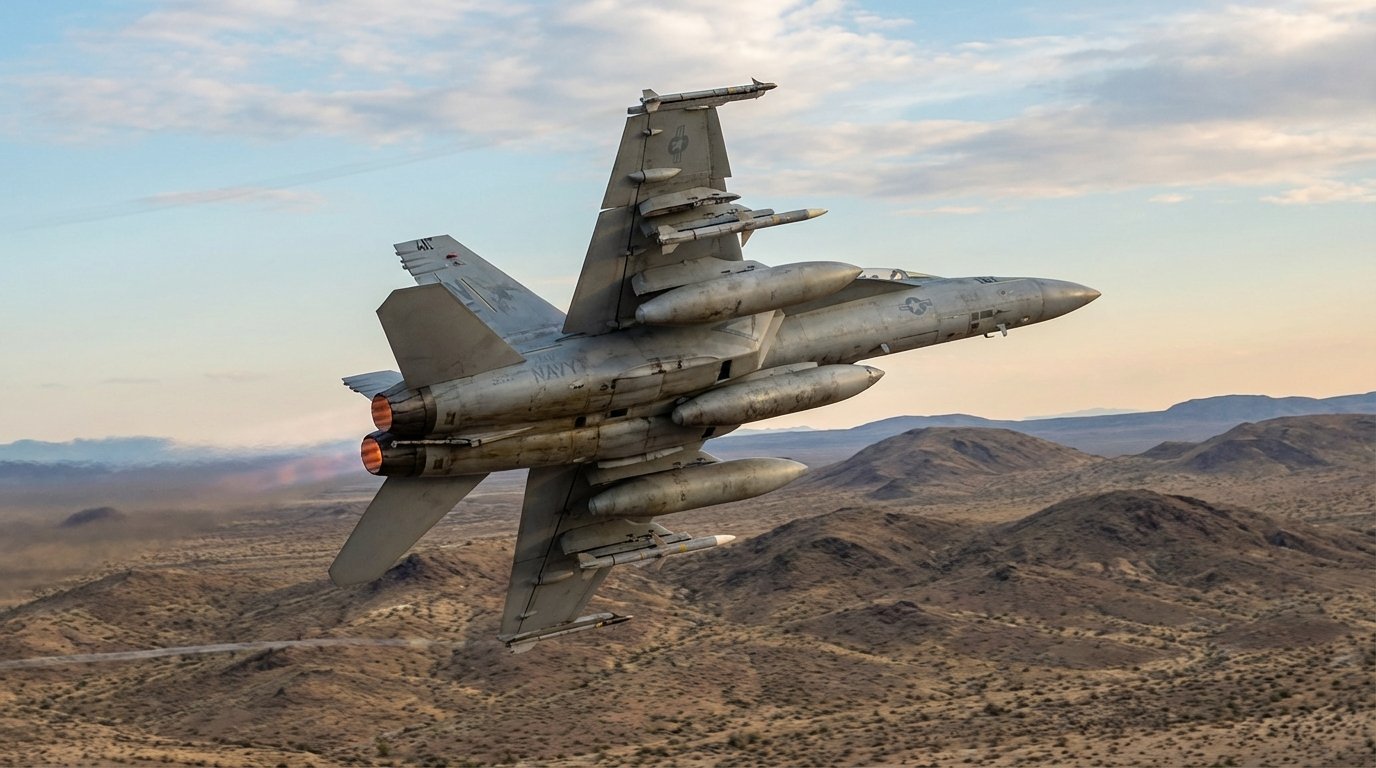
The F/A-18 Super Hornet emerges as the relentless powerhouse of U.S. naval air combat, shaping the battlefield sky in the ongoing air campaign over Iran with unparalleled versatility and resilience.
In the complex and high-stakes environment of Operation Epic Fury, the F/A-18E/F Super Hornet has cemented its role not just as a fighter jet but as the backbone of U.S. naval air power. Its evolution over the past few decades has propelled it to the forefront, allowing it to confront and suppress formidable Iranian defenses while delivering precision strikes across a diverse range of tactical scenarios. This multi-mission fighter combines advanced technology, rugged design, and cost-effective operation, presenting an ideal platform for continuous dominance throughout this rapidly evolving conflict.
Unrivaled versatility: How the F/A-18 Super Hornet adapts to every facet of modern aerial warfare
The F/A-18 Super Hornet’s reputation as a “Swiss Army knife” of naval aviation is well-earned, with its ability to pivot seamlessly between roles such as air superiority, precision strikes, aerial refueling, and electronic warfare. In the context of the 2026 Operation Epic Fury, the aircraft’s flexibility has proven invaluable.
Designed to operate from aircraft carriers like the USS Abraham Lincoln and USS Nimitz, the Super Hornet boats an expansive arsenal including AIM-120 AMRAAM missiles for air-to-air combat, AGM-158 JASSM for long-range precision strikes, and a 20mm M61A2 Vulcan cannon for close-in combat. This weapon diversity allows the F/A-18 to engage a broad spectrum of threats, from highly mobile enemy fighters to hardened missile launchers and command centers.
In addition to weapons payload, the Super Hornet’s Block III upgrades have introduced conformal fuel tanks (CFTs), which extend its operational range dramatically without compromising maneuverability or payload capacity. This enhancement translates into more time over the battlefield and less reliance on aerial refueling, critical for sustained combat operations far from friendly bases.
The introduction of advanced sensor fusion and enhanced networking capabilities within Block III permits pilots to access a comprehensive battlefield picture in real time. By synthesizing data from onboard sensors and external sources, the Super Hornet empowers its pilots to make faster and more precise targeting decisions, enhancing mission success rates across complex threat environments.
Moreover, its compatibility with the E/A-18G Growler electronic warfare variant enables integrated suppression of enemy air defenses (SEAD). During Operation Epic Fury, Super Hornets have often operated in tandem with Growlers to neutralize Iranian radar and missile sites, clearing paths for other strike aircraft and reducing risk to allied forces.
The aircraft’s ability to undertake multiple mission types within a single sortie reduces the number of aircraft needed for each operation, optimizing carrier deck space and sortie rates. This adaptability ensures that carrier strike groups maintain relentless pressure while maximizing efficiency in combat resource allocation.
Engineering excellence: Inside the maintenance and performance edge of the F/A-18 Super Hornet’s design
Beneath the sleek exterior of the Super Hornet lies a design focused heavily on maintainability and reliability, addressing the unique challenges of carrier-based operations. One of the aircraft’s most notable advantages is its streamlined maintenance processes compared to older naval fighters like the F-14 Tomcat and A-6 Intruder.
The General Electric F414-GE-400 turbofan engines exemplify the Super Hornet’s maintenance-friendly innovations. These engines can be detached quickly, with just ten connection points and a four-person team able to replace one in as little as 20 minutes. This design philosophy translates directly into an impressive 80 percent readiness rate in operational theaters, minimizing downtime and maintaining a steady flow of aircraft on missions.
Super Hornet’s structural upgrades have extended its service life to 10,000 flight hours, a significant boost from earlier models’ 6,000 hours. This marks it as a long-term asset capable of serving deep into the 2040s, ensuring robust naval aviation capability without the immediate need for wholesale replacement.
Its tougher airframe and enhanced fuel capacity not only extend range but also support increased payloads — enabling delivery of a diverse range of ordnance and equipment essential for modern warfare. The aircraft measures 60.3 feet in length, with a wingspan close to 44.9 feet and a maximum take-off weight around 30,000 kilograms, allowing it to carry a lethal blend of weapons and fuel.
Ease of maintenance also reduces lifecycle operational costs, preserving budgetary flexibility for advanced upgrades and sustained deployments. The Navy’s ongoing investment in Block III modifications underlines the platform’s potential for continuous modernization over the years.
Its agility, coupled with a ceiling exceeding 15,000 meters and a top speed pushing Mach 1.8, keeps the Super Hornet competitive against both older adversaries and modern stealth platforms. This balance of power, endurance, and maintainability makes it a linchpin in the high-tempo aerial campaigns like Epic Fury.
Historical milestones shaping the F/A-18’s battlefield dominance and evolution
The F/A-18 Super Hornet is not a newcomer to battle; its combat legacy began early in the 21st century and has only grown more prominent through decades of refinement and operational use. From its initial rollout in 1999, this platform has been at the forefront of U.S. naval air power.
Its first combat action during Operation Southern Watch in Iraq in 2002 marked the jet’s baptism by fire. On November 6, two F/A-18Es carried out precision strikes against surface-to-air missile (SAM) sites, employing JDAM 910-kilogram bombs for the first time in active combat. This set a precedent for its role as a versatile precision strike fighter.
Fast-forward to 2017, when an F/A-18E achieved a notable air-to-air kill against a Syrian Su-22, the first by a U.S. fighter in 26 years. The engagement was crucial for supporting allied Kurdish forces fighting ISIS, demonstrating the jet’s effectiveness in protecting coalition partners and enforcing air superiority in contested skies.
The Super Hornet has also been core to naval operations against non-state actors, as evidenced in late 2023 when aircraft from the USS Dwight D. Eisenhower neutralized multiple Houthi attack drones and missiles threatening Red Sea shipping lanes. Following this, a massive, coordinated bombing campaign in early 2024 targeted over 60 enemy sites to degrade hostile missile infrastructure.
These historical engagements illustrate the Super Hornet’s steadily expanding operational scope, including suppression of enemy air defenses, precision strike, maritime interdiction, and aerial defense roles.
Each mission has informed improvements in avionics, weapon systems, and aircraft survivability, culminating in the advanced Block III variants at the heart of Operation Epic Fury’s ongoing campaign.
Strategic impact of Operation Epic Fury: The F/A-18’s role in dismantling Iranian military capabilities
Since the launch of Operation Epic Fury on February 28, 2026, the F/A-18 Super Hornet has been the core platform executing U.S. objectives aimed at crippling Iran’s nuclear and missile infrastructures. The operation’s design focuses on three critical goals: suppressing Iranian air defenses, dismantling nuclear weapons production capabilities, and degrading missile launch networks primarily controlled by the Islamic Revolutionary Guard Corps (IRGC).
The carrier strike groups deployed in the Persian Gulf bring formidable firepower with wings packed full of Super Hornets, stealth F-35Cs, and electronic warfare EA-18Gs. These groups operate relentlessly to neutralize thousands of strategic targets identified through decades of surveillance and intelligence efforts.
Super Hornets excel in SEAD missions, often flying alongside EA-18G Growlers to jam enemy radars and missile guidance systems. This combined arms approach has cleared the way for precision strikes on heavily defended sites, showcasing the aircraft’s indispensable role in modern coalition warfare.
The synergy of these deployment strategies ensures that U.S. forces maintain air dominance despite Iran’s sophisticated layered defenses. With over several thousand targets struck, the F/A-18-enabled strike packages continue to degrade Iranian offensive capabilities systematically. This attrition severely hampers the IRGC’s ability to threaten regional and global stability.
While stealthier platforms like the F-35C offer complementary capabilities, the Super Hornet’s balance of range, payload, cost, and reliable availability makes it the persistent workhorse capable of sustaining long-term campaigns without exhausting resources.
Its presence aboard the latest Ford-class carriers symbolizes America’s enduring power projection, enabling rapid response to emerging threats and reinforcing allies’ confidence across the Middle East.
How the F/A-18 Super Hornet’s upgrades ensure dominance through the 2040s and beyond
Technological evolution has been vital in keeping the Super Hornet relevant amid emerging threats and evolving warfare demands. The latest Block III upgrades, which continue to roll out through 2026, incorporate state-of-the-art cockpit displays, enhanced radar-absorbent materials, and upgraded avionics systems that keep pilots ahead of adversaries’ detection and targeting capabilities.
Among these features are Conformal Fuel Tanks that extend range by hundreds of kilometers, advanced sensor fusion that integrates radar, infrared, and electronic warfare sensors, plus a revolutionary touchscreen display that replaces traditional bulky control panels. These enhancements increase situational awareness and reduce pilot workload, a crucial factor in high-pressure combat zones.
The Super Hornet’s reduced radar cross-section, while not as low as dedicated stealth jets, makes it significantly harder to detect than earlier models, providing a practical trade-off between stealth and survivability. Additionally, the new networking infrastructure accelerates data sharing across platforms, enabling coordinated multi-aircraft tactics that amplify strike effectiveness.
Service life extension initiatives ensure that the airframes maintain structural integrity and performance reliability well beyond their originally intended lifespan. This strategic approach avoids costly early replacements by keeping the fleet combat-ready and technologically competitive into the mid-21st century.
Such upgrades promise that the Super Hornet will not only maintain but broaden its operational role, potentially incorporating emerging weapons like hypersonic missiles or directed energy systems as they become operational. This capability trajectory positions the F/A-18E/F as an enduring cornerstone of U.S. naval aviation strategy.
Capt. Michael Burks, the F/A-18 and EA-18G Program Office manager, emphasizes that the aircraft’s ongoing evolution represents one of naval aviation’s greatest success stories—reflecting decades of design ingenuity, operational experience, and relentless modernization.
Key features making the F/A-18 Super Hornet unstoppable in aerial combat
- Multi-role capability: Effective across air-to-air, air-to-ground, electronic warfare, and refueling missions.
- Advanced avionics: Block III enhanced sensor fusion and secure data link networking enable real-time battlefield awareness.
- Extended range and endurance: Conformal fuel tanks and efficient engines allow longer missions without refueling.
- High maintainability: Quick engine swaps and reduced maintenance downtime maintain high readiness rates.
- Robust weapons loadout: Ballistic missiles, precision-guided bombs, air-to-air missiles, and electronic attack pods.
- Service life extension: Upgraded structures and systems secure operational relevance through 2040 and beyond.
| Specification | Details |
|---|---|
| Length | 60.3 feet (18.4 meters) |
| Wingspan | 44.9 feet (13.7 meters) |
| Maximum takeoff weight | 30,000 kilograms (66,000 lbs) |
| Top speed | Mach 1.8+ |
| Service ceiling | Over 15,000 meters (50,000+ ft) |
| Powerplant | Two General Electric F414-GE-400 turbofan engines |
| Armament | 1× 20 mm M61A2 Vulcan cannon, multiple missile types including AIM-120 AMRAAM, AIM-9 Sidewinder, AGM-158 JASSM, and JDAM bombs |
While stealth aircraft like the F-35 are often the headline, the Super Hornet’s reliability, adaptability, and cost-effectiveness ensure it remains a dominant force in the skies over Iran and beyond.
What makes the F/A-18 Super Hornet a ‘workhorse’ of the U.S. Navy?
Its remarkable versatility to perform a wide variety of missions, high availability due to streamlined maintenance, and reliable performance in high-threat environments contribute to its ‘workhorse’ status.
How does the Super Hornet complement stealth fighters like the F-35C?
While F-35Cs provide superior stealth and advanced sensor integration, Super Hornets offer greater payload, endurance, and ease of maintenance, making them effective partners in mixed strike packages.
What upgrades are key in the Block III Super Hornet?
Block III features include conformal fuel tanks for range extension, enhanced cockpit displays, improved sensor fusion, reduced radar cross-section, and advanced networking capabilities.
How does the Super Hornet support suppression of enemy air defenses (SEAD)?
Paired with the EA-18G Growler electronic warfare variant, Super Hornets can conduct SEAD missions by jamming enemy radar and communications, clearing skies for follow-on strikes.
Will the F/A-18 remain relevant in future conflicts?
Thanks to ongoing upgrades and structural life extensions, the Super Hornet is expected to serve well into the 2040s, adapting to new threats with advanced weaponry and technology.
