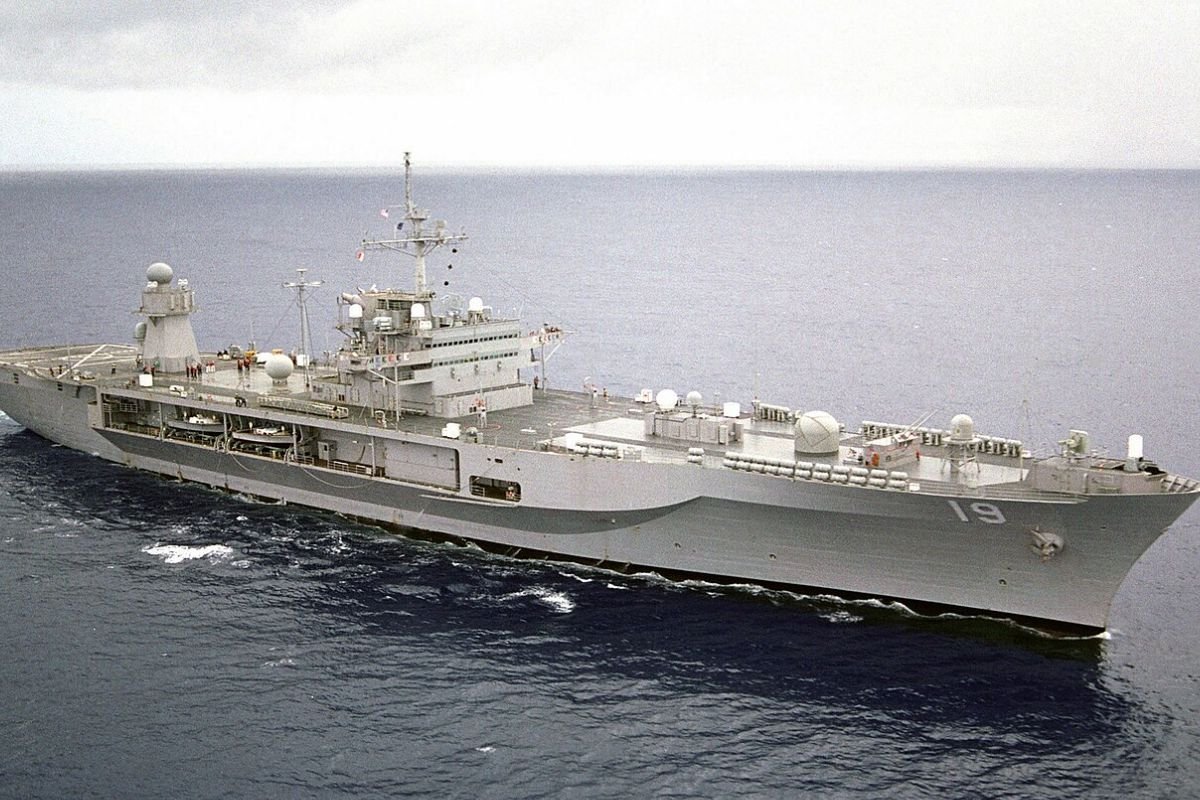
The Blue Ridge-class amphibious command ships continue to serve as the silent backbone of U.S. naval power, commanding vast fleets and coordinating complex missions across oceans.
Often overshadowed by massive aircraft carriers and stealthy submarines, the Blue Ridge-class ships are the command center nerves that keep fleet operations synchronized and efficient. These two vessels, the USS Blue Ridge and USS Mount Whitney, have logged decades of service, constantly evolving to meet new technological demands while remaining essential to U.S. global military strategy. Their transformative role across multiple theaters, especially in the Indo-Pacific and European waters, underscores their unique capabilities and tactical footprint.
The unique design and capabilities of the Blue Ridge-class command ships
The Blue Ridge-class stands apart in naval engineering as the only amphibious command and control (C2) vessels purpose-built from the keel up for their unique mission. Unlike other support ships retrofitted for command roles, these ships were conceived specifically to serve as floating battle offices. Their design leverages the amphibious assault Iwo Jima-class hull architecture but adapts it for advanced communications and coordination.
Built in the late 1960s and early 1970s, the two ships in this class—USS Blue Ridge (LCC-19) and USS Mount Whitney (LCC-20)—feature robust specifications designed to support sustained command operations across oceans:
- Displacement: Approximately 19,170 metric tons fully loaded, providing stability and room for state-of-the-art equipment
- Dimensions: Hull length of roughly 193 meters with a beam of 33 meters, balancing maneuverability and operational space
- Propulsion: Steam-powered turbines delivering 22,000 horsepower, allowing speeds up to 42.6 km/h (23 knots)
- Range: A remarkable 24,000 km cruising range, enabling extended missions without frequent refueling stops
- Combat systems: Defensive armaments like the Phalanx close-in weapon systems and automated 25mm machine gun mounts protect the ship, paired with advanced radar and sensor suites for situational awareness
The internal layout prioritizes command and control functions, with specialized, secure communications arrays connecting the fleet’s assets seamlessly. This includes commercial and military satellite links capable of managing real-time intelligence, surveillance, and reconnaissance feeds for air, land, and maritime domains.
This technological infrastructure makes these vessels one of the most advanced command platforms afloat today. With enough space to embark a full command staff complement, their role extends beyond simple coordination—they embody an operational headquarters at sea enabling tactical decisions and strategic oversight in fluid combat environments.
The strategic significance of Blue Ridge-class command ships in Indo-Pacific security
Since 1979, the USS Blue Ridge serves as the flagship of the U.S. Seventh Fleet, the Navy’s largest forward-deployed fleet. Stationed out of Yokosuka, Japan, this floating nerve center drives regional deterrence and alliance assurance across the vast Indo-Pacific theater. Its presence symbolizes the United States’ commitment to maintaining freedom of navigation and stability in contested waters like the South China Sea.
The Blue Ridge’s role transcends mere symbolic value; it functions as the operational brain behind multi-domain naval task forces integrating aircraft carriers, destroyers, submarines, and maritime patrol aircraft. Its Command and Control suite translates data into actionable insights, coordinating fleet maneuvers with precision in an environment marked by fast-developing threats—from advanced missile systems to cyber intrusions.
For instance, the USS Blue Ridge’s 2025 port visit to Wellington, New Zealand, highlighted its diplomatic and strategic utility. This stop marked the first U.S. naval visit to the country since 2021, reinforcing bilateral cooperation and interoperability aspects, particularly in joint exercises focused on humanitarian aid and disaster response missions. The ship’s ability to project command influence across such distant allies illustrates its multifaceted role as both a tactical leader and a platform for military diplomacy.
Moreover, the ship’s extensive endurance permits continual presence missions, which are critical for intelligence gathering and demonstrating sustained U.S. engagement amid rising regional tensions. As geopolitical challenges in the Indo-Pacific shift, the Blue Ridge ensures that the Seventh Fleet remains agile and responsive without sacrificing command cohesion.
USS Mount Whitney and the Sixth Fleet: Power projection in European and African theaters
Across the Atlantic, the USS Mount Whitney (LCC-20) operates as the flagship of the U.S. Sixth Fleet, deployed primarily out of Gaeta, Italy. This position anchors U.S. naval power in European and African waters, providing a platform that facilitates complex multinational exercises and crisis response missions. Unlike carriers or amphibious assault ships, the Mount Whitney specializes in net-centric warfare communications, managing information flow within a multilayered alliance environment including NATO partners.
This vessel’s operational history highlights its critical support of humanitarian missions and rapid deployment commands. During the 2008 Russo-Georgian conflict, Mount Whitney became the first NATO ship to deliver humanitarian aid to Georgia’s port of Poti, demonstrating its diplomatic influence and logistical capabilities. In recent years, visits to Libyan cities such as Tripoli and Benghazi in 2025 underscored renewed efforts to stabilize the region amid persistent unrest, positioning the ship as a tactical and political tool bridging naval force with diplomacy.
The ship’s deployment pattern involves continuous presence without permanent U.S. bases within its area of operations, adding flexibility and responsiveness to evolving threats or crises. Its mixed crew of Navy personnel and civilian mariners reflects an operational model that balances military readiness with the expertise of the Military Sealift Command, enhancing sustainability for prolonged missions.
Its state-of-the-art C2 systems integrate with allied forces’ networks, orchestrating joint maneuvers and real-time strategic planning. This connectivity is crucial for synchronizing efforts during NATO exercises or responding to asymmetric threats like piracy, cyberattacks, and terrorism across maritime chokepoints.
Technological enhancements and future-proofing the Blue Ridge-class
While both ships were commissioned over five decades ago, they have received multiple upgrades ensuring their technological edge remains sharp. Their command centers continuously integrate cutting-edge software and hardware, including enhanced cryptographic devices and network capabilities for secure global communications in contested environments.
In 2011, the Chief of Naval Operations extended the operational life of both vessels to at least 2039, reflecting their irreplaceable composite value in the Navy’s strategic architecture. Plans include ongoing modernization of satellite communications, electronic warfare systems, and sensor arrays to keep pace with rapidly evolving threats.
Moreover, their modular design allows for refreshes without significant structural overhaul—an advantage in cost-effectiveness and operational availability. For example, improvements in cyber defense protocols now enable the ships to withstand sophisticated hacking attempts, ensuring mission integrity during high-stakes operations.
Their sustained service also offers a platform to experiment with emerging maritime C2 technologies, bridging legacy maritime command functions with next-generation warfare concepts like artificial intelligence-assisted decision-making and maritime domain awareness tools. This ensures that these “living relics” continue to serve as vital assets rather than obsolete ones.
The lack of a clearly defined replacement program further emphasizes the Navy’s reliance on these vessels’ proven versatility and robustness, even as naval warfare pushes into more futuristic domains.
Key performance metrics and technical specifications overview
| Specification | Blue Ridge (LCC-19) | Mount Whitney (LCC-20) |
|---|---|---|
| Displacement (metric tons) | 19,170 | 19,170 |
| Length (meters) | 193 | 193 |
| Beam width (meters) | 33 | 33 |
| Top speed (km/h) | 42.6 | 42.6 |
| Range (km) | 24,000 | 24,000 |
| Complement | 34 officers + 564 enlisted | 34 officers + 564 enlisted |
| Armament | 2 × Phalanx CIWS, 2 × Mark 38 25mm guns | 2 × Phalanx CIWS, 2 × Mark 38 25mm guns |
Command and control as a force multiplier for the U.S. Navy’s operational reach
Command and control (C2) functions make the Blue Ridge-class indispensable in coordinating complex maritime operations involving a diverse array of assets. These ships act as floating headquarters, bringing together information streams from surface fleets, submarines, surveillance aircraft, and even land-based stations for comprehensive situational awareness.
For naval commanders, the ability to make timely decisions based on the fusion of intelligence and sensor data is critical. The Blue Ridge-class provides this through multi-level encrypted communications, tactical displays, and data management systems that can adapt dynamically to the operational picture. This means rapid dissemination of orders, intelligence updates, and fleet directives, significantly improving reaction times during crises.
The ships also serve diplomatic and alliance-building roles by hosting high-profile visitors and conducting joint exercises, strengthening coalition interoperability and maritime security frameworks. This diplomatic angle provides the U.S. military with leverage beyond kinetic power, underscoring the dual nature of these command vessels as both warfighting tools and “ambassador-level” platforms.
In practical terms, using specialized C2 ships like the Blue Ridge class streamlines naval expeditionary warfare, enabling coordination across vast distances in scenarios such as anti-submarine operations, crowd control during multi-national exercises, and multi-domain warfare settings which involve cyber, space, and electronic warfare elements.
- Enhances operational speed: Rapid command decisions reduce response times
- Improves situational awareness: Integration of diverse sensor data in real time
- Strengthens naval diplomacy: Hosting allies and partners fosters cooperation
- Supports multi-domain warfare: Connects kinetic and cyber/electronic warfare efforts
- Extends fleet endurance: Enables prolonged missions without command degradation
What distinguishes Blue Ridge-class ships from aircraft carriers?
Unlike aircraft carriers that serve primarily as strike platforms with air wings, Blue Ridge-class ships are dedicated command and control centers. Their main role is to coordinate fleet operations, manage communications, and provide strategic leadership rather than launch combat aircraft.
How do Blue Ridge-class ships adapt to modern cyber threats?
These ships have integrated advanced cyber defense protocols and electronic warfare systems ensuring secure communications and resilient operations, thus maintaining mission integrity amidst sophisticated hacking attempts and signal interference.
Why have the service lives of the Blue Ridge-class ships been extended to 2039?
The Navy values these ships for their unique role as operational brains, diplomatic platforms, and the highly flexible command hubs they provide. No direct replacements are currently planned, and their modernization ensures continued relevance in evolving strategic environments.
What recent diplomatic missions did these ships participate in?
In 2025, USS Blue Ridge visited Wellington, New Zealand, marking the first naval visit there since 2021, strengthening ties in the Indo-Pacific. USS Mount Whitney made notable visits to Libyan ports Tripoli and Benghazi to reaffirm U.S. presence and support regional stability in North Africa.
How do these ships influence multinational naval exercises?
Blue Ridge-class ships serve as the central hub for communication and coordination during complex joint operations. Their advanced C2 systems synchronize the efforts of allied navies, enabling seamless interoperability and efficient mission execution.
Source: https://nationalsecurityjournal.org/forget-aircraft-carriers-blue-ridge-class-is-1-of-the-u-s-navys-most-important-warships/
Image:
The Blue Ridge-class is a class of command and control ships built for the United States Navy, comprising only two vessels: USS Blue Ridge (LCC-19) and USS Mount Whitney (LCC-20).
Designed in the 1960s to coordinate large-scale amphibious operations and replace battleships as fleet flagships, only two ships were ultimately completed. Both remain in service today, serving respectively as flagships of the U.S. 7th Fleet and U.S. 6th Fleet.
