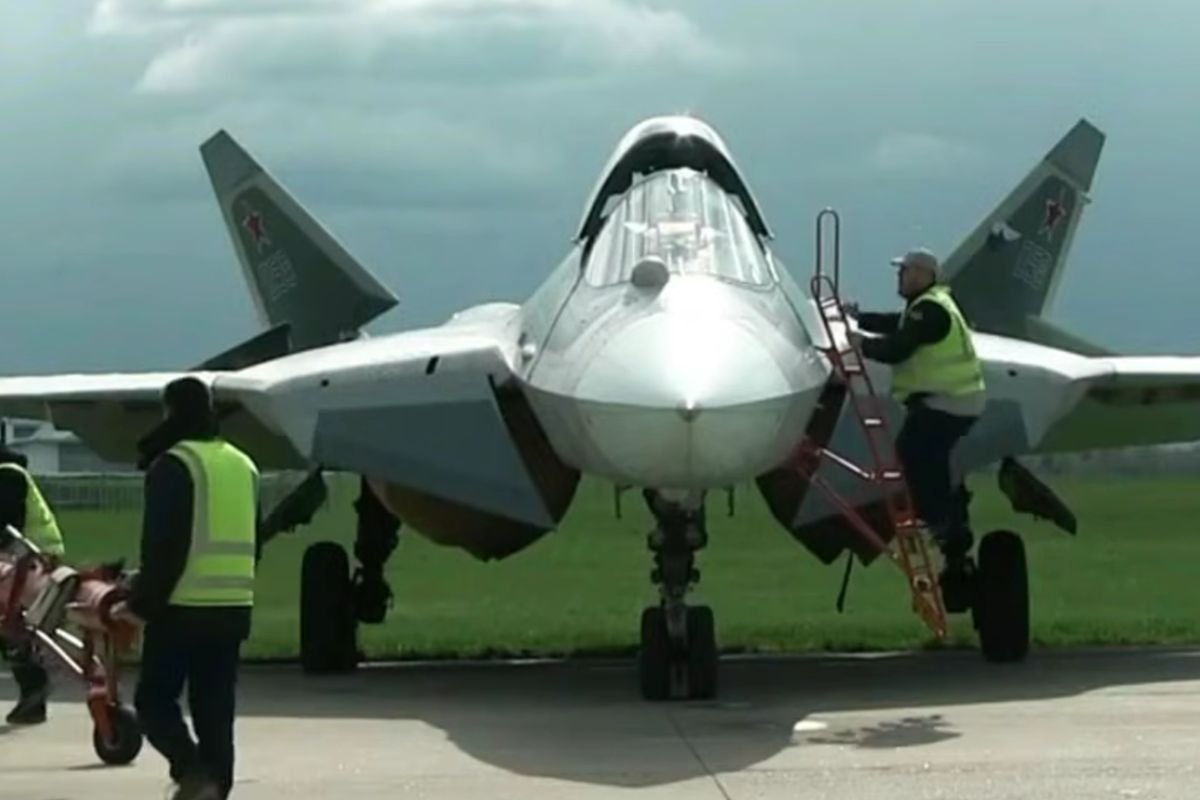
Russia’s Su-57 stealth fighter jets stand as a symbol of ambition in aerial warfare, but can a mere handful of these jets really challenge the overwhelming might of over 1,300 American F-35s in the skies?
In the intensely competitive world of fifth-generation fighters, Russia’s Su-57 represents a fascinating yet challenging chapter. While the jet showcases impressive speed and maneuverability, the realities of modern air dominance hinge on much more than raw performance. The United States and its allies command a massive fleet of the Lockheed Martin F-35 Lightning II, equipped with groundbreaking sensor fusion and advanced AI capabilities. With just a limited number of Su-57s operational, Russia faces significant hurdles in shifting the balance of power in the skies. This discussion delves deeply into how the Su-57 aligns with, or falls short against, the global standard set by the F-35, analyzing concepts like stealth, avionics, production scale, and unmanned teaming technologies shaping aerial dominance in 2026.
Unpacking the raw power: Speed and agility of the Su-57 in comparison to American stealth fighters
The Su-57 earns respect for its impressive top speed and maneuverability, representing one of Russia’s boldest steps toward next-generation air combat. Estimated to hit speeds near Mach 2, the Su-57 outpaces the F-35, which generally maxes out around Mach 1.6. This noticeable speed advantage gives the Su-57 an edge in closing distances quickly in a dogfight or intercept scenario, offering tactical opportunities the slower F-35 may struggle to meet.
However, speed alone does not translate directly into air superiority. Despite being slightly slower, the American F-22 Raptor still edges out the Su-57 at Mach 2.25, while delivering superior thrust-to-weight ratios. The Su-57’s thrust vectoring enhances its agility, helping with rapid directional changes and supermaneuverability, a vital attribute in close-range engagements.
Still, raw agility and velocity must be paired with advanced situational awareness and sensor technologies to truly dominate the battlefield. The F-35’s design centers on integrating stealth with cutting-edge avionics and a comprehensive sensor fusion system, enabling pilots to perceive the battlespace like never before. In many cases, this integration aims to neutralize the speed advantage by detecting threats early and striking preemptively.
Consider the strategic implications: if a Su-57 pilot spots an F-35 first, their ability to catch the opponent by surprise improves. Yet, the F-35’s superior sensor range often means that it detects opponent jets like the Su-57 well before the Su-57 acquires a target lock. This disparity limits the Su-57’s opportunities to leverage its speed and maneuverability effectively, especially in a networked air combat environment.
The stealth dilemma: How the Su-57’s radar cross-section and sensor suite compare internationally
Stealth technology remains critical to fifth-generation fighters, allowing aircraft to evade enemy radar and strike with surprise. The Su-57 features design modifications such as a blended-wing structure and curved fuselage, aiming to reduce its radar cross-section (RCS). However, experts indicate that its RCS still remains higher than Western stealth fighters, possibly limiting its survivability against advanced detection systems.
While Russia claims the Su-57 deploys an Active Electronically Scanned Array (AESA) radar and incorporates phased-array radar technology combined with extensive electronic countermeasures, many details regarding its sensor fusion capabilities remain unverified.
By contrast, the F-35’s sensor fusion relies on decades of US research and massive investments in AI-enhanced processing to collect, analyze, and merge data from radar, infrared, and external sources in real-time. This delivers the pilot a comprehensive and intuitively digestible picture of the battlefield, drastically reducing reaction times and increasing lethality. Whether the Su-57’s on-board systems approach this level is still questionable given its developmental history.
Another strategic advantage for American stealth jets is sensor networking. The F-35 integrates seamlessly into multi-platform, joint-force kill webs, sharing targeting and positional data across ground, naval, and air assets. The Su-57’s networking capacities lag behind, a critical factor in future air warfare, where connectivity and rapid decision-making will trump individual platform performance.
This technology gap sheds light on why stealth is not only about low RCS but also about sensor integration and the real-time AI computations that deliver actionable tactical insight – areas where the Su-57 so far appears less mature.
The staggering aircraft fleet gap: Only a handful of Su-57 jets versus a global F-35 force
One of the Su-57’s most glaring challenges in facing the F-35 is purely numerical. Reports indicate that by 2026, less than 50 Su-57 aircraft have been built, with a current operational count somewhere between 4 and 15. Despite official Russian plans to raise production to around 76 units over the next five years, this pace strays far behind the massive deployment of more than 1,300 F-35s worldwide.
Such a disparity is not just a matter of quantity but shapes the very viability of any force projection or air superiority strategy. A small contingent of Su-57s simply lacks the fleet density to conduct sustained air campaigns or cover Russia’s vast territorial expanse effectively against countries operating large F-35 fleets.
Moreover, fleet size impacts operational readiness, maintenance cycles, pilot training opportunities, and eventual upgrades – all vital in maintaining a credible threat. In stark contrast, the United States and NATO nations maintain a highly integrated training and operational network with their F-35 force, leveraging economies of scale for upgrades and logistics support.
To illustrate this imbalance, consider this table summarizing fighter jet numbers in 2026:
| Fighter model | Number of aircraft (approx.) | Operational countries | Production status |
|---|---|---|---|
| Lockheed Martin F-35 Lightning II | 1,300+ | 15+ (including U.S., UK, Japan, South Korea, Italy) | Full-scale production and upgrades ongoing |
| Sukhoi Su-57 Felon | 32 – 42 (planned) | Russia (limited export plans) | Slow ramp-up; technical and sanction-related delays |
Unmanned teaming and network warfare: Why the Su-57 trails behind the U.S. next-gen aviation ecosystem
Forward-looking air dominance depends increasingly on pairing manned fighters with unmanned systems, effectively multiplying combat capability and situational awareness. The U.S. Air Force’s leadership in this area is evident with projects like the “Loyal Wingman” Valkyrie drone being integrated with F-35 operations, enabling real-time data sharing and cooperative attack strategies.
Russia, meanwhile, has introduced the S-70 Okhotnik-B heavy drone intended to operate alongside the Su-57. Despite this, evidence suggests that the integration between Su-57 pilots and drones remains limited or experimental, with unconfirmed progress on real-time manned-unmanned teaming capabilities.
The challenge lies not only in developing advanced drone platforms but in creating seamless, secure data linkages and AI-driven coordination frameworks. The U.S. sixth-generation programs emphasize sophisticated kill webs where AI coordinates swarms of unmanned assets alongside manned jets to overwhelm adversaries strategically.
The Su-57’s current technological ecosystem reportedly cannot match this level of complexity or integration, leaving it vulnerable to coalition forces leveraging multi-domain networked warfare. This gap erodes Russia’s ability to harness force multipliers that redefine aerial combat in the 2020s and onward.
Balancing stealth, speed, and strategic factors: What does the future hold for Russia’s Su-57 program?
Despite its limitations, the Su-57 remains a bold strategic initiative symbolizing Russia’s intent to reclaim air combat relevance. Its emphasis on supersonic speed and thrust-vectoring offers a different approach compared to American stealth fighters, which lean heavily on sensor capability and networked warfare.
Nevertheless, the future success of the Su-57 hinges on several critical factors:
- Expanding production: Achieving meaningful fleet numbers to sustain operations and pilot proficiency.
- Technological upgrades: Enhancing AESA radar capabilities, sensor fusion, and electronic warfare systems to narrow the gap with Western counterparts.
- Networking and drone integration: Realizing effective manned-unmanned teaming to multiply battlefield presence and decision speed.
- Export and alliance building: Leveraging sales to allied nations to increase operational footprint and funding for development.
- Maturity of AI-driven combat systems: Developing onboard and offboard AI that can compete with the F-35’s Battle Management System for rapid data processing and decision-making.
Until these elements advance substantially, the Su-57 will likely remain a niche player confronting a vastly superior F-35 global force. Its limited numbers and current technology gaps underscore that true air dominance today extends far beyond speed and raw power.
Russia’s ambitious pursuit of the Su-57’s potential continues amid geopolitical tension and technological rivalry, setting the stage for a future where aerial warfare increasingly depends on integrated systems, swarm tactics, and artificial intelligence. Whether the Felon can evolve into a strategic rival to the F-35 in this arena remains a compelling question driving ongoing military modernization efforts.
How many Su-57 jets are currently operational?
As of 2026, estimates suggest between 4 and 15 operational Su-57 aircraft, far fewer than the massive F-35 fleet globally. Plans exist to increase this number over coming years.
What is the main advantage of the Su-57 compared to the F-35?
The Su-57’s superior top speed of about Mach 2 and its thrust-vectoring capabilities give it enhanced agility, potentially offering tactical advantages in close combat and interception missions.
Does the Su-57 have advanced stealth and sensor fusion like the F-35?
While the Su-57 employs stealth design features and AESA radar, its radar cross-section remains higher, and its sensor fusion and AI-enabled situational awareness lag behind the F-35’s highly integrated systems.
Is Russia capable of manned-unmanned teaming with the Su-57?
Russia has developed the S-70 Okhotnik-B drone to operate with the Su-57, but integration between manned jets and unmanned platforms is limited compared to U.S. programs like the Loyal Wingman.
Can the Su-57 challenge the F-35 in future air combat?
Despite notable speed and maneuverability, the Su-57’s limited production numbers, technology gaps, and weaker network integration make it unlikely to match the global F-35 force anytime soon.
Source: https://nationalinterest.org/blog/buzz/russias-su-57-felon-vs-americas-f-35-lightning-ii-who-would-win-bw-092425
