
The clash between traditional armored tanks and swarms of First-Person View (FPV) drones is reshaping modern military strategies with a radical debate over cost-effectiveness and battlefield dominance.
The ongoing conflict in Eastern Europe has accelerated the scrutiny of military assets, where the once-dominant tank faces staggering losses against nimble, low-cost FPV drone swarms. Russian military analysts have examined this evolving battlefield dynamic closely, weighing whether heavily armored and expensive tanks maintain their tactical value or if disposable drone swarms represent the future of ground warfare. As drones rapidly become a preferred option for many armies, this analysis unveils the tactical, economic, and doctrinal implications for militaries worldwide.
Tactical evolution: comparing armored tanks and FPV drone swarm capabilities
The Russian study delves into the stark contrast between Main Battle Tanks (MBTs) and FPV drone swarms regarding their operational roles and battlefield effectiveness. Tanks are armored juggernauts designed primarily for firepower, maneuverability, and sheer survivability in direct combat. In contrast, FPV drones are small, agile, and often low-cost unmanned aerial vehicles controlled remotely that can swarm enemy targets, employing hit-and-run tactics and precision strikes.
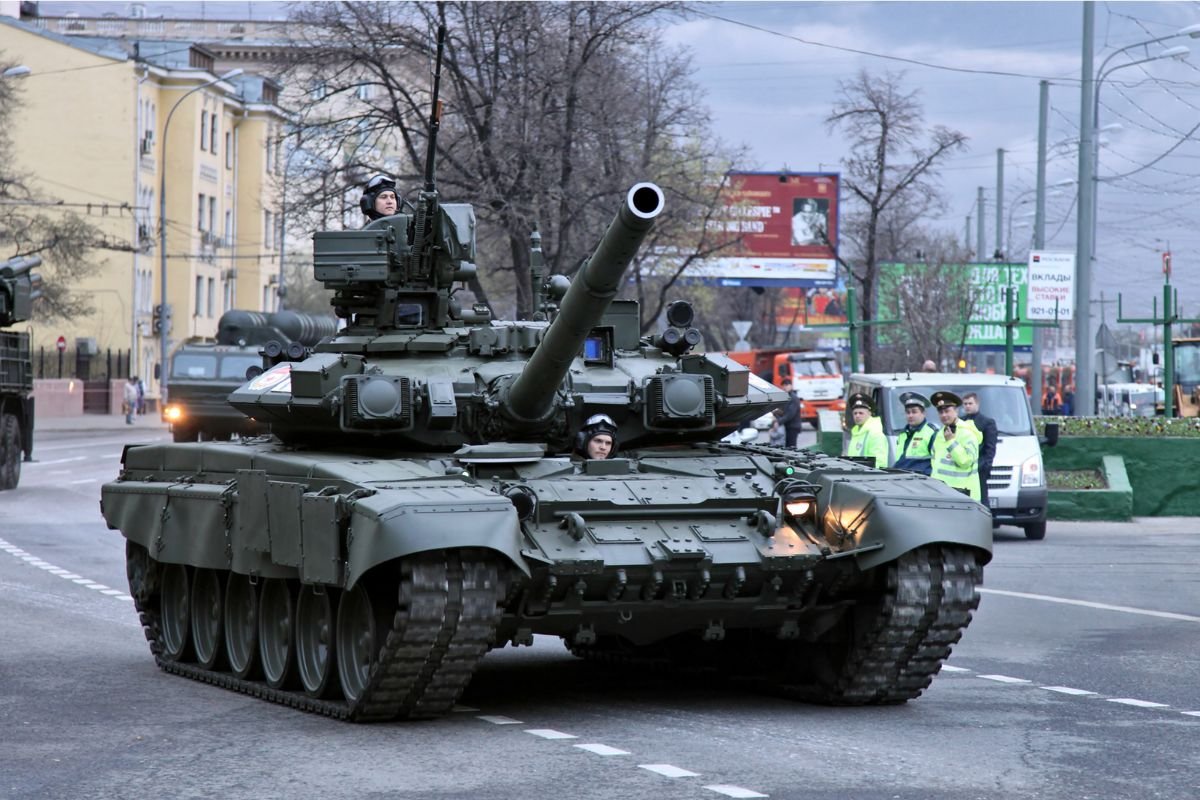
Armored tanks like the T-90 and T-14 Armata platforms boast thick composite armor, high-velocity cannons, and advanced targeting systems. They serve as a centerpiece for conventional offensive operations, breaking enemy lines and providing mobile fire support. However, tanks are expensive to build, operate, and maintain—costing millions of euros per unit, and crew survivability is a paramount concern, given the exposure inherent in ground operations.
On the other hand, FPV drone swarms cost only several hundred euros each to produce but can be deployed en masse to overwhelm tank defenses. Their maneuverability allows them to evade traditional anti-tank missiles and traverse terrain inaccessible to armored vehicles. Moreover, their loitering capabilities and real-time video feed empower operators to execute precision kamikaze strikes or relay battlefield intelligence.
One key tactical advantage of FPV drones lies in the ability to strike beyond line-of-sight and saturate air defenses, forcing tanks to operate under constant threat without guaranteed protection. Conversely, tanks can provide sustained firepower and direct battlefield control but require extensive support and are vulnerable to multi-axis drone attacks.
Operational costs and economic impact of maintaining tank
s versus drone swarms
The study places a significant emphasis on analyzing the economic dimensions of deploying and maintaining MBTs as compared to FPV drone swarms. The manufacturing cost of a single modern tank ranges from €3 million to over €5 million depending on configuration and upgrades. Added to this are the logistics, fuel consumption, crew training, and maintenance costs, which escalate the overall expense substantially during prolonged conflicts.
In sharp contrast, FPV drones can be mass-produced at a fraction of the cost—often as low as €300 to €500 per unit. This immense cost gap has triggered a tactical revolution, where armies like Ukraine produce over 200,000 FPV drones monthly, enabling them to field enormous swarms capable of saturating enemy defenses with a minimal budget footprint.
This cost disparity also affects the sustainability of battlefield operations. Tanks, if lost, represent a multi-million euro asset destroyed, significantly impacting operational budgets and requiring lengthy replenishment times. FPV drones, being expendable, permit rapid attrition while keeping costs low. This replaces the traditional cost-value equation underpinning armored warfare and introduces new approaches to force composition and procurement policies.
Moreover, the drone-centric approach reduces the risk to human life compared to manned tanks, which often suffer heavy crew casualties during ambushes or drone attacks. Economically, investing in large-scale drone production and swarm tactics can be far more viable for militaries under significant budget constraints or facing protracted attrition-based warfare.
Comparative operational cost table
| Military Asset | Unit Cost (€) | Maintenance per year (€) | Crew requirement | Deployment Speed | Expected Service Life (Years) |
|---|---|---|---|---|---|
| Main battle tank (e.g., T-90) | 4,200,000 | 500,000 | 3-4 | Moderate | 20-30 |
| FPV drone (single unit) | 450 | Negligible | 0 (Remote operator controls swarm) | Rapid | Short (disposable) |
Doctrinal implications: how drone swarms challenge traditional armored warfare
The increasing prevalence of FPV drones has compelled military strategists, including Russian defense analysts, to reconsider established doctrines. Historically, tank-heavy formations dominated ground offensives—pushing the frontlines forward while supported by infantry and air cover. However, the rise of FPV drone swarms introduces novel complexities that affect command and control, force integration, and combat tactics.
Drone swarms operate under decentralized control, dispersing attacks from multiple vectors simultaneously, making traditional anti-tank defenses less effective. Tanks must now allocate significant attention and resources to counter-drone systems, complicating battlefield coordination. Commanders face challenges maintaining situational awareness while simultaneously focusing on mobility, fire control, and drone defense.
These circumstances force an operational shift whereby armored units must integrate layered air defense, electronic warfare, and rapid response teams to neutralize drone threats. The doctrine now increasingly accommodates unmanned aerial assets alongside infantry and armor, creating hybrid teams that balance firepower and agility.
Furthermore, drone swarms blur the lines between reconnaissance and attack, providing real-time battlefield intelligence while executing aggressive strikes. This dual-role capability reshapes operational planning, benefiting forces that adapt quickly to asymmetric threats rather than relying solely on heavy armor. Tactical adaptations also include dispersed formations, enhanced camouflage, and counterintelligence to defeat swarm tactics.
Lessons from the Ukraine conflict on the effectiveness of FPV drone swarms
Ukraine’s active deployment of tens of thousands of FPV drones provides a real-world laboratory for evaluating their battlefield success versus conventional armored vehicles. Reports indicate that a significant proportion of Russian tank losses—up to 65%—are directly attributable to FPV drone strikes, reflecting a paradigm shift in armored vulnerability.
One notable incident involved the destruction of a Russian T-90M “Breakthrough” tank using simply two FPV kamikaze drones, demonstrating how small swarms can neutralize sophisticated armor systems. The mass production of drones, combined with skilled operators using advanced video feeds, allows Ukrainian forces to conduct precision strikes on high-value targets while minimizing direct exposure.
These lessons have galvanized multiple military forces worldwide to reconsider their investment in traditional tank fleets and expand drone production and deployment. The effectiveness of FPV drones in disrupting armored warfare has stimulated rapid defense innovation, including upgraded active protection systems (APS) on tanks designed to neutralize incoming drones, though these technologies are not yet foolproof.
Additionally, the conflict highlights the psychological impact of drone swarms, as crews inside tanks often face heightened stress and reduced operational effectiveness under persistent drone harassment. This has caused changes in crew training emphasizing electronic countermeasures and multitasking under pressure.
Future projections: will drones replace tanks or redefine armored warfare?
Looking towards the near future, the Russian analysis suggests that while FPV drone swarms will not entirely replace tanks, they will certainly redefine their roles in combined arms warfare. Tanks will likely continue to serve critical functions in heavily contested environments requiring sustained firepower and protection. However, their designs and operational doctrines must evolve to incorporate robust drone defense systems, networked battlefield communications, and AI-guided threat detection.
Meanwhile, drone technology is progressing rapidly with improvements in flight endurance, payload capacities, and swarm coordination algorithms. The proliferation of autonomous drone swarms capable of independent target selection and cooperative maneuvers points toward an increasingly complex combat environment where human-operated armored vehicles must coexist with drone assets.
This new battlefield landscape calls for a mixed-force approach optimized for cost, flexibility, and lethality. Resource allocation decisions will increasingly favor versatile, low-cost drones for reconnaissance, harassment, and attrition missions, while tanks will be reserved for decisive breakthroughs and force projection.
- Mass production of drones offers scalability unmatched by armored vehicles.
- Emerging counter-drone technology seeks to protect tanks from low-cost swarm attacks.
- Hybrid tactics combining drones and tanks improve battlefield survivability.
- Economic and psychological factors push militaries to invest in drone warfare capabilities.
- Continuous innovation in both domains will define future combat effectiveness.
How much cheaper are FPV drones compared to tanks?
FPV drones typically cost around €300 to €500 each, whereas a modern tank can cost upwards of €4 million, making drones substantially more cost-effective for mass deployment.
Can FPV drones completely replace tanks on the battlefield?
While FPV drones excel in precision strikes and overwhelming enemy defenses, tanks still provide essential firepower and protection in heavy combat situations. The future battlefield will likely see combined use rather than total replacement.
What countermeasures exist against FPV drone swarms?
Modern tanks are being equipped with active protection systems (APS), electronic jammers, and rapid response units to detect and neutralize incoming drones. However, these systems are still evolving and not fully effective against large swarms.
How have FPV drones affected crew morale in armored units?
The constant threat and harassment from drone swarms increase stress and reduce operational effectiveness of tank crews, emphasizing the need for enhanced training and psychological resilience programs.
What lessons has the Russia-Ukraine conflict offered on drone warfare?
The conflict has proven the practical effectiveness of FPV drones in disabling armored vehicles at low cost, prompting militaries globally to reconsider force structures and prioritize drone technology development.
Sources:
- https://www.csis.org/analysis/calculating-cost-effectiveness-russias-drone-strikes
- https://reference-global.com/download/article/10.2478/kbo-2025-0005.pdf
Image: The T-90 is a Russian main battle tank developed by Uralvagonzavod, combining the T-72 platform with systems derived from the T-80U.
Introduced in 1992, it remains one of Russia’s best-known modern tanks, with upgraded versions such as the T-90A and T-90M featuring improved armor, fire control, and mobility.
