France confronts a critical naval bottleneck as its only nuclear-powered aircraft carrier, Charles de Gaulle, takes on high-risk missions amid escalating Middle Eastern tensions, highlighting urgent modernization needs.
France’s strategic naval power now hinges entirely on the aging Charles de Gaulle, a 42,000-ton giant facing a demanding redeployment from the Baltic Sea to the volatile Eastern Mediterranean amid rising conflict with Iran. This situation underscores the limits of French maritime capabilities and accelerates Paris’s push toward the ambitious PANG (Porte-Avions de Nouvelle Génération) program—promising a bigger, technologically advanced successor designed to secure France’s naval dominance well into the next decades.
France’s exclusive reliance on the charles de gaulle carrier strain naval operations
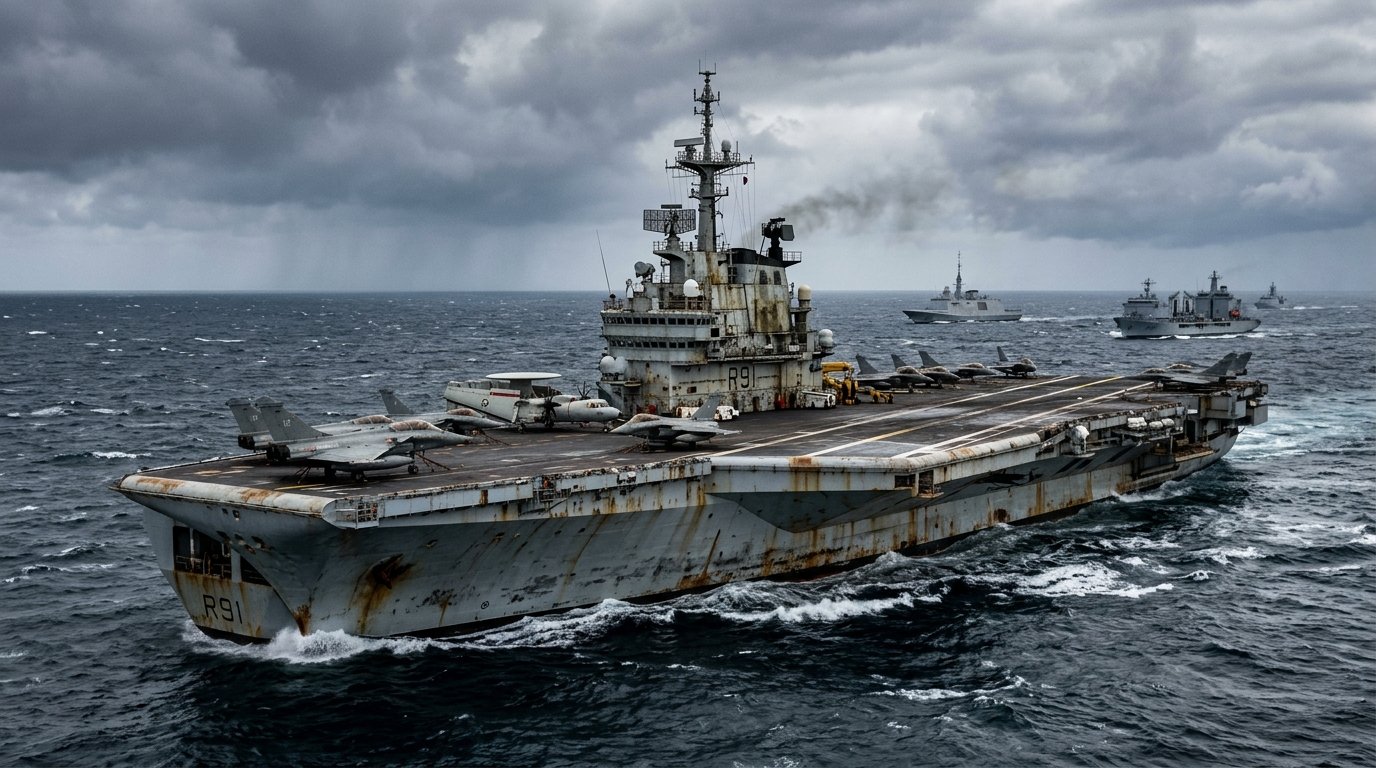
In March 2026, President Emmanuel Macron ordered the immediate redeployment of the Charles de Gaulle aircraft carrier strike group from NATO exercises in northern Europe to the Eastern Mediterranean. As tensions between Iran and Western allies intensify, the carrier group, including the frigate Languedoc, is charged with safeguarding critical maritime routes near Cyprus and defending NATO assets like RAF Akrotiri against missile and UAV assaults. This move puts France’s entire naval air power on the line, revealing the inherent vulnerability of maintaining just a single nuclear-powered carrier in active service.
Why one carrier is a significant operational risk
Unlike the United States Navy, which fields multiple supercarriers, France operates solely the Charles de Gaulle as its nuclear-powered centerpiece. At roughly 42,000 tons, this carrier is significantly smaller and carries fewer aircraft than American counterparts, limiting sortie rates and operational flexibility during extended conflicts. Its deployment to a hotspot leaves no room for backup, maintenance rotations, or simultaneous missions elsewhere, essentially creating a single point of failure for French naval aviation.
The current geopolitical climate, mainly shaped by Iran’s drone and missile attacks on key regional players, challenges the Charles de Gaulle to maintain constant air patrols and defensive operations beyond typical peacetime levels, stretching its capabilities.
The strategic implications of the eastern mediterranean deployment
France’s decision to enter the increasingly turbulent Eastern Mediterranean theater reflects its commitment to protecting European interests and maintaining regional stability amid a proxy conflict escalating between Iran, Israel, and U.S.-led coalitions. With attacks already targeting NATO bases on Cyprus, such as RAF Akrotiri, the French carrier’s mission includes air defense support and escorting vital shipping lanes that keep global trade flowing through critical choke points like the Strait of Hormuz.
Charles de Gaulle’s presence serves as a deterrent and an operational platform for around 20 Rafale M fighter jets and E-2C Hawkeye surveillance aircraft, enabling France to project power without relying on fixed land bases, an invaluable asset given the region’s volatility.
Coordinated European naval response under strain
France is not acting in isolation; alongside several European navies, it is reinforcing maritime air defenses to protect allied forces. Despite this coalition effort, the outsize role the Charles de Gaulle must play highlights the strain on Europe’s collective maritime defense. The carrier strike group’s deployment signals both solidarity and a warning about the limited naval options available to European countries without robust carrier fleets.
Why the future hinges on the PANG program’s success
France already knows the Charles de Gaulle’s limitations—both in size and nearing retirement, expected around 2038. This knowledge fuels the PANG program, which aims to deliver Europe’s largest nuclear-powered aircraft carrier at a staggering 70,000 tons, nearly doubling the displacement of its predecessor.
PANG is designed to embrace modern naval warfare demands, including the integration of electromagnetic aircraft launch systems (EMALS) to boost aircraft sortie rates, as well as the deployment of next-generation fighter jets under the Future Combat Air System (FCAS) program and advanced unmanned aerial vehicles. This blend of technology aims to secure France’s edge in an “era of predators,” where drones and advanced missile systems dominate the battlefield.
Anticipated capabilities of France’s next-gen supercarrier
- Displacement near 70,000 tons, the largest warship built in Europe.
- Electromagnetic aircraft launch system improving launch efficiency and volume.
- Advanced FCAS-compatible multirole fighter jets increasing air dominance.
- Drone and unmanned system integration for networked maritime and air operations.
- Enhanced defensive systems to counter missile and drone threats in contested waters.
Operational challenges faced by Charles de Gaulle today
Despite its nuclear propulsion offering extended range and endurance, the Charles de Gaulle carrier’s operational reality reveals constraints. Its limited air wing cannot sustain high-intensity conflict sortie rates, crucial when confronting swarm tactics involving drones and missile salvos.
Additionally, the carrier works without a backup within the French Navy, a vulnerability Macau highlighted by its escalating commitment in a relatively small but hostile operational theater far from France’s shores. The strain on crew, logistics, and maintenance cycles increases risks that could impair France’s ability to respond quickly to new crises.
Key statistics on charles de gaulle’s operational profile
| Category | Specifications | Operational Details |
|---|---|---|
| Displacement | Approx. 42,000 tons | Mid-sized nuclear carrier |
| Aircraft carried | ~20 Rafale M jets + E-2C Hawkeye | Limited sortie generation capacity |
| Year commissioned | 2001 | Only carrier in French fleet |
| Decommission date | Expected ~2038 | Accelerates need for PANG |
Broader geopolitical and economic stakes of France’s naval deployment
The redeployment of the Charles de Gaulle to counter intensified Iranian drone and missile threats carries more than military weight—it influences global maritime trade and economic security. The Eastern Mediterranean and adjacent waters near the Strait of Hormuz are vital to international energy and shipping flows. Interruptions here threaten not only regional stability but also global markets.
France’s naval posture highlights how critical it is for European powers to maintain credible maritime capabilities in a multipolar world, especially when facing irregular, tech-driven warfare.
Impacts on maritime commerce and allied logistics
Protecting sea lanes keeps energy supplies steady and ensures safe passage for commercial vessels bound to and from Europe, Asia, and beyond. Disruptions risk consumer prices, impacting everything from fuel to goods. France’s naval efforts to secure these routes contribute directly to safeguarding Europe’s economic interests amid turbulent Middle East geopolitics.
Why does France have only one aircraft carrier?
France’s defense policy, budgetary constraints, and strategic choices have led it to operate just a single nuclear-powered aircraft carrier, Charles de Gaulle, to cover its global naval interests.
What improvements will the PANG carrier bring?
The PANG carrier will be nearly twice the size, with advanced launch systems and integration of next-gen fighter jets and drones, vastly enhancing operational capability compared to Charles de Gaulle.
How does the Charles de Gaulle contribute to regional security?
It projects naval air power to protect shipping lanes, defend allied bases such as RAF Akrotiri, and help deter hostile missile and drone attacks in conflict zones.
What are the risks of relying on a single carrier?
Having only one carrier means any mechanical issues or maintenance periods leave France without carrier-based air power, reducing flexibility and response times in multiple theaters.
When is the Charles de Gaulle expected to retire?
The Charles de Gaulle is slated for decommissioning around 2038, accelerating the need to finalize and deploy its successor, the PANG aircraft carrier.
