
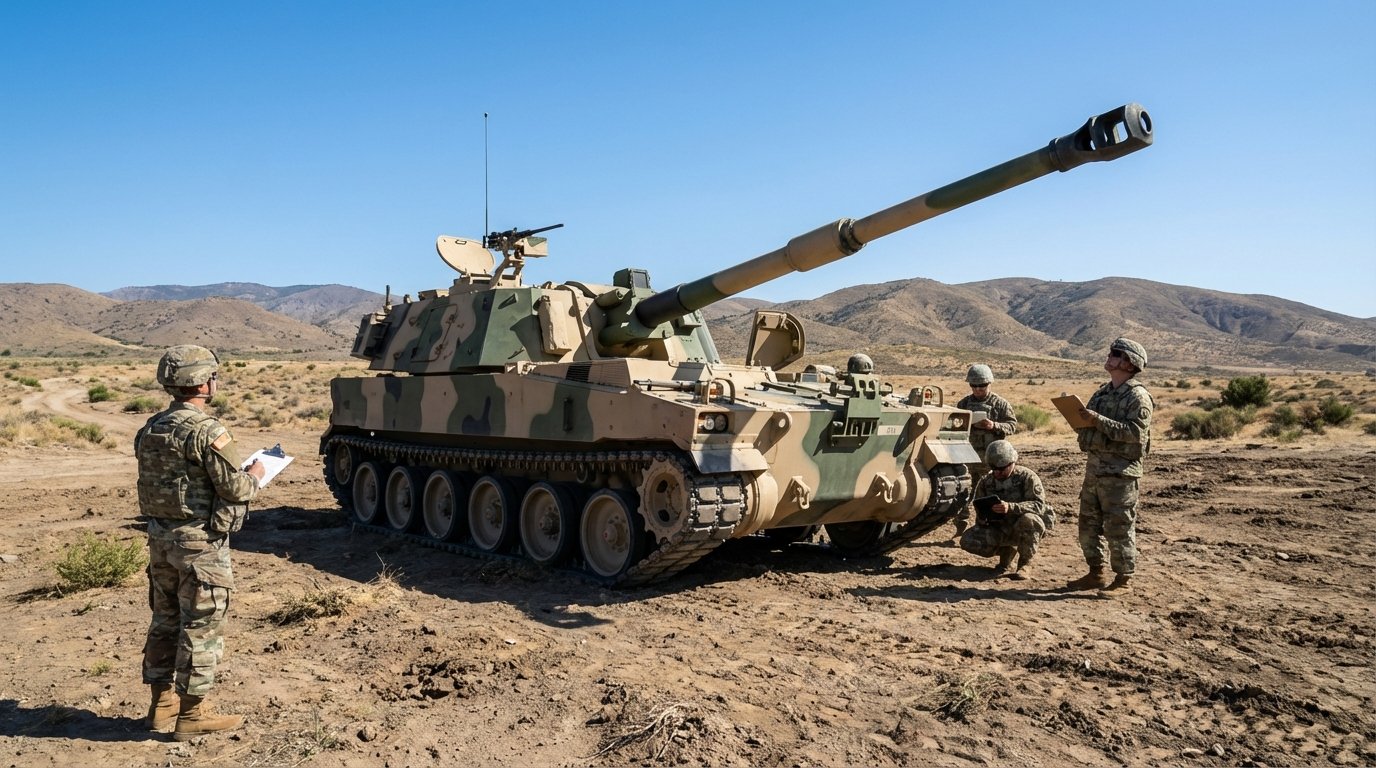
The U.S. Army’s latest move to evaluate the Morana 155mm self-propelled howitzer signals a potential game-changer in modern artillery, combining cutting-edge automation, mobility, and firepower. This sophisticated weapon system could redefine battlefield dynamics with its extended operational capabilities and advanced crew protection.
As artillery technology rapidly evolves, the U.S. Army has begun a thorough assessment of the Advanced Morana self-propelled howitzer developed by Czech defense manufacturer Excalibur Army. Packing a 155mm/52-caliber gun capable of reaching over 41 kilometers, this wheeled artillery piece aims to meet the Army’s growing demands for precision, automation, and mobility in its artillery units. With a 3-man crew, automatic loading, and robust armor protection, the Morana presents a fresh take on the self-propelled howitzer role.
How the Morana blends firepower and tactical mobility
The Morana self-propelled howitzer stands out by combining the heavy artillery firepower traditionally seen in tracked vehicles with the mobility advantage of truck-mounted guns. This unique design allows it to rapidly reposition on the battlefield, a crucial factor in modern warfare where speed equals survivability. The 155mm/52-caliber gun boasts a maximum firing range exceeding 41 kilometers, letting artillery units engage targets from safer, longer distances. Furthermore, the automatic loading system enables sustained firing without the usual delays of manual shell handling, giving crews the edge during high-tempo operations.
Enhanced crew protection and survivability features
Crew safety in artillery units is paramount, especially during counter-battery fire scenarios. The Morana’s armored cabin design provides significant protection against small arms fire and shell fragments, enabling its 3-man crew to operate under intense battlefield conditions. Advanced situational awareness tools integrated into the system also help crews quickly assess threats and adapt their firing strategies in real time, minimizing vulnerabilities on the move.
Automation as a force multiplier in artillery operations
One of the defining features of the Morana is its sophisticated automation. Unlike older models requiring labor-intensive manual loading, the Morana is equipped with a fully automatic loading and aiming system, which drastically reduces crew fatigue and increases its rate of fire. This level of automation is seen as a crucial step forward for the U.S. Army’s ambitions to modernize its artillery forces, integrating digital battlefield networks for precision engagements and rapid deployment cycles.
Operational flexibility: integrated or stand-alone missions
The Morana’s design allows it to function efficiently as part of a traditional artillery battery or as a stand-alone unit for specific tactical tasks. Its versatility is reflected in its ability to carry 45 rounds ready for action, ensuring that the howitzer remains combat-effective for extended periods without immediate resupply. This kind of operational independence broadens tactical options, especially in complex conflict environments where supply lines may be disrupted.
The U.S. Army’s artillery modernization journey and the Morana’s place
The U.S. Army has grappled for decades with replacing or upgrading its aging M109 Paladin self-propelled howitzer fleet. Past modernization efforts encountered technological and budgetary hurdles, delaying progress. The Morana, with its NATO standard compliance and proven capabilities demonstrated at recent defense exhibitions, offers a promising candidate for inclusion in future artillery modernization programs, potentially bridging gaps in range, automation, and mobility.
Economic and strategic aspects of adopting foreign artillery systems
Choosing a cutting-edge, foreign-developed artillery system like the Morana carries both benefits and challenges. While it can speed up modernization timelines and introduce novel technologies, integrating it with the Army’s existing digital networks and logistics can be complex. Additionally, procurement decisions weighing cost against strategic value are under close consideration, especially in eras demanding fiscal responsibility alongside military readiness.
Key performance data and assessment timeline
| Feature | Specification | Comments |
|---|---|---|
| Caliber | 155 mm / 52 caliber | Standard NATO artillery caliber with extended barrel length |
| Max firing range | 41+ km | Allows engagement beyond many current self-propelled howitzers |
| Ammunition onboard | 45 rounds | Sufficient for rapid, sustained fire missions |
| Crew | 3 personnel | Reduced crew size due to automation |
| Protection | Armored cabin | Enhanced crew survivability in combat environment |
| Assessment period | 2026 (ongoing) | US Army evaluation for potential adoption |
- Fully automatic loading and aiming reducing crew workload
- High mobility on wheeled chassis for rapid deployment
- Integrated digital battle management compatibility
- Robust armored protection for crew safety
- Extended firing range enhancing artillery reach
Global interest and future export potential
Beyond the United States, the Morana howitzer has attracted attention from several NATO countries seeking to upgrade their artillery capabilities rapidly. With its blend of mobility, automation, and firepower, it matches the operational demands of many modern armies aiming to maintain technological edge while managing costs. The Morana’s export success could influence the global artillery market significantly over the next decade.
What makes the Morana howitzer stand out among other self-propelled artillery?
The Morana combines a powerful 155mm/52-caliber gun with advanced automation and mobility features, including an automatic loading system, armored crew protection, and a wheeled chassis for rapid repositioning.
How does automation improve artillery effectiveness in the Morana?
Automation reduces the physical demands on the crew, increases firing rates, and enhances precision through integrated digital aiming systems, allowing for faster and more accurate fire missions.
Why is the U.S. Army interested in foreign artillery systems like Morana?
The Army sees value in accelerating its artillery modernization by assessing proven foreign technologies, potentially saving development time and costs while boosting combat capabilities.
What operational advantages does the Morana’s wheeled chassis provide?
Wheeled mobility allows the howitzer to move quickly over roads and rough terrain, offering tactical flexibility and faster redeployment compared to traditional tracked artillery systems.
How many rounds can the Morana carry on board?
The Morana carries 45 rounds ready for rapid firing, which enables prolonged missions without immediate resupply needs.
