
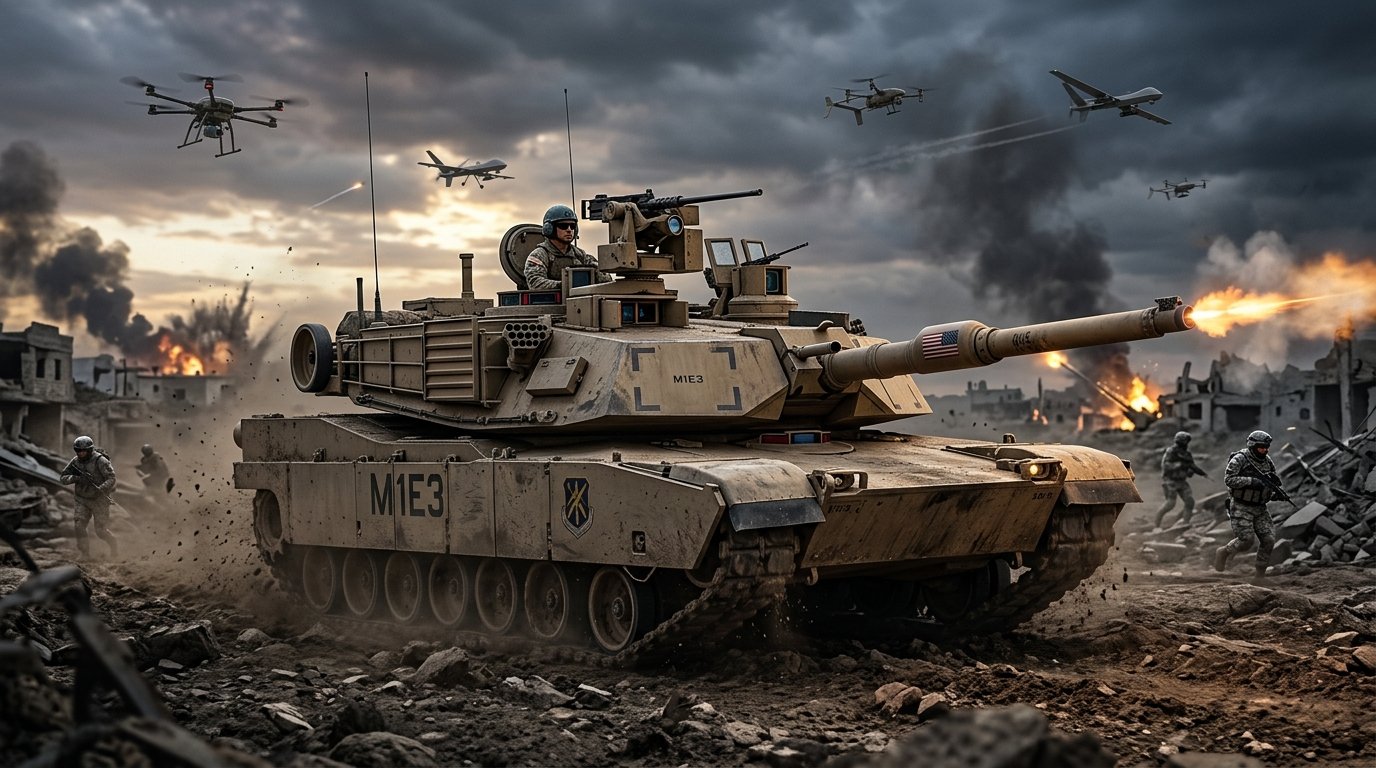
The M1 Abrams tank, an iconic symbol of American armored might, is undergoing a dramatic evolution with the arrival of the M1E3 variant, promising revolutionary changes for future warfare.
For nearly five decades, the M1 Abrams has been synonymous with battlefield dominance, but as threats evolve and warfare demands intensify, so too must this legendary tank. The latest iteration, the M1E3, is designed not merely to preserve the Abrams legacy but to redefine it. From groundbreaking propulsion to advanced defenses against drones and unmanned threats, this next-generation platform heralds a new era for armored combat as the world approaches 2040 and beyond.
Origins of the Abrams: A Cold War powerhouse built to outmatch the Soviets
The M1 Abrams was conceived in the 1970s during a period when American military planners sought a decisive edge over the Soviet Union’s formidable armored forces. Stemming from the failure of the MBT-70 project, the Army initiated the XM1 program to develop a tank prioritizing speed, firepower, and survivability. The core innovation lay in the introduction of Chobham composite armor, offering superior protection compared to conventional steel, combined with a potent 120mm smoothbore gun designated the M256.
Early Abrams models swiftly outpaced predictions, proving their mettle during the Gulf War when their range and firepower overwhelmed Iraqi tanks. With a production tally approaching 3,300 units during its initial run, the Abrams swiftly became the backbone of American armored forces and set the standard for main battle tanks across NATO allies.
The challenges ahead: Limitations of today’s Abrams variants under future combat demands
Despite impressive longevity, the Abrams faces growing challenges in the 21st century. The current 80-ton variants place significant strain on logistics, complicating deployment and resupply for modern armies. The Army Science Board (ASB) warns that as warfare becomes more mobile and digitally interconnected, the Abrams’ heavy weight and aging platform threaten to reduce battlefield effectiveness by 2040.
Modern combat scenarios emphasize agility, resilience, and networked operations, areas where older tank designs struggle. Furthermore, new threats such as unmanned aerial vehicles (UAVs) and smart anti-tank systems require active defenses beyond traditional armor, pushing the Abrams toward a fundamental redesign.
Hybrid power and reduced crew: Innovations defining the M1E3’s cutting-edge design
Transitioning from pure combustion engines, the M1E3 introduces a hybrid-electric drivetrain, promising approximately 50% better fuel efficiency and extended operational range on the battlefield. This technological leap aims to slash the logistical burden of constant fuel resupply, a critical factor for sustained combat operations in hostile territories.
The tank also shrinks its crew size from four to three by relocating the crew members inside the hull while transforming the turret into an unmanned system equipped with an autoloader. This unmanned turret setup enhances survivability by removing personnel from the most vulnerable part of the tank and accelerates firing cycles.
Why a hybrid drivetrain matters for future battlefields
The hybrid system is not only about fuel economy; it provides silent operational modes that reduce the tank’s acoustic signature, helping troops maneuver undetected. It also opens pathways for integrating future energy-hungry technologies such as directed-energy weapons or advanced electronic warfare suites, preparing the M1E3 for multifaceted threats.
Modern threats, modern defenses: Protecting crews from drones and sophisticated munitions
The M1E3 aims to surpass the protection levels of its predecessors by incorporating a suite of active and passive armor systems designed to counter drone-delivered munitions and advanced anti-tank missiles. One such system is the Israeli-proven Trophy active protection system (APS) already fielded on some Abrams variants, which intercepts incoming projectiles with kinetic bursts—now adapted to fend off drone attacks as well.
The tank’s hull armor and electronic countermeasures are continually upgraded to tackle “near transparency” battlefield conditions, meaning that enemies have reduced ability to detect and target the vehicle thanks to sophisticated concealment and electronic warfare capabilities.
Streamlined upgrades: Modular architecture shaping the Abrams future
The M1E3 abandons rigid legacy systems in favor of a modular open systems architecture (MOSA). This flexibility streamlines the integration of emergent technologies such as AI-enhanced targeting, command and control systems, and drone coordination tools. Faster upgrades mean the tank can stay ahead in the technological race without costly and time-consuming overhauls.
This adaptability will allow the Abrams to evolve alongside changing warfare paradigms—keeping it relevant through 2040 and beyond in a rapidly shifting combat landscape.
M1 series evolution at a glance: From original M1 to forthcoming M1E3
| Model | Introduction Year | Main Features | Strengths | Limitations |
|---|---|---|---|---|
| M1 Abrams | 1980 | 105 mm gun, Chobham armor, gas turbine engine | High survivability, mobility for its time | Outmatched by newer threats, heavy weight |
| M1A1 Abrams | 1986 | 120 mm M256 gun, improved armor, CBRN protection | Superior firepower, widely respected in Gulf War | Still heavy, logistic burden |
| M1A2 SEP V3 | 2020s | Advanced thermal viewers, digital systems integration | Improved targeting, networked warfare capable | Weight limits further upgrades |
| M1E3 Abrams | Expected 2030s | Hybrid-electric drivetrain, unmanned turret, modular design, AI defense systems | Reduced weight, enhanced efficiency, drone countermeasures | In developmental testing |
Looking forward: Why the Abrams’ legacy must evolve to meet tomorrow’s wars
Warfare in 2040 will differ drastically from today’s conflicts, emphasizing multi-domain agility, drones, and electronic battlefield dominance. The M1E3 is a proactive step to ensuring the Abrams remains a critical asset in such an environment. Its hybrid power and unmanned systems address logistical and survivability challenges, while modular designs prepare the tank for unforeseen technological innovations.
While the Army Science Board cautions that the Abrams family won’t dominate the battlefield indefinitely, the M1E3 provides a vital bridge toward next-generation platforms yet to come. Its success will influence armored tactics and defense strategies for decades, cementing the Abrams’ status as an evolving legend rather than a relic.
What makes the M1E3 different from previous Abrams models?
The M1E3 introduces a hybrid-electric drivetrain, unmanned turret, advanced AI defenses, and modular design, increasing efficiency and adaptability while reducing crew size.
When is the M1E3 expected to be operational?
Initial prototypes are scheduled for 2026, with early operational capability expected in the early 2030s.
How does the Trophy active protection system defend against anti-tank threats?
Trophy uses kinetic projectiles to intercept incoming missiles and rockets, recently upgraded to counter drone-delivered munitions.
Why is the M1 Abrams considered heavy and logistically challenging?
At 80 tons, the Abrams is difficult to transport and maintain, requiring extensive fuel and support, which limits operational flexibility.
What technological upgrades enable the M1E3 to handle future battlefield threats?
Its modular open systems architecture allows quick integration of new tech like AI threat detection, drone coordination, and electronic countermeasures.
