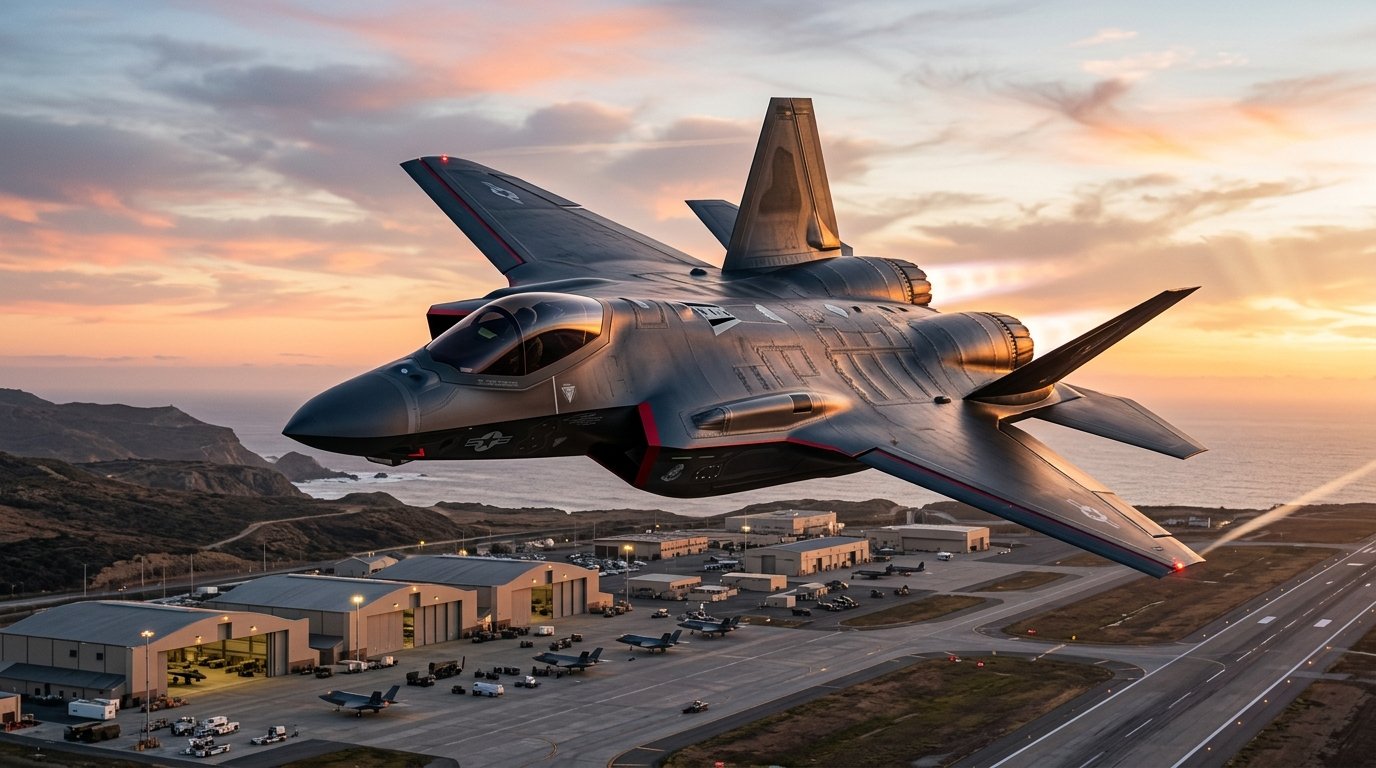
The U.S. Air Force’s F-35 Lightning II is not just a fighter jet; it’s evolving into a super stealthy, high-performance “Ferrari” variant that could redefine air superiority and reshape global military dynamics.
As aerial warfare intensifies, the U.S. military is pivoting toward quality over quantity with its flagship F-35 fleet. The latest upgrades, designed to inject sixth-generation tech into this fifth-generation platform, promise unprecedented capabilities that go well beyond conventional strike missions. More than just a stealth fighter, the F-35 is becoming a versatile combat node capable of orchestrating the future battlefield.
How the F-35’s tactical role is expanding in contested zones
The F-35’s operational value has skyrocketed amid ongoing conflicts, notably in Iran’s airspace, where it has moved beyond bombing runs to serve as a penetrating sensor node. This aircraft gathers critical intelligence on enemy defense systems and relays real-time targeting data to allied forces, essentially acting as an airborne command hub. Its advanced sensor fusion and secure data links enable seamless networked warfare—capabilities absent in legacy jets like the F-15 or F-16.
Why stealth and sensor fusion make the F-35 indispensable
Stealth is only part of the F-35’s winning formula. The deep integration of sensor fusion allows it to absorb and distribute battlefield data, making other units more effective. Unlike older fighters that rely on external support, the F-35 functions internally across intelligence, surveillance, and reconnaissance roles. This capability transforms it from a traditional attack platform into a key player in multi-domain combat scenarios, paving the way for a new era of air dominance driven by information superiority.
Challenges in fleet readiness and sustainment spotlight the need for a “Ferrari” standard
While the F-35’s potential is clear, the program grapples with sustainment issues. Readiness rates have stubbornly remained between 50% and 60% due to spare parts shortages and maintenance bottlenecks. This creates a gap between having a fleet and fielding a fully mission-capable force. With the U.S. Air Force’s operational fighters having dwindled to around 1,100 aircraft, it’s evident that quantity without quality won’t secure aerial superiority.
The critical importance of high-performance, fully upgraded jets
Simply adding more airframes isn’t the solution. The U.S. military needs “Ferrari” F-35s—jets operating at their designed performance limits with complete Technology Refresh-3 (TR-3) and Block 4 upgrades. These enhancements unleash the processing and thermal management power necessary to integrate advanced electronic warfare systems and next-gen weapons, delivering a combat edge unmatched by rivals. This focus on excellence ensures the fleet remains lethal and relevant amid evolving threats.
The Ferrari F-35: a new benchmark for 6th generation capabilities at a fraction of the cost
Lockheed Martin envisions the “Ferrari” F-35 as a game-changer—capable of delivering about 80% of 6th generation fighter performance for roughly half the cost of developing a completely new aircraft. This ambitious upgrade hinges on completing current technology transitions that enhance computing power and expand electronic warfare and sensor ranges.
The planned advancements include:
- Improved power generation and optimized thermal control thanks to upgraded Pratt & Whitney engines.
- Expanded weapons integration allowing for next-generation munitions to operate effectively.
- Enhanced Multifunction Advanced Data Link (MADL) providing near-invisible, high-bandwidth communication among F-35s.
- Expanded interoperability with legacy fighters through an upgraded Link 16 datalink.
- Capability to command collaborative unmanned systems, turning the F-35 into a force-multiplier.
Comparing fighter inventory and modernization efforts: U.S. versus China
| Aspect | U.S. Air Force | Chinese Air Force |
|---|---|---|
| Active fighters | ~1,100 fully mission-capable | Rapidly growing, hundreds annually |
| Average aircraft age | ~30 years | Significantly younger fleet |
| Stealth fighters in service | Operational F-35s, Block 4 upgrades ongoing | J-20 production scaling rapidly |
| Annual procurement goal | 72 fighters minimum | Several hundred annually |
| Focus | Upgrades for higher performance, readiness issues | Mass production and industrial capacity expansion |
Why data networking transforms air combat more than raw numbers
In future air battles, individual aircraft performance means less than how well they connect and share information. The F-35’s dual data links—MADL and Link 16—create a comprehensive combat network where jets act as interconnected nodes rather than isolated platforms. This allows for rapid target detection and coordinated multi-attack strategies.
With the Block 4 and TR-3 upgrades, these data-sharing capabilities will see a significant boost in speed, range, and bandwidth, enabling the F-35 to coordinate teamed operations with unmanned “loyal wingmen.” This development foreshadows a revolutionary shift in air warfare where networks dominate over solo heroics.
Key advantages of the F-35’s collaborative warfare design
- Secure, low-probability interception communications among stealth jets.
- Integration with legacy and allied aircraft to maximize operational flexibility.
- Centralized command and control functions embedded within the fighter.
- Support for unmanned systems, amplifying force projection with fewer pilots.
Increasing F-35 purchases: timelines and strategic necessities
Despite the strategic need, procurement rates have lagged below the Air Force’s required 72 units per year for maintaining and growing the fleet. With the expected 2026 rollout of TR-3 and Block 4 capability expansions, accelerating purchases becomes essential.
Fulfilling these goals means not only increasing numbers but delivering each jet at the highest operational standard, creating a robust and flexible aerial force capable of countering near-peer adversaries and supporting allies worldwide.
What makes the ‘Ferrari’ F-35 different from earlier versions?
The ‘Ferrari’ F-35 refers to fully upgraded F-35s with TR-3 and Block 4 enhancements that boost computing power, thermal management, sensor range, and electronic warfare capabilities. This variant is designed to approach sixth-generation fighter performance at a fraction of the cost of new platforms.
Why can’t the U.S. rely on simply building more F-35s?
Increasing fighter numbers alone won’t achieve superiority because many existing jets face readiness and sustainment challenges. High mission-capable rates and advanced upgrades are essential to fielding an effective force, hence the emphasis on ‘Ferrari’ F-35s.
How do MADL and Link 16 data links enhance combat?
MADL enables stealthy, high-bandwidth communication exclusively among F-35s, preserving their low observability, while Link 16 connects them to older and allied platforms. Together they create a unified, networked warfighting system vital for future combat.
What is the significance of controlling Collaborative Combat Aircraft (CCA)?
Collaborative Combat Aircraft, including unmanned ‘loyal wingmen,’ act as force multipliers by extending the F-35’s reach and capabilities. Controlling CCAs allows pilots to direct multiple assets simultaneously, revolutionizing air strike tactics.
How does the U.S. fighter inventory compare with China’s?
The U.S. operates around 1,100 fighters, many older models, while China is rapidly expanding its younger fleet with hundreds of new fighters produced annually, including stealth jets like the J-20. This dynamic intensifies the urgency for U.S. modernization and fleet readiness.
