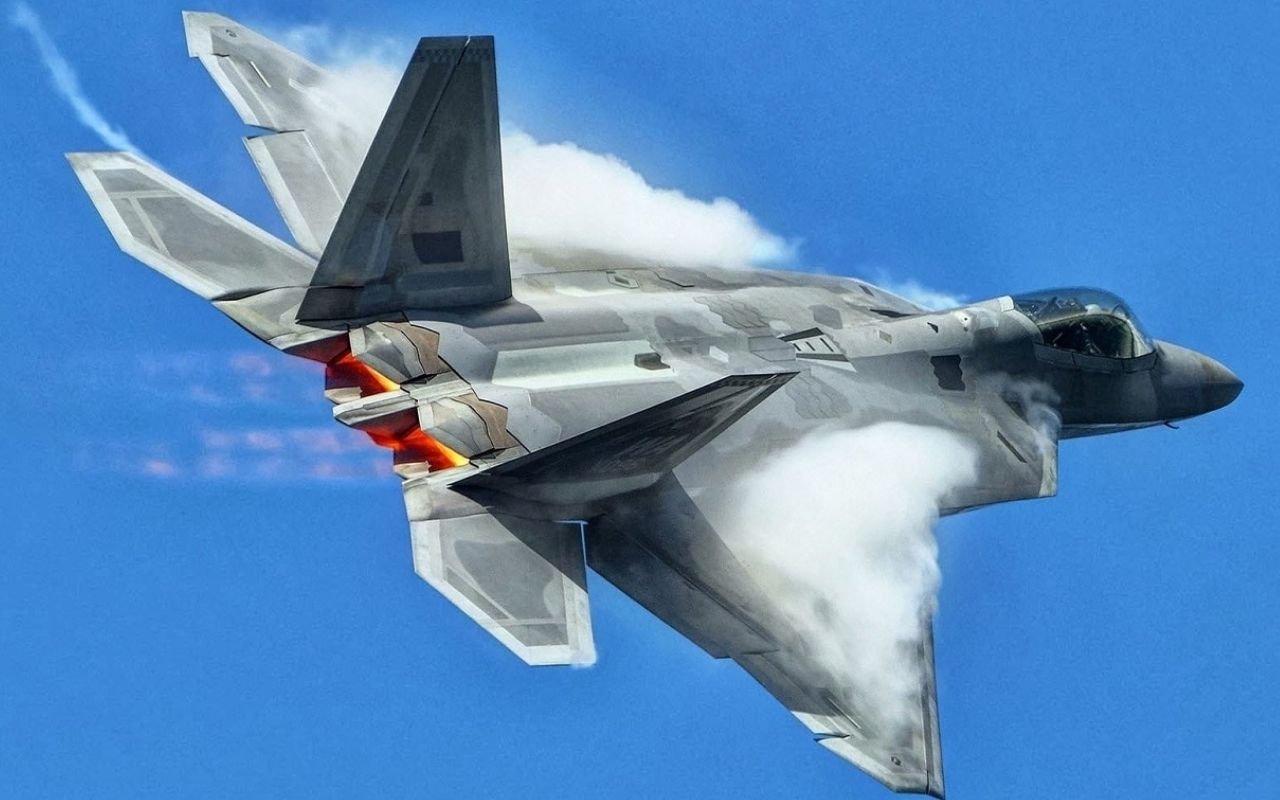
The simulated dogfights between the F-22 Raptor and F-35 Lightning II during Red Flag 21 highlight the evolving dynamics of stealth combat, showcasing the strengths and challenges of America’s premier fifth-generation fighters.
The skies above Nellis Air Force Base became the arena for a groundbreaking showdown where stealth met stealth head-on. In Red Flag 21, the U.S. Air Force brought together its two most advanced fighters, the iconic F-22 Raptor and the versatile F-35 Lightning II to push the limits of aerial combat training.
How Red Flag 21 reshaped stealth-on-stealth aerial combat tactics
Red Flag 21 was not just another training exercise; it marked a historic milestone by integrating high-fidelity simulations where both sides employed cutting-edge stealth platforms. Pilots faced off in a vivid reenactment of potential future conflicts against peer adversaries such as Russia’s Su-57 Felon and China’s J-20 Mighty Dragon. This evolution compelled American pilots to rethink existing tactics, challenging their mastery over radar evasion and advanced avionics in a space infused with cyber and information warfare threats.
F-35’s radar-evasive edge challenges traditional dogfighting
Colonel Scott Mills, an F-35 aggressor pilot, emphasized how the Lightning’s radar-shielding abilities forced opponents to abandon conventional strategies. The F-35’s state-of-the-art avionics suite enables pilots to operate with superior situational awareness and electronic countermeasures, making it a formidable “flying computer” in the dogfight arena.
Why the F-22 Raptor remains the king of dogfighting agility
Despite the F-35’s impressive stealth, the F-22’s design prioritizes air superiority, excelling in maneuverability and supercruise speeds exceeding Mach 1.8. Veteran instructors like Captain Patrick “Smokah” Bowlds attested that the Raptor’s agility and proven aerial combat tactics still offer a significant edge in close-range engagements.
A perfect storm: tactics meet technology in aerial duels
The clash of the F-22’s raw agility and the F-35’s tech-heavy approach is the centerpiece of simulated engagements. Pilots wrestle with unpredictable opponent maneuvers while juggling the demands of multi-domain warfare that includes cyber and space elements, making every dogfight uniquely challenging.
A multi-domain threat environment intensifies training realism
Red Flag 21 introduced simulated surface-to-air missiles and information warfare elements, replicating the complex web in modern battlefields. This integration forces pilots not just to fly aggressively but to think strategically, managing simultaneous threats in air, cyber, and space domains to maintain dominance.
Elevating pilot preparedness for near-peer conflict scenarios
The practice of engaging stealth opponents like the F-35 refines skills necessary for real-world encounters with Russia’s Su-57 or China’s J-20. This readiness is vital for maintaining aerial dominance in contested and denied environments where every second counts.
F-22 and F-35 strengths summarized in high-stakes engagements
| Feature | F-22 Raptor | F-35 Lightning II |
|---|---|---|
| Primary role | Air superiority fighter | Multirole stealth warfighter |
| Stealth capabilities | Exceptional, especially in dogfights | Advanced radar-evading with cutting-edge avionics |
| Speed | Supercruise at Mach 1.8+ | Subsonic cruise with supersonic capability |
| Maneuverability | Outstanding agility for dogfights | Good, optimized for sensor fusion and strike missions |
| Avionics | Excellent, focused on air dominance | Superior situational awareness and electronic warfare tools |
| Cost per unit | Approximately €290 million | Approximately €79 million |
- Stealth technology advances: Both jets incorporate cutting-edge radar-evading designs that challenge detection systems.
- Aerial combat philosophy: The F-22 leans on raw agility and speed to dominate dogfights, while the F-35 leverages superior avionics and multi-domain awareness.
- Complementary roles: These jets are designed to work in tandem, each excelling in different combat scenarios to provide comprehensive air power.
- Training evolution: Exercises like Red Flag 21 expose pilots to complex, realistic threats, including cyber and space, preparing them for multi-layered warfare.
- Operational costs: The F-22’s sophisticated systems come at a higher price, influencing fleet size and deployment strategy.
How low observability redefines air combat success metrics
Stealth has shifted the paradigm from brute force dogfighting to invisible, sensor-driven battles. Both the F-22 and F-35 bring unique approaches—one focusing on maintaining air superiority with supreme agility, the other providing comprehensive battlefield intelligence and strike capabilities.
Use of advanced avionics shapes pilot decision-making
The F-35’s sensor fusion technology provides pilots with an unparalleled picture of the battlespace, enabling quicker decisions and precision targeting beyond visual range. Meanwhile, the F-22 relies heavily on pilot reflexes and maneuver mastery to close with stealth adversaries.
Red Flag exercises solidify the U.S. air dominance outlook
By simulating the “invisible” confrontations that define modern warfare, Red Flag 21 proves that U.S. pilots remain the top aerial predators—even when flying against the toughest stealth enemies ever. The exercise sharpens tactical adaptability amid rapidly shifting and multi-domain threats.
Watching real excerpts from Red Flag 21 helps visualize the intense and complex interplay between these two stealth giants.
Preparing for the next decade of aerial warfare challenges
As rivals enhance their stealth fighters and anti-access strategies, the U.S. continues to invest in pilot training, aircraft upgrades, and multi-domain integration. Maintaining superiority will depend on mastering stealth, electronic warfare, and flexible tactics under pressure.
What makes the F-22 superior in dogfights?
The F-22’s exceptional agility, higher supercruise speed, and design tailored for air dominance give it an edge in close-range, maneuver-intensive dogfights.
Why is the F-35 considered a better warfighter overall?
The F-35 combines stealth with advanced avionics, electronic warfare systems, and multirole capabilities, making it versatile across various combat missions beyond just dogfighting.
How did Red Flag 21 change pilot training?
Red Flag 21 introduced stealth-on-stealth engagements and incorporated cyber and space threats, preparing pilots for complex multi-domain battlefields.
Are the F-22 and F-35 designed to compete with each other?
No, they are complementary fighters with distinct roles: the F-22 dominates air superiority, while the F-35 handles multirole missions including strike and surveillance.
What lessons did pilots learn from simulated stealth encounters?
Pilots learned to adapt tactics against radar-evasive threats, improved coordination in congested airspaces, and enhanced situational awareness under multi-spectrum challenges.
