
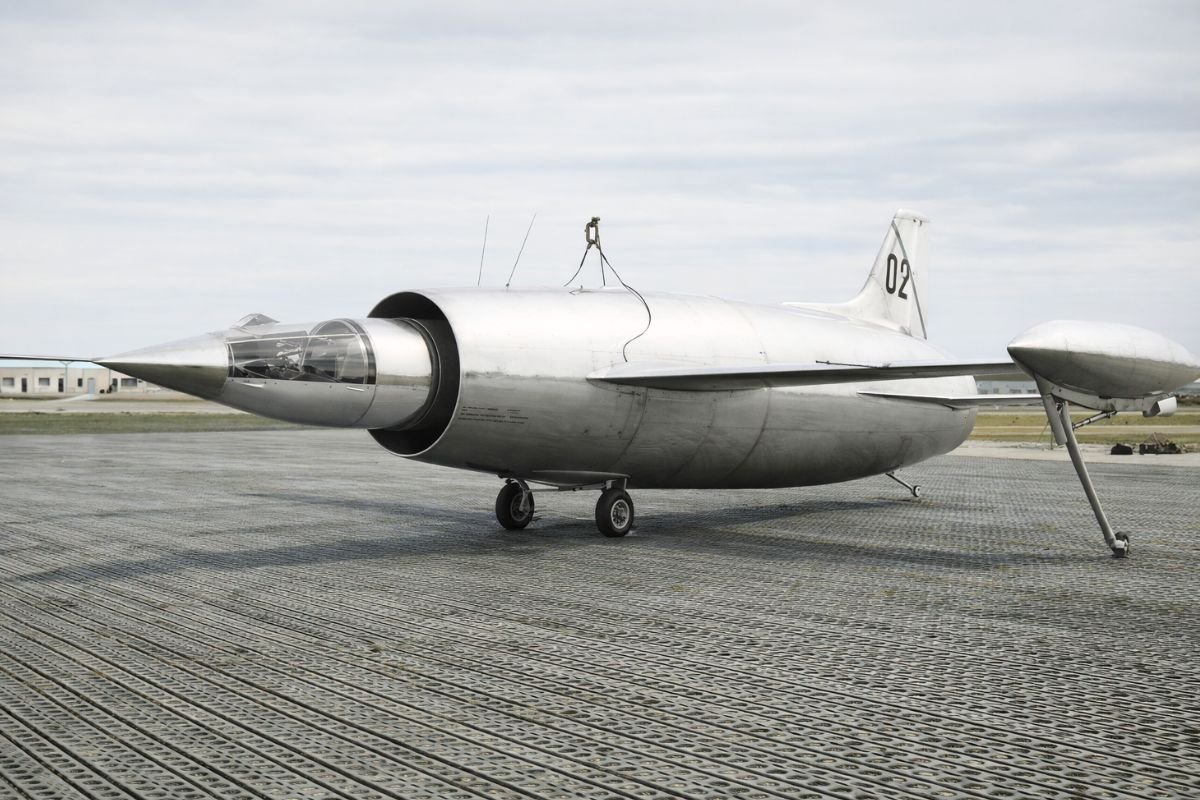
It looked like a jet, flew like a rocket—and yet, it could not even take off on its own!
In the early 1950s, France was rebuilding more than cities—it was rebuilding technological ambition. You are looking at a country determined to rejoin the front line of aerospace innovation, competing with the United States and the Soviet Union in a rapidly evolving Cold War landscape.
One engineer, René Leduc, pushed that ambition to its limits. His vision was simple in theory but extreme in execution: abandon conventional jet engines and build an aircraft entirely around a ramjet propulsion system.
The result was the Leduc 0.21, an aircraft that was less a plane than a flying engine—designed to validate a concept decades ahead of operational reality.
Leduc 0.21, the French aircraft built around a single idea
The Leduc 0.21 did not resemble traditional aircraft of its time. There was no classic fuselage wrapped around an engine. Instead, the engine was the fuselage.
At its core was a ramjet—a propulsion system with no compressor, no turbine, and no moving parts. It relies entirely on high-speed airflow entering the engine to compress incoming air before combustion.
That design led to one of the most unusual cockpits ever built.
- The pilot sat inside the air intake
- Encased in a small forward capsule
- Exposed to extreme aerodynamic constraints
- With limited forward visibility
This configuration was not just unconventional—it was risky. You were essentially placing a human being inside the front end of a high-speed combustion system.
Yet the payoff, at least on paper, was compelling. Ramjets become highly efficient at speeds between Mach 3 and Mach 5 (2,300 to 3,800 mph)—far beyond what early jet fighters could sustain.
A rocket-like launch for a jet aircraft
Here lies the fundamental paradox of the Leduc 0.21: it could not generate thrust at low speed.
A ramjet only works when air is already entering the engine at high velocity. No speed means no compression. No compression means no combustion. No combustion means no thrust.
So how do you launch such an aircraft?
You carry it.
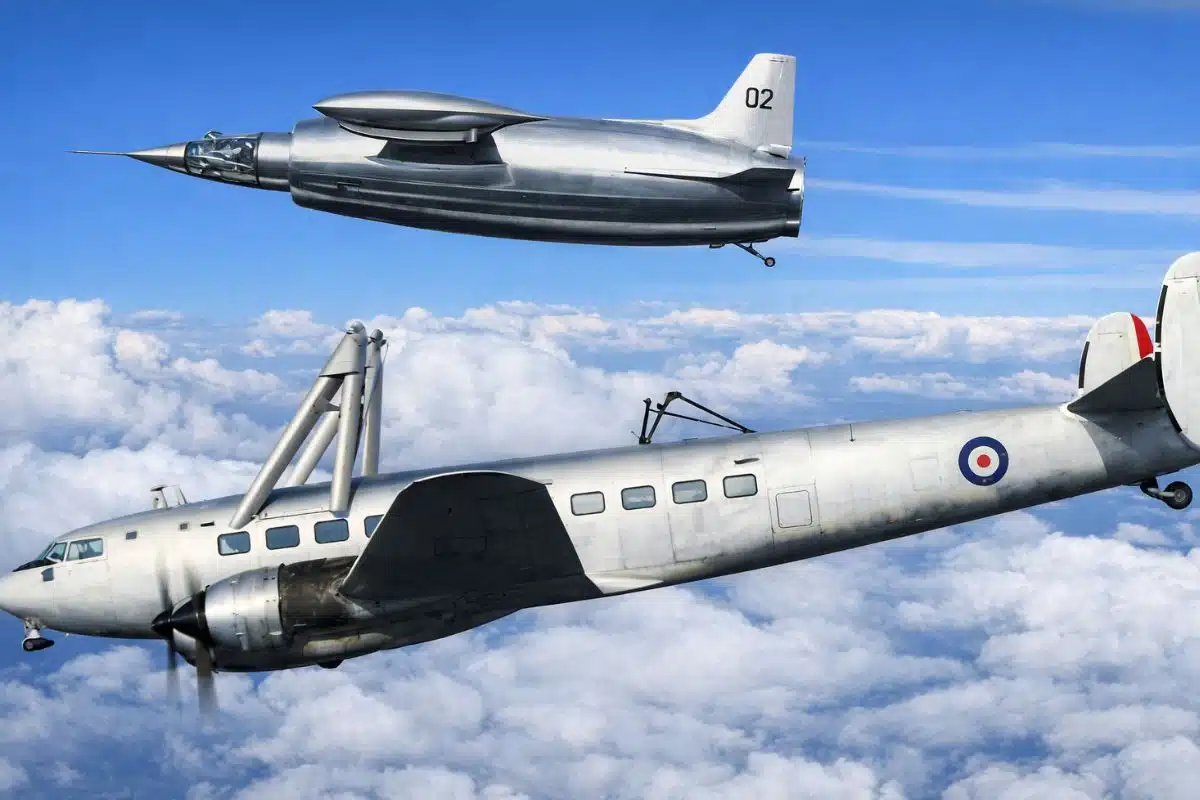
The Leduc 0.21 was mounted under a modified SNCASE SE.161 Languedoc bomber, which acted as a mothership. Once airborne, the sequence unfolded:
- The carrier aircraft climbed to altitude
- The Leduc was released mid-air
- The ramjet ignited at high speed
- The test flight began
This method resembled rocket deployment more than aviation. It was elegant in concept—but operationally complex.
Promising performance, crippling limitations
From a purely technical standpoint, the program worked. Flight tests conducted between 1953 and 1956 demonstrated that the ramjet concept was viable in manned flight.
But viability is not the same as usability.
Below is a clear breakdown of the aircraft’s operational reality:
| Category | Assessment |
| Propulsion efficiency | High at supersonic speeds |
| Mechanical complexity | Low (few moving parts) |
| Takeoff capability | None (requires carrier aircraft) |
| Range | Extremely limited |
| Fuel consumption | Very high |
| Operational flexibility | Very low |
| Deployment cost | High (dual-aircraft requirement) |
You quickly see the problem. While the Leduc 0.21 proved the physics, it failed the battlefield test.
For military planners, the aircraft posed multiple challenges:
- Total dependence on a carrier aircraft
- Heavy logistical footprint
- Limited endurance
- Inability to conduct rapid or repeated missions
In an era moving toward autonomous, fast-reacting interceptor aircraft, this was a dead end.
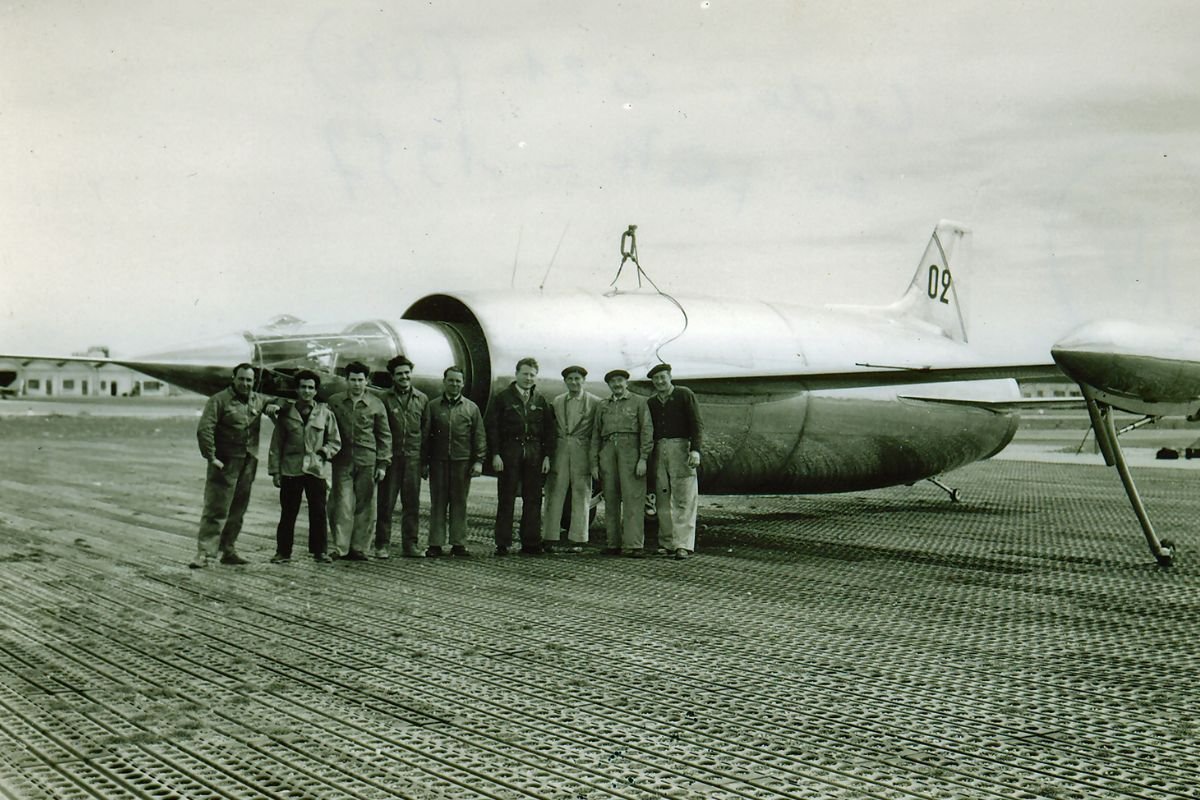
Only two prototypes were built before the program was abandoned.
Too early for its own revolution
And yet, dismissing the Leduc 0.21 as a failure would be a mistake.
What René Leduc explored in the 1950s has quietly become relevant again.
Ramjet and scramjet technologies are now at the heart of:
- Supersonic and hypersonic missiles
- Experimental high-speed reconnaissance platforms
- Future strike systems exceeding Mach 5+ (3,800+ mph)
The key evolution has been the scramjet (supersonic combustion ramjet), capable of operating efficiently at even higher speeds—something Leduc could only anticipate.
In that sense, the Leduc 0.21 was not obsolete. It was simply misaligned with the technological ecosystem of its time.
The materials, fuel systems, and mission doctrines required to make such propulsion viable did not yet exist.
A symbol of engineering audacity
You are looking at a machine born in a unique moment—when engineers were willing to take extreme risks to leapfrog entire generations of technology.
The Leduc 0.21 never entered service. It never reshaped air combat. It never became more than a prototype.
But it represents something more enduring: a mindset.
An era when aerospace design was driven less by incremental optimization and more by radical ideas—tested in full scale, often at great cost.
Today’s hypersonic race, unfolding between major powers, echoes that same logic. The difference is that now, the industrial base and digital tools exist to support it.
Back in the 1950s, René Leduc was building the future with analog tools—and betting on physics alone.
Sources:
- Forum Militaire, The Leduc 0.21, the French ramjet aircraft that was 50 years ahead of its time but never took off on its own (March 22, 2026),
In-depth article detailing the development of the Leduc 0.21 experimental aircraft, highlighting its pioneering ramjet propulsion system, its dependence on a carrier aircraft for launch, and the broader technological ambitions of post-war France in high-speed aviation. - AviationsMilitaires.net, Leduc 0.21 (accessed 2026),
https://aviationsmilitaires.net/v3/kb/aircraft/show/1739/leduc-021
Technical reference page providing specifications and historical context of the Leduc 0.21, including performance data, design features, testing phases, and its role within early supersonic and ramjet research programs.
The featured image was created using archival photos and AI for illustrative purposes in this article.
