Two contract modifications. One radar. Nearly a billion dollars. The AN/TPY-2 is quietly becoming the most expensively sustained piece of hardware in America’s missile defense architecture — and Washington just committed to keeping it that way through 2030.
Buried inside the Pentagon’s March 26 contract release — a dense document most defense reporters skim for the headline numbers — are two modifications that, read together, say something significant about where American missile defense investment is actually flowing. Both go to Raytheon. Both concern the same system. And together they add up to $966.7 million in new ceiling value for a radar that most Americans have never heard of but that underpins virtually every THAAD battery deployed on the planet.
Related articles:
What the AN/TPY-2 Actually Does
The Army Navy Transportable Radar Surveillance and Control Model 2 — AN/TPY-2 in Pentagon shorthand — is the eyes of the THAAD system. Without it, the interceptors are blind. It tracks ballistic missiles from launch through terminal phase, feeds targeting data to the fire control system, and can operate in two distinct modes: forward-based, watching for launches from a distance, or as an integral component of a THAAD battery. It has been deployed to Japan, South Korea, Israel, Guam, and the UAE. When a THAAD battery goes somewhere, the AN/TPY-2 goes with it.
Which makes the scale of this week’s investment easier to understand.
Two Modifications, One Clear Message
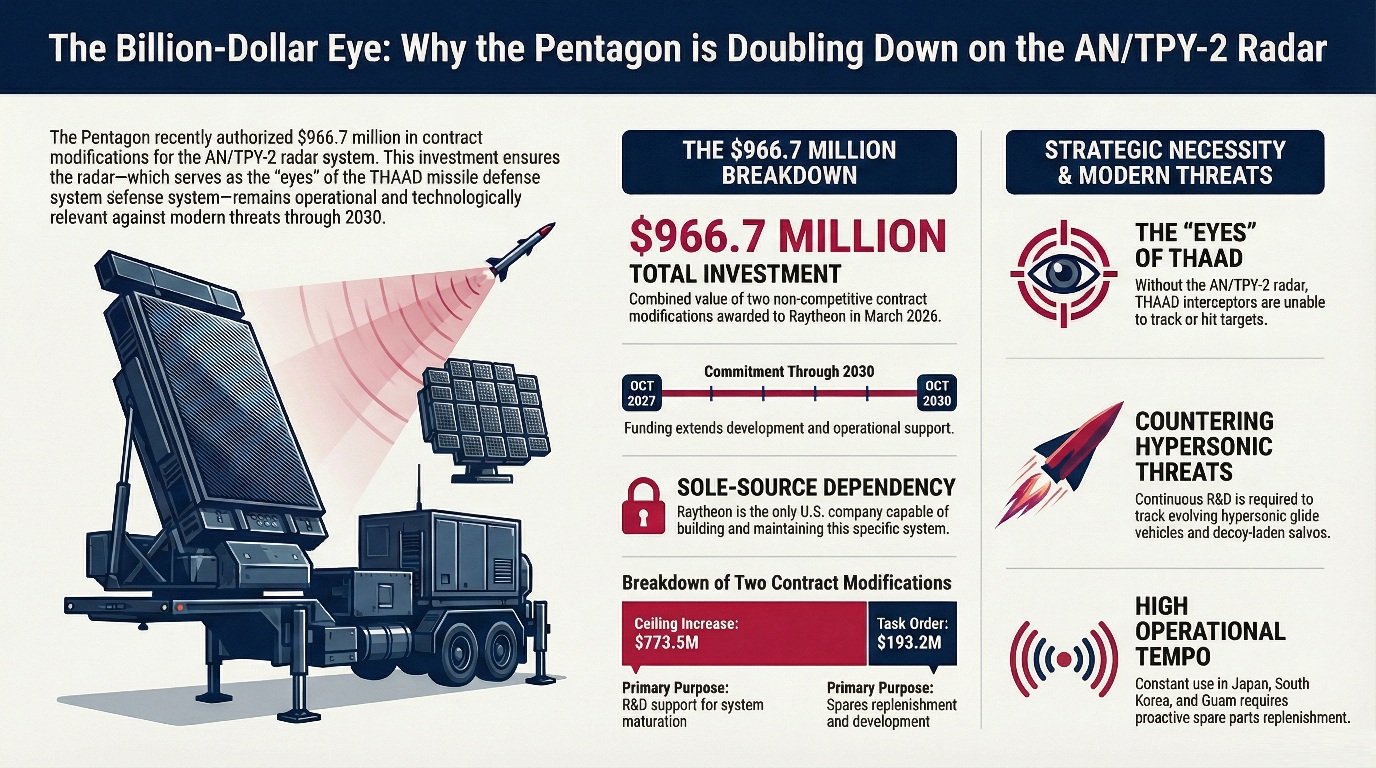
The first contract action extends Raytheon’s existing AN/TPY-2 radar development contract by three years — pushing the ordering period from October 2027 to October 2030 — while increasing its total ceiling from $1.47 billion to $2.25 billion. That’s a $773.5 million increase in authorized spending on research and development support for a system that, by conventional measures, should be mature by now.
The second modification is smaller but operationally telling: $193.2 million added to a task order specifically for spares replenishment and continued development support, running through the same October 2030 endpoint.
Put them side by side:
| Modification | Value | Purpose | Period |
| Contract ceiling increase (P00031) | $773.5M | R&D support, AN/TPY-2 radar | Through Oct. 2030 |
| Task order increase (P00026) | $193.2M | Spares replenishment + dev. support | Mar. 2026 – Oct. 2030 |
| Combined new obligation | $966.7M |
Both awards are noncompetitive. Raytheon is the sole source — not because the Pentagon prefers it that way, but because no other company in the United States builds this radar.
Why You’re Still Paying for R&D on a Decades-Old System
The AN/TPY-2 entered service in the early 2000s. The fact that it still commands hundreds of millions in annual R&D funding is not a sign of inefficiency — it’s a sign of an evolving threat environment pressing hard against a fixed architecture.
Ballistic missile technology hasn’t stood still. Hypersonic glide vehicles, maneuvering reentry vehicles, and decoy-laden salvos are all specifically designed to degrade the tracking and discrimination capabilities of ground-based radars like the AN/TPY-2. Keeping the system relevant means continuously updating its signal processing, software baselines, and electronic countermeasure resistance — none of which is cheap, and none of which ever fully ends.
The spares replenishment component of the second modification points to a different but related pressure: operational tempo. AN/TPY-2 systems deployed in South Korea, Japan, and Guam are running hard. Equipment that runs hard breaks more often and burns through consumables faster than peacetime planning assumptions typically account for. Washington is replenishing that pipeline proactively, not reactively.
The Broader Picture: A Week of Layered Defense Spending
The AN/TPY-2 contracts don’t sit in isolation. The same March 26 release includes $127.3 million to Northrop Grumman for 28 GQM-163A Coyote supersonic sea-skimming target drones — the high-speed surrogates used to simulate exactly the kind of anti-ship missile threats that Pacific defense planners lose sleep over. Japan and South Korea are both listed as foreign military sales customers on that contract, which tells you something about who is most urgently testing their defenses against that threat profile right now.
Elsewhere in the same document: $454.8 million to Advanced Engineering Solutions & Services for C5ISR shelter systems and platform integration, covering the sensor networks that feed targeting data up the chain. And $126.5 million to Austal USA for shipbuilding incentives tied directly to the One Big Beautiful Bill Act — the legislative vehicle the administration has used to channel shipbuilding investment.
Taken individually, each contract is a line item. Taken together, they sketch the outline of a defense industrial push that is less about any single weapon and more about hardening the entire sensor-to-shooter chain that makes modern integrated air and missile defense work.
Nearly a billion dollars on one radar system in a single week’s contract release. It’s easy to read that as excess — a defense procurement apparatus running on institutional inertia. The more accurate read is that the AN/TPY-2 sits at the intersection of every serious ballistic missile threat Washington is currently managing, and that no one in Huntsville or the Pentagon has found a cheaper way to keep it sharp. In missile defense, the radar is never just a radar. It’s the foundation everything else is built on — and right now, Washington is making very sure that foundation holds.
Sources: United States Department of Defense contract announcements, March 26, 2026. Missile Defense Agency, Huntsville, Alabama.
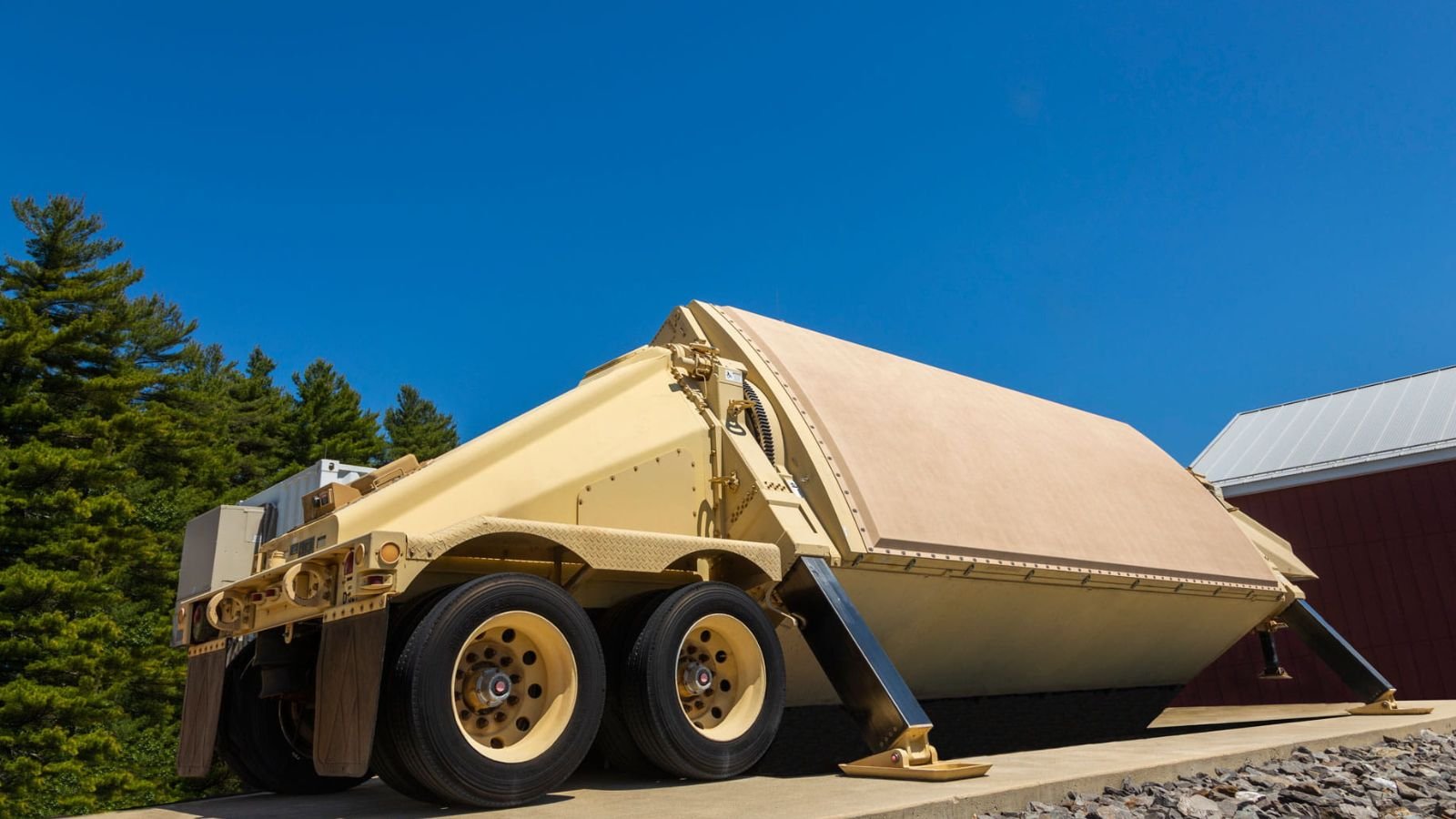
Image: The AN/TPY-2 transportable radar is a long-range, high-altitude missile defense radar designed to detect, track, and discriminate ballistic missiles. Developed by Raytheon, it is a core sensor of the THAAD and can also support systems like Patriot PAC-3. credit: RTX
