The European Commission has placed $132 million (€115 million) on the table for a new defense instrument called AGILE.
For years, Europe has funded research generously, then struggled to translate that research into deployable capability. The gap between laboratory and battlefield has been measured not in months, but in years—sometimes decades.
AGILE is meant to live in that gap.
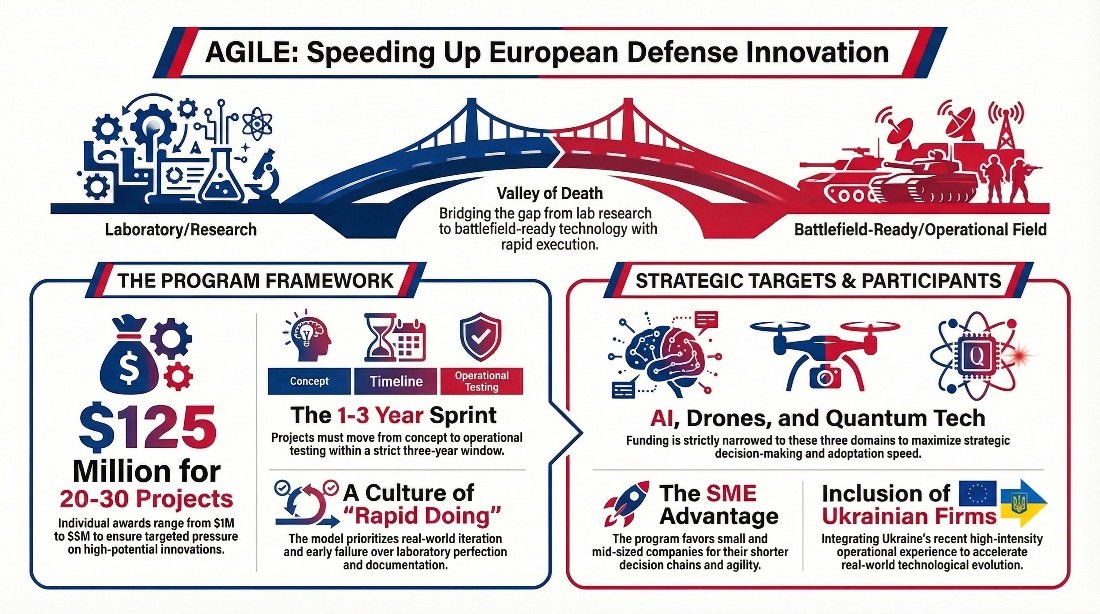
Not to replace procurement, not to rival large defense programs, but to accelerate the moment when an idea becomes something a soldier can use. The timeline is explicit: one to three years from concept to operational testing.
That is not how European defense usually works.
Related articles:
- US-based Kraus Hamdani unveils the record-breaking K1000ULE electric drone redefining ISR missions
- The US is cracking down on foreign drones, but these exemptions show Washington still cannot fully cut the cord
European Commission sets AGILE at $132 million for 20-30 projects
The structure of AGILE reflects a certain discipline.
Instead of dispersing funds widely, the Commission plans to support 20 to 30 projects, with individual awards ranging from roughly $1 million to $5 million.
This is not venture capital in the traditional sense. It is targeted pressure.
You fund fewer actors. You demand more from each. You expect something tangible at the end—something that can be tested outside controlled environments.
British Army regiment gunners become the first “drone aces” after intercepting Iranian drones
For a startup, that kind of funding can be decisive:
- Hiring specialized engineers
- Building functional prototypes
- Conducting field trials
But it is not enough to sustain long development cycles. And that is intentional.
AGILE is not designed to carry a project indefinitely. It is designed to force movement.
The quiet bet on smaller players
There is another layer to this initiative, one that is less visible but equally important.
The Commission is deliberately favoring small and mid-sized companies.
The reasoning, articulated by Commissioner Andrius Kubilius, is straightforward. Modern warfare is increasingly shaped by technologies that evolve faster than traditional procurement cycles. Smaller firms, with fewer layers and shorter decision chains, can adapt more quickly.
That is the theory.
The reality is more complex.
By channeling funds toward smaller actors, Brussels is also attempting to reshape the defense industrial landscape—to reduce reliance on a handful of large primes and introduce more competition.
That creates opportunity.
It also creates tension.
Established contractors, long accustomed to dominating defense markets, may see this as a shift in balance—one that introduces subsidized competitors into a space that has historically been closed.
AGILE, in that sense, is not just about innovation. It is about redistribution of influence.
A culture of “rapid doing”
The language coming from Brussels is revealing.
Executive Vice-President Henna Virkkunen has emphasized the need for a culture of “rapid execution”—a phrase that carries an implicit critique of existing processes.
European defense programs have often been defined by documentation, compliance, and layered approvals. These are not accidental. They exist to manage risk in systems where failure can be catastrophic.
But they also slow everything down.
AGILE attempts to rebalance that equation.
The model prioritizes:
- Real-world testing over laboratory validation
- Iteration over perfection
- Early failure over late disappointment
This is a different rhythm.
It accepts that some projects will fail, and that failure is part of the process—provided it happens early enough to inform the next iteration.
The challenge, as always, is discipline. Speed without control becomes noise. Control without speed becomes paralysis.
Three technologies, one direction
The Commission has narrowed AGILE’s focus to three domains:
- Artificial intelligence
- Quantum technologies
- Drones
This is not a broad portfolio. It is a deliberate selection.
Each of these areas reflects a shift in how military power is applied.
Artificial intelligence is less about autonomy in the abstract and more about decision compression—processing information faster than an adversary can react.
Quantum technologies remain partially speculative, but their implications for navigation, sensing, and secure communications are already shaping long-term planning.
Drones, meanwhile, have moved from niche tools to central instruments of modern conflict, altering the economics of surveillance and strike.
The common thread is speed—not just physical speed, but the speed of adaptation.
AGILE is trying to fund that.
The geography of participation
Eligibility for the program extends beyond the European Union itself.
Companies from the EU, the European Economic Area, and Ukraine are expected to participate.
That last inclusion is not incidental.
Ukraine brings something that Europe often lacks: recent, high-intensity operational experience. Its firms have adapted quickly under pressure, iterating technologies in real time.
Integrating that experience into European programs offers clear advantages.
But it also introduces complexity.
Participation in EU-funded initiatives requires compliance, reporting, and governance structures that can be burdensome—even for established companies. For smaller actors, especially those operating under wartime conditions, the balance between access and constraint will matter.
The familiar friction of European timelines
If there is one uncertainty surrounding AGILE, it is timing.
The Commission aims to launch the program in early 2027. But before that happens, it must pass through the European Parliament and the Council.
This is where ambition meets procedure.
European defense policy has gained urgency in recent years. But it remains shaped by national sensitivities, competing priorities, and the need for consensus.
Delays are not inevitable—but they are common.
And in a program built around speed, delay carries a particular cost.
Time as the real metric
For investors, founders, and engineers, the success of AGILE will not be measured in speeches or funding totals.
It will be measured in time.
- Time from call announcement to contract
- Time from contract to prototype
- Time from prototype to field testing
If those timelines compress, AGILE will have achieved something meaningful.
If they stretch, it risks becoming another layer in a system already known for its complexity.
A founder in Paris, running a small autonomy software firm, put it plainly:
The funding matters. But the calendar matters more.
A test of European intent
AGILE is, at its core, an experiment.
It tests whether Europe can move faster without losing control. Whether it can empower smaller actors without fragmenting its industrial base. Whether it can translate innovation into capability before the strategic environment shifts again.
The stakes are not abstract.
In a world where technological cycles are accelerating, the ability to deploy—not just develop—new systems becomes a form of power.
AGILE is a modest program in financial terms.
But it touches a larger question.
Whether Europe can adapt its institutions to a pace of change it did not design for—and whether it can do so before that pace begins to define its strategic limits.
Sources:
- Hezelburcht, “New European funding programme AGILE accelerates defence technologies” (published 2026),
https://www.hezelburcht.com/en/news/new-european-funding-programme-agile-accelerates-defence-technologies/
industry-focused article presenting the AGILE programme, a new European funding initiative aimed at accelerating the development of defence technologies, supporting innovation ecosystems, and improving the transition from research to operational capabilities across EU member states. - European Commission, “EU launches new initiative to accelerate defence innovation (AGILE programme)” (published 2026),
https://ec.europa.eu/commission/presscorner/detail/en/ip_26_687
official European Commission press release announcing the AGILE programme, detailing its objectives to strengthen Europe’s defence technological and industrial base, enhance cooperation between member states, and fast-track the development and deployment of critical defence capabilities.
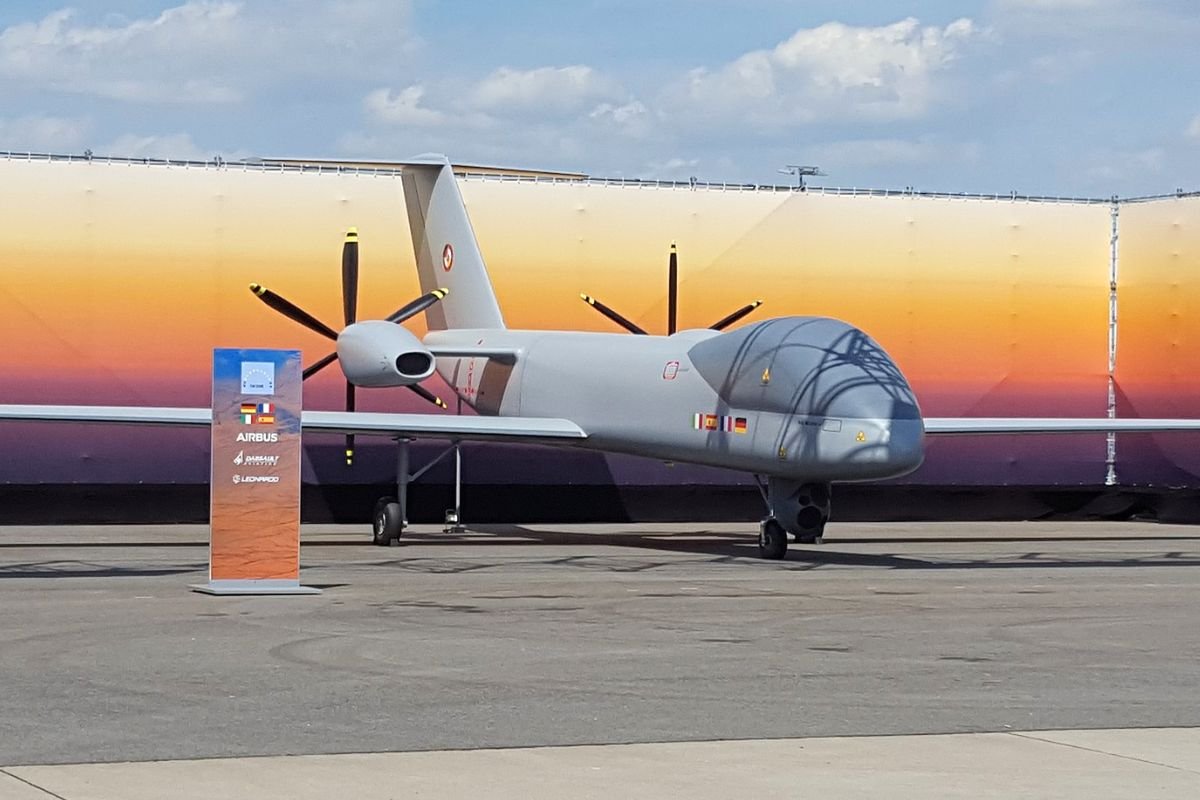
Image: European MALE RPAS Mock-up at ILA 2018
