A partnership that says more than it announces.
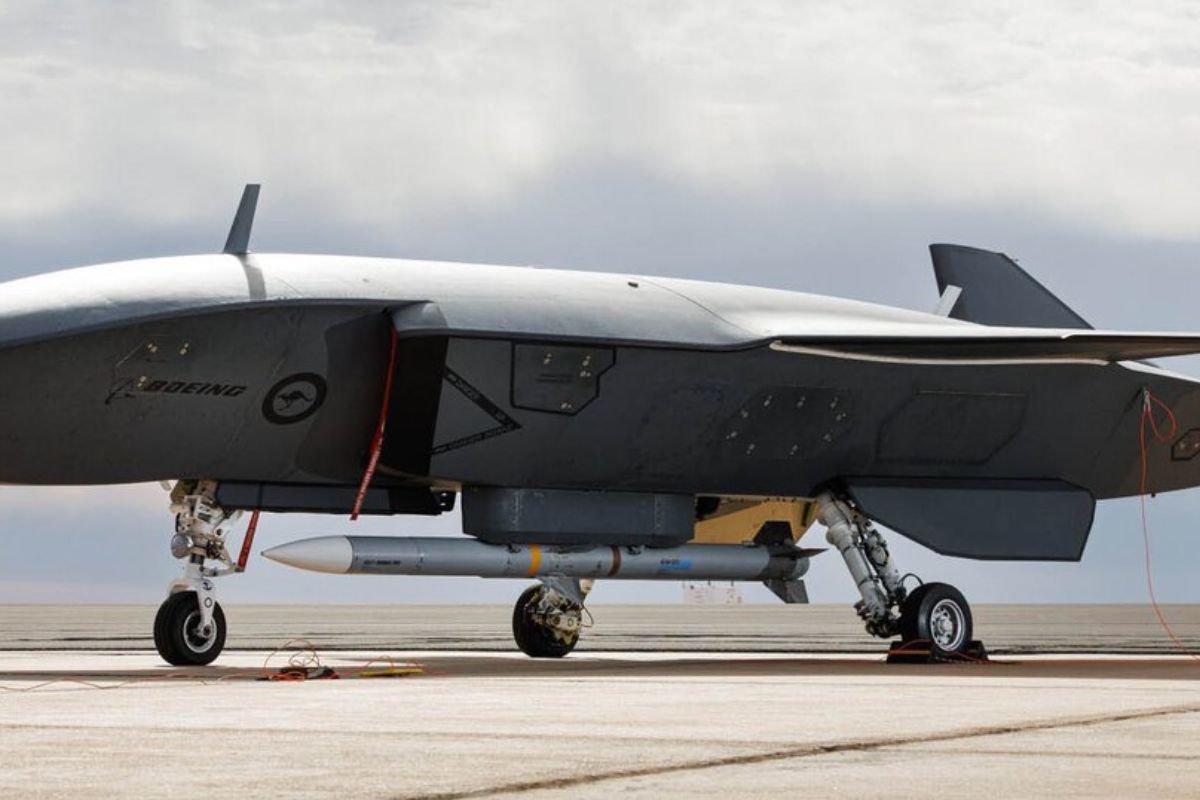
When Rheinmetall and Boeing confirmed their partnership around the MQ-28 Ghost Bat, the message was delivered in the usual language of industry, timelines, integration, value creation.
But beneath that language, there is a more consequential shift.
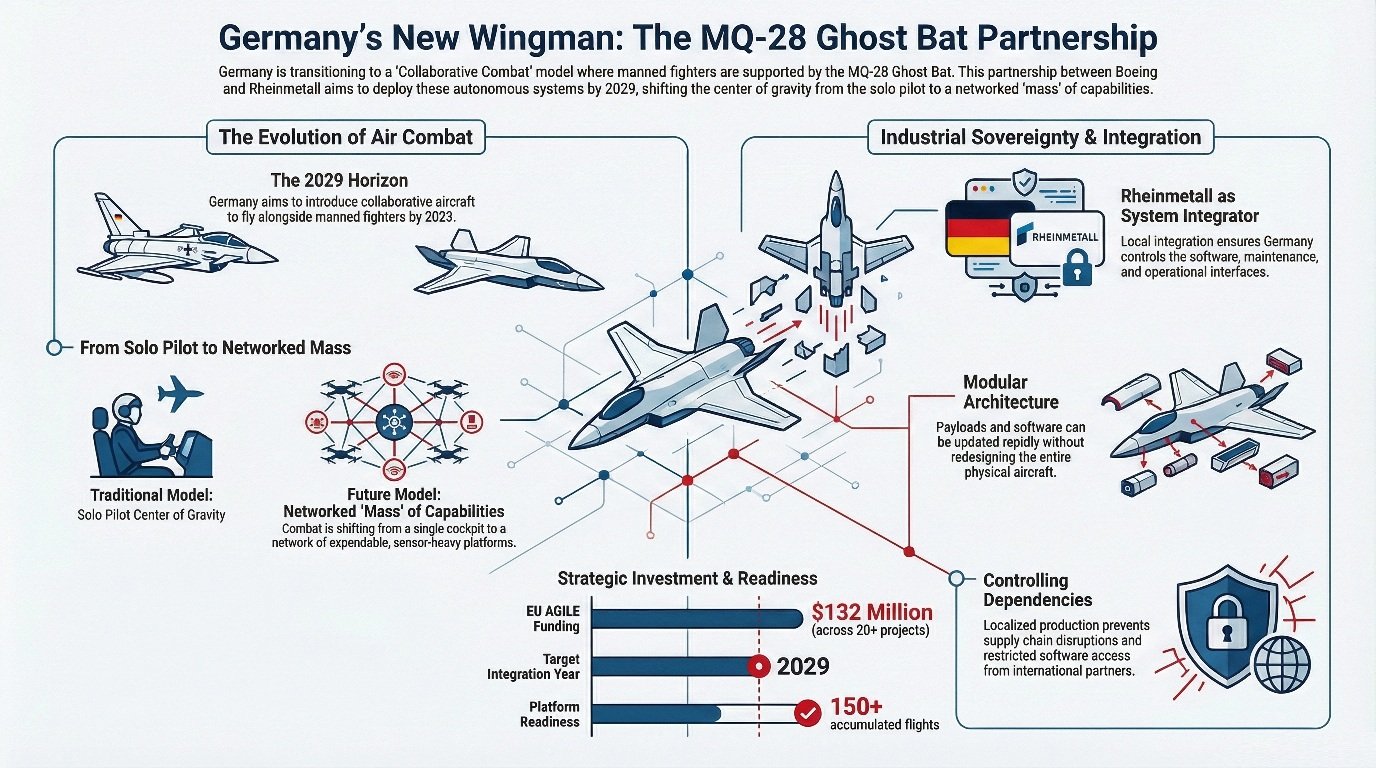
Germany is preparing to introduce collaborative combat aircraft, systems designed to fly alongside manned fighters, extending their reach, absorbing risk, and quietly reshaping how airpower is applied. The target date, 2029, is not distant. In defense terms, it is tomorrow morning.
And the choice of the MQ-28 is not accidental. It is one of the few platforms in this category that has already accumulated more than 150 flights. Not a promise, but a trajectory.
Related articles:
- The European Union finally appears to be grasping the stakes around military drones, committing $132 million across more than 20 projects under AGILE
- British Army regiment gunners become the first “drone aces” after intercepting Iranian drones
Germany is not just looking at a new aircraft, It is trying to understand what air combat will look like when pilots are no longer alone in the sky
For most of the modern era, air combat has revolved around a single figure, the pilot, enclosed in a cockpit, managing sensors, weapons, and decisions in real time. The aircraft was an extension of the individual.
That model is beginning to fracture.
The Ghost Bat represents a different logic. It is not designed to replace the pilot, but to surround him, or her, with additional capabilities. Sensors can be pushed forward without exposing a human life. Electronic warfare can be conducted from a distance. Weapons can be carried by platforms that are, in a sense, expendable.
This is what military planners describe as “mass,” but the word is misleading. It is not about numbers alone. It is about presence, saturation, the ability to complicate an adversary’s decisions.
One aircraft becomes several. One decision becomes a network of actions.
And gradually, the center of gravity shifts away from the cockpit.
Rheinmetall and the question of control
What matters in this partnership is not only the aircraft itself, but who shapes how it is used.
Rheinmetall’s role as system integrator places it in a position of quiet authority. Integration is where systems either align or fail. It is where software speaks to sensors, where data flows, where command structures take form.
Germany is not simply importing a drone designed elsewhere. It is insisting on embedding that drone within its own operational framework, adapting it to national requirements, ensuring that maintenance, logistics, and evolution are anchored locally.
There is also an industrial calculation behind this.
Berlin has become increasingly aware of the risks tied to dependence. Supply chains can be disrupted. Software can be restricted. Upgrades can be delayed or conditioned.
By placing Rheinmetall at the center of integration, Germany is attempting to retain a degree of sovereignty, even within a partnership that is, by definition, international.
This is not autonomy in the pure sense. It is something more nuanced, an effort to control the interfaces where dependence becomes vulnerability.
A platform that does not stay still
The MQ-28 was designed with a certain flexibility in mind. Its architecture is modular, which is another way of saying that it is meant to change.
Payloads can be replaced. Software can be updated. Missions can evolve without redesigning the entire system.
That matters because the pace of technological change is no longer aligned with traditional procurement cycles. By the time a system is fully developed, approved, and fielded, the environment it was designed for may already have shifted.
A platform that cannot adapt becomes obsolete quietly, almost without notice.
Here, the partnership extends beyond hardware. German and Australian engineers are expected to work together, refining both the physical system and the digital environment that supports it. There is talk of creating a domestic ecosystem for testing and validation, a space where new capabilities can be tried, discarded, improved.
This is where the real work happens. Not in announcements, but in iterations.
The geography of modern airpower
It is easy to think of airpower in terms of aircraft specifications, speed, range, payload.
But increasingly, geography asserts itself in different ways.
Europe is not the Pacific. It is denser, more constrained, layered with air defenses, surveillance systems, overlapping jurisdictions. Operating in such an environment requires more than performance. It requires coordination.
Collaborative aircraft fit into that geography.
They allow a force to extend its awareness without extending its vulnerability. They distribute functions across multiple platforms, making it harder for an adversary to disrupt the system as a whole.
For Germany, this is not an abstract consideration. It sits at the center of Europe, exposed to multiple directions, integrated within NATO structures, dependent on interoperability as much as on national capability.
The Ghost Bat becomes, in that sense, a tool not just of national defense, but of alliance cohesion.
A quiet competition of timelines
There is another dimension to this story, one that is rarely stated directly.
Across the world, major powers are exploring similar concepts. The United States, China, and others are all investing in collaborative combat systems, each with its own doctrine, its own industrial base, its own assumptions about how future conflicts will unfold.
In that environment, time becomes decisive.
Not just time to develop, but time to deploy. Time to integrate. Time to train.
The 2029 horizon reflects an awareness of that pressure. It suggests that Germany does not intend to arrive late to this transformation.
But timelines in defense are rarely linear. They stretch, they compress, they encounter friction. Political decisions intervene. Technical challenges emerge.
What matters is not whether 2029 is met precisely, but whether the momentum holds.
What changes, and what does not
It would be easy to describe the MQ-28 as a revolution.
That would be misleading.
Air combat will not change overnight. Pilots will remain central. Fighters will still carry the weight of missions. Decisions will still be made by humans.
But something is shifting beneath that continuity.
The pilot is no longer alone. The aircraft is no longer singular. The mission is no longer confined to one platform.
Instead, there is a system forming, gradually, almost imperceptibly, where autonomy, data, and coordination reshape how force is applied.
Germany’s partnership with Boeing, anchored by Rheinmetall, is one step in that direction.
A measured step, cautious in its structure, but clear in its intent.
And like many changes in military history, it will likely be understood fully only in retrospect, when what once seemed experimental has become simply how things are done.
Sources:
- Rheinmetall, “Rheinmetall and Boeing partner on German MQ-28 Ghost Bat” (published March 31, 2026),
https://www.rheinmetall.com/en/media/news-watch/news/2026/03/2026-03-31-rheinmetall-and-boeing-partner-on-german-mq-28-ghost-bat
official corporate release announcing a partnership between Rheinmetall and Boeing to develop and adapt the MQ-28 Ghost Bat for Germany, outlining industrial roles, integration into European defense ecosystems, and the strategic objective of enhancing collaborative combat aircraft capabilities. - ASDNews, “Rheinmetall, Boeing partner on German MQ-28 Ghost Bat” (published March 31, 2026),
https://www.asdnews.com/news/defense/2026/03/31/rheinmetall-boeing-partner-german-mq28-ghost-bat
defense news article summarizing the Rheinmetall–Boeing partnership around the MQ-28 Ghost Bat program, highlighting key program details, industrial cooperation aspects, and the implications for Europe’s future air combat systems and unmanned teaming capabilities.
