
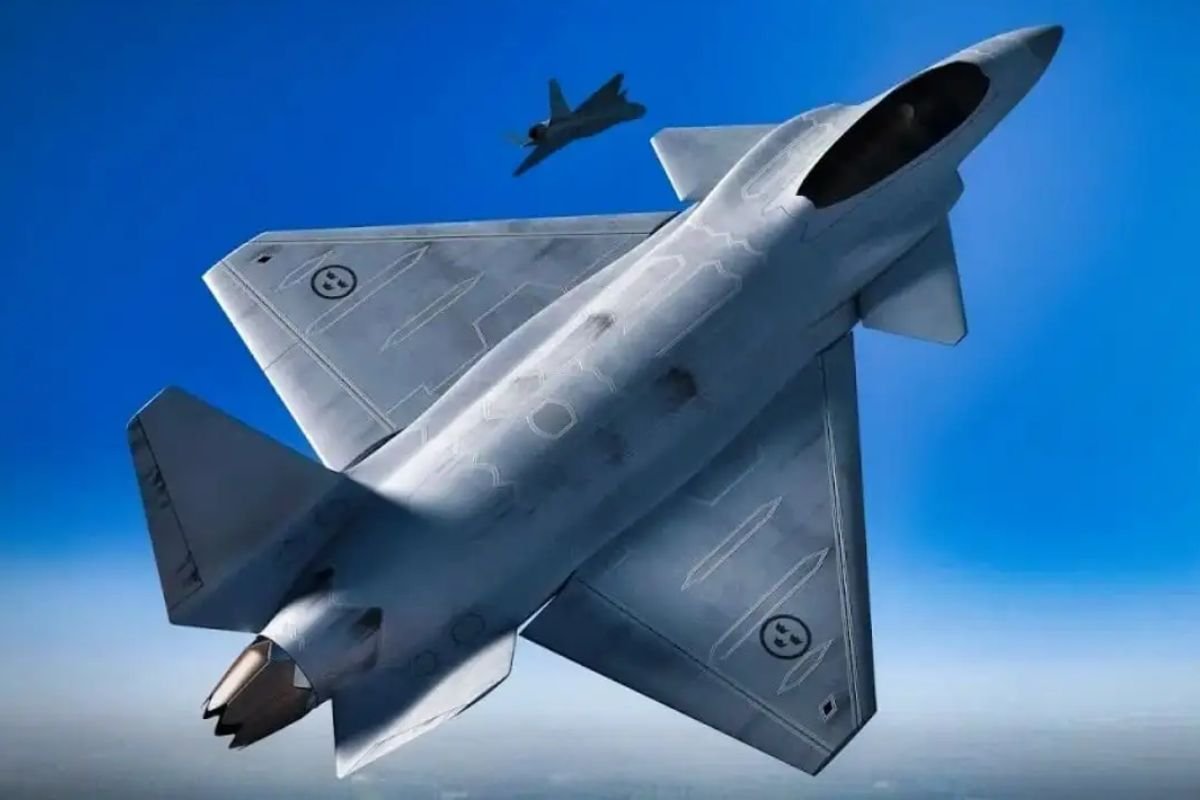
Saab is pressing Ottawa to join work on technologies that could define the next generation of air combat, at the same moment Canada is rechecking the assumptions behind its fighter plan.
The Swedish company says Canada has the industrial depth to contribute to sixth-generation development, while also reviving its offer to build Gripen jets and GlobalEye surveillance aircraft on Canadian soil.
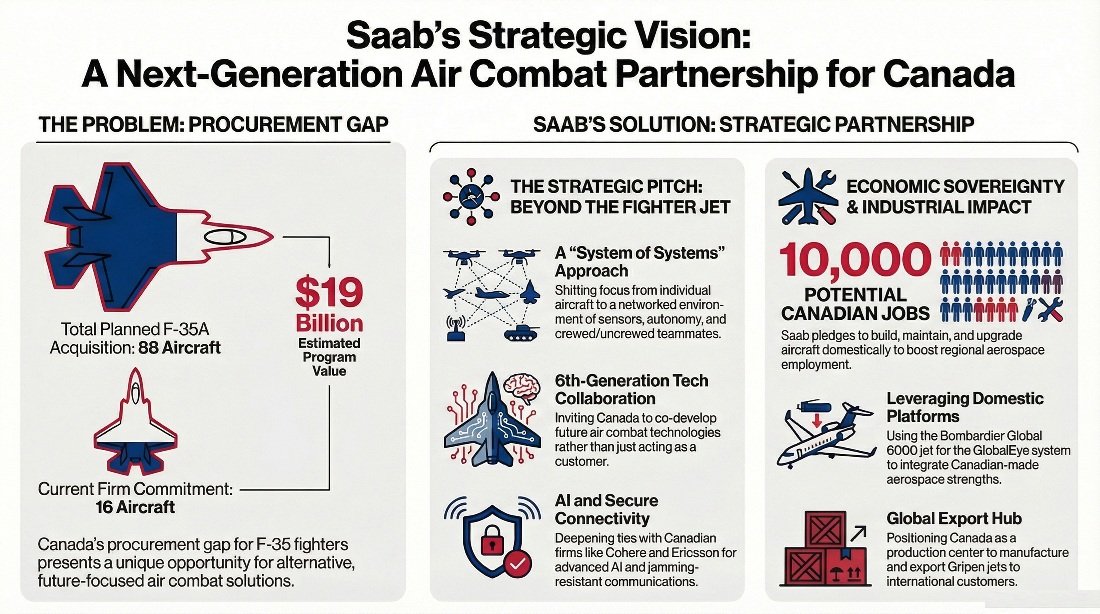
The timing is not accidental. Canada has an announced plan valued at about $19 billion for 88 F-35A fighters, but the government has only committed to buying 16 so far, with initial payments made for 14. With a strategic review underway, Saab is trying to turn a procurement debate into a longer-term partnership conversation about sensors, autonomy, and “system of systems” air warfare.
Related articles:
- F-22 vs F-35 at Red Flag 21: inside the stealth-on-stealth dogfights that forced U.S. pilots to rewrite modern air combat tactics
- France’s Rafale is carving out a unique lane against the F-35 and J-20, and the “super Rafale” upgrade is the reason why
Peter Nilsson pitches Canada on sixth-generation collaboration
Saab’s message to Canada is built around participation, not only sales. Peter Nilsson, who leads future programs at Saab, has said the company wants to work with countries and firms that are willing, interested, and have the skill set for next-generation aerial warfare systems. In that framing, Canada is not just a customer, it is a contributor to technologies that could shape future combat aviation.
The pitch lands as Ottawa studies what comes after the CF-18 era and what comes after today’s fighter concepts. Saab points to the direction of travel across advanced air forces, where the fighter is increasingly one node in a wider network. That includes crewed aircraft, uncrewed teammates, long-range sensors, and communications designed to survive heavy jamming and cyber pressure.
On the Swedish side, Saab is already under contract to keep moving its national future combat aviation concept forward. Sweden’s effort, known as KFS, received a contract worth about SEK 2.6 billion to continue research into what next-generation air combat should look like, including both manned and unmanned systems. Saab is signaling that partners could plug into that kind of work.
There is also a political logic to making Canada part of the story. If Ottawa can claim it is buying into future capability, not just buying aircraft, it can argue the spending supports domestic industry and long-term sovereignty. The nuance is that sixth-generation timelines are long, requirements are still fluid, and participation can range from meaningful co-development to narrower workshare, depending on what Canada is willing to fund and what partners are willing to share.
Ottawa’s F-35 plan and the mixed-fleet option resurface
Canada’s current path centers on the F-35A, with an announced acquisition of 88 aircraft at about $19 billion. But the government has only committed to 16 jets to date, and it has made initial payments for 14. That partial commitment matters because it leaves room for Ottawa to adjust quantities, timing, and even the overall structure of the fleet.
A mixed fleet is now part of the discussion, pairing the F-35 with another fighter type such as Saab’s Gripen. Supporters of a dual approach argue it can balance stealth and high-end penetration missions with more affordable aircraft for day-to-day sovereignty patrols, training, and surge capacity. Critics counter that two fleets can create duplicated training pipelines, separate spares, and added complexity for maintainers.
The Royal Canadian Air Force’s own capacity concerns are part of the backdrop. Maj. Gen. Jeff Smyth, the chief of air and space force development, has publicly noted that 88 jets is not a lot for a country the size of Canada, and he did not rule out buying more in the future. In plain terms, the arithmetic of readiness, maintenance downtime, and pilot availability can shrink a headline fleet number fast.
Saab is using that gap between headline numbers and real availability to argue there is room for another solution. The company’s strategy is to position Gripen not just as an alternative to the F-35, but as a complement if Ottawa wants more airframes, faster. The challenge for Canada is that any shift has consequences for interoperability expectations, basing, training, and the long-term cost of running a fleet across decades.
Saab’s “Made-in-Canada” Gripen plan targets jobs and exports
Saab is explicitly tying its fighter pitch to industrial policy. The company has marketed Gripen in Canada as a “Made-in-Canada” option and has said the program could generate about 10,000 jobs if Ottawa chose the Swedish bid. It has pledged to build, maintain, and upgrade the aircraft with Canadian industry partners, an offer designed to resonate in regions where aerospace employment is politically and economically significant.
Executives have also described a production concept that starts in Sweden to move quickly, then shifts the bulk of manufacturing to Canada. That sequencing is meant to reduce schedule risk while building up domestic capacity. Saab’s Gripen leadership has said the company is ramping toward a production rate of about 36 aircraft per year across existing and future lines, a figure it uses to argue it can deliver at scale.
The export angle is central to the pitch. Saab has said it wants to ramp fighter production to a level that is not only for Canada, and it has floated the idea of a Canadian line producing for export. In briefings, Saab has displayed maps of current and possible customers, and it has included Canada among prospective Gripen E operators. The company has also referenced Ukraine as a potential future customer on those maps.
There is a hard-nosed caveat that tends to get less attention in job-focused messaging. Export viability depends on geopolitical approvals, financing, and long-term demand, and it is never guaranteed. A Canadian production hub would need a steady drumbeat of orders to stay efficient, and that can be difficult in a market where large fighter buys are episodic. That uncertainty is one reason Ottawa will scrutinize what is contractually firm versus what is aspirational.
GlobalEye and Bombardier link Saab’s offer to Canadian aerospace
Saab’s Canada strategy is not limited to fighters. The company has repeatedly paired Gripen with its GlobalEye airborne early warning and control aircraft, describing it as a way to deepen industrial cooperation and provide a broader capability package. GlobalEye matters because it speaks to the “system of systems” approach, where long-range sensors and battle management can shape the air fight before a fighter ever fires a weapon.
Canada has an obvious industrial connection point here. Saab’s GlobalEye uses the Bombardier Global 6000 business jet as its platform, which allows Saab to argue it is building on Canadian aerospace strengths rather than importing a wholly foreign product. The practical appeal is that a platform based on a business jet can offer long endurance and a mature airframe supply chain.
Saab has framed this as long-term workshare, not a one-off assembly job. The company has talked about domestic production and sustained aerospace work, which typically implies ongoing maintenance, software updates, and potential modernization cycles. For Canada, that kind of work can be as important as initial assembly because it keeps engineering talent employed and can support sovereign sustainment options.
Still, the procurement reality is that bundling attractive capabilities can complicate evaluation. Canada would need to decide whether it wants an AEW&C program on its own merits, or whether it becomes part of a broader negotiation around fighters and industrial benefits. There is also the question of how any GlobalEye purchase would fit with Canada’s existing command-and-control architecture and allied interoperability expectations, which tend to drive cost and schedule.
AI and secure communications deals signal Saab’s long game in Canada
Saab has been building a broader Canadian footprint that reaches beyond airframes. The company has signed a memorandum of understanding with Canadian AI firm Cohere focused on advanced AI collaboration. While an MOU is not the same as a funded program, it is a signal that Saab wants to tie its future combat vision to Canadian software strengths, where data fusion and decision support are increasingly decisive.
Saab has also highlighted partnerships with Ericsson and Calian to explore secure, dual-use, interoperable communications innovation in Canada. That matters because sixth-generation concepts depend on resilient connectivity between aircraft, sensors, and command nodes. If those links fail under jamming or cyberattack, the “system of systems” advantage collapses into isolated platforms.
High-level engagement has reinforced the message. Saab executives have traveled to Ottawa for meetings with senior Canadian defense leadership, including the deputy minister of national defence, Christiane Fox, and the commander of the Royal Canadian Air Force, Lt.-Gen. Jamie Speiser-Blanchet. Saab’s chairman Marcus Wallenberg has also met Prime Minister Mark Carney and Industry Minister Mélanie Joly at Davos, and CEO Micael Johansson is expected in Canada soon.
Ottawa is also looking outward at other sixth-generation pathways. Reporting has suggested Canada may seek observer status in the GCAP program led by the UK, Japan, and Italy, which would offer limited access to program development details without guaranteeing full partnership. Sweden previously held a similar position but left in 2023, citing mismatched requirements and cost challenges. For Canada, the strategic question is whether to spread bets across multiple frameworks or focus resources on one path.
Sources:
AvioSpace, “Canada, GCAP, sixth-generation fighter & F-35 review” (published 2026),
https://aviospace.org/canada-gcap-sixth-generation-fighter-f35-review/
defense analysis article examining Canada’s fighter aircraft strategy, including the F-35 program and potential interest in next-generation platforms such as GCAP, with discussion on industrial, operational, and geopolitical considerations shaping Ottawa’s long-term airpower decisions.
CBC News, “Saab pitches fighter jets to Canada as F-35 debate continues” (published 2026),
https://www.cbc.ca/news/politics/saab-canada-fighter-jets-9.7112654
mainstream news report covering Saab’s efforts to promote its Gripen fighter to Canada amid ongoing debates over the F-35 acquisition, highlighting political, economic, and strategic factors influencing the country’s fighter procurement process.
Image:
The Flygsystem 2020 developed by Saab offers an early glimpse into what could shape the successor to the Gripen. While still conceptual, it reflects a shift toward more integrated, network-centric air combat systems, combining manned and unmanned capabilities. As development costs for next-generation fighters continue to rise sharply, concepts like Flygsystem 2020 also highlight the need to balance cutting-edge performance with affordability and scalability for smaller air forces.
Credit: Saab
