
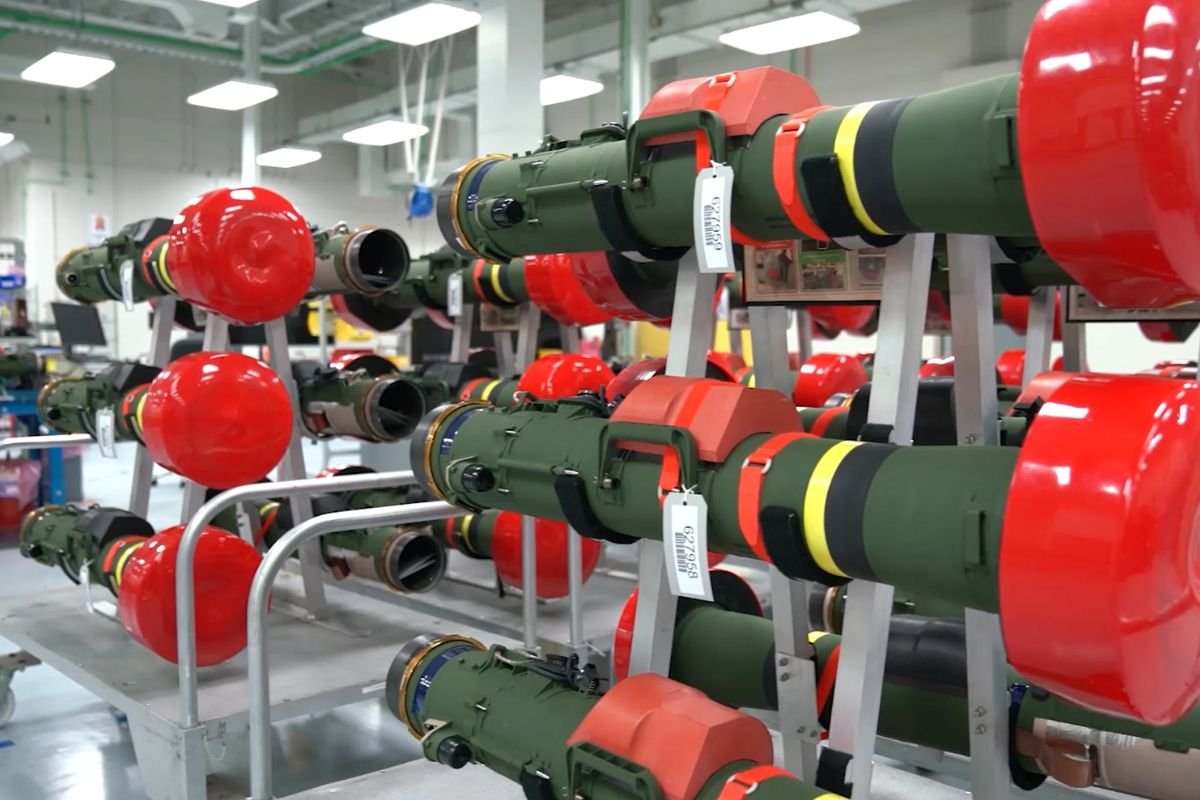
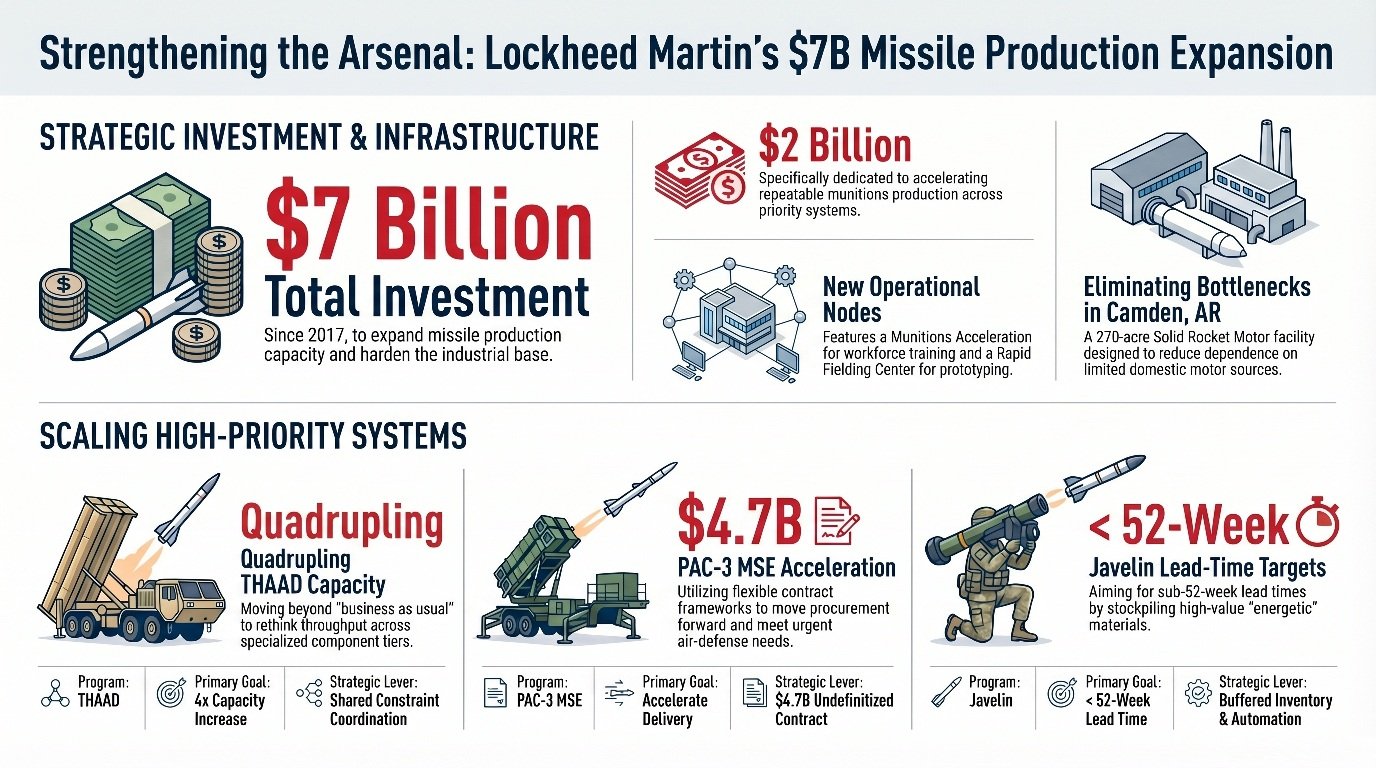
Lockheed Martin says it has invested more than $7 billion since 2017 to expand missile production capacity and harden the industrial base behind US and allied air defense.
The company frames the effort as a multi-year buildout of facilities, workforce, and supplier throughput, with about $2 billion aimed specifically at accelerating munitions production.
The spending comes as demand signals stay elevated across interceptor and long-range strike portfolios, and as Pentagon acquisition leaders push industry to deliver faster, with fewer supply-chain surprises. Lockheed points to new and expanded sites, process changes, and earlier supplier engagement designed to raise output of systems like PAC-3 MSE, THAAD, and PrSM, while keeping quality and schedule performance from slipping under higher tempo.
Related articles:
- European missile maker MBDA has doubled its production in two years, and with a $6.3 billion investment, it’s only the beginning
- This new Zeus missile could revolutionize infantry warfare at a fraction of the cost
War-driven consumption changes everything
That pressure is no longer theoretical. It is now tied directly to operational consumption rates in an active conflict environment.
The current war began on February 28, 2026, when US forces launched large-scale strikes against Iran, targeting nuclear facilities and Islamic Revolutionary Guard Corps (IRGC) bases. In the opening phase alone, more than 1,700 targets were hit using a mix of long-range cruise missiles, air-launched weapons, and precision-guided munitions. The scale of the initial salvo immediately translated into an unprecedented drawdown of US missile inventories.
Tomahawk stockpiles under severe strain
Within just one month, the United States fired more than 850 Tomahawk cruise missiles. Pre-war stockpiles were estimated at roughly 3,000 to 4,000 units, meaning close to one-third of available inventory was consumed in weeks.
With annual production limited to around 190 to 240 missiles, replenishment timelines are now measured in years, not months. Defense officials have privately described the situation as “alarming,” with some using the term “Winchester” to signal near depletion of available strike capacity.
JASSM-ER and global force posture impacts
The strain extends well beyond Tomahawk. The AGM-158 JASSM-ER, a key long-range air-launched strike missile, has also seen heavy usage.
Of an estimated 2,300 units available before the conflict, more than 1,000 have already been expended. Global force posture adjustments have further concentrated remaining inventory in the Middle East, leaving roughly 425 missiles available for other theaters, a sharp reduction in strategic flexibility.
Air defense interceptors under constant demand
Air defense systems are facing similar pressure. Patriot and THAAD interceptors are being consumed at high rates in response to sustained Iranian missile launches.
Approximately 1,800 Patriot interceptors have already been used, while annual production sits at roughly 700 units, creating a widening gap between usage and replenishment. Even with Iranian launch rates declining from around 150 missiles per day to roughly 30, the cumulative demand remains significant.
A fragile pause, but a structural imbalance
At day 35 of the conflict, the situation has entered a fragile phase. A two-week ceasefire has recently been announced, temporarily easing operational tempo.
However, stockpile levels remain critically low across multiple missile categories, underscoring the structural imbalance between modern high-intensity warfare consumption and industrial production capacity.
Pentagon response: scaling for long wars
This is the backdrop behind the Pentagon’s request for an additional $50 billion in defense funding, with a strong emphasis on munitions production acceleration.
The goal is not only to replenish depleted inventories, but to fundamentally reshape the industrial base to sustain prolonged high-intensity operations.
From investment headline to production reality
Lockheed’s headline figure, more than $7 billion invested since 2017, is presented as a sustained capacity expansion rather than a single factory announcement.
The company says the spending spans facilities, tooling, and workforce growth across “priority systems,” with roughly $2 billion carved out for munitions acceleration. That split matters because it signals a focus on repeatable production flow, not only R&D.
New production nodes and faster cycles
Two newer nodes in that approach are the Munitions Acceleration Center and the Rapid Fielding Center.
Lockheed describes the first as a workforce-oriented facility meant to prepare future production talent, while the second is positioned to compress the end-to-end cycle, development, testing, and prototype builds for US government customers. Put plainly, the company is trying to reduce the dead time between a requirement and a manufacturable, testable item.
Managing risk across the supply chain
This is also about risk management. When output targets rise, the weak links are rarely the final assembly line alone.
They show up in sub-tier suppliers, specialty materials, test equipment, and the availability of trained technicians who can work to spec under tighter timelines. Lockheed’s narrative is that earlier investment is cheaper than scrambling later, especially when demand spikes are driven by real-world security needs.
The question of real capacity gains
A fair critique is that big investment numbers can blur what is truly “new” capacity versus modernization that would have happened anyway.
Lockheed does not break down the $7 billion line by line in its public statements. But the company is tying the spending to measurable production goals, and that sets a bar: if output does not rise on schedule, the market and the Pentagon will treat the investment story as unfinished.
Sources:
- Lockheed Martin, “Lockheed Martin secures first contract for PAC-3 R MSE accelerated production, strengthening the arsenal of freedom” (published April 10, 2026),
https://news.lockheedmartin.com/2026-04-10-Lockheed-Martin-Secures-First-Contract-for-PAC-3-R-MSE-Accelerated-Production,-Strengthening-the-Arsenal-of-Freedom
official corporate release announcing a first contract to accelerate production of PAC-3 MSE interceptors, detailing increased manufacturing capacity, supply chain expansion, and the strategic objective of reinforcing air and missile defense capabilities for the United States and allied nations. - Lockheed Martin, “Scaling up Javelin supply chain: redefining ramped missile production” (published March 31, 2026),
https://www.lockheedmartin.com/en-us/news/features/2026/scaling-up-javelin-supply-chain-redefining-ramped-missile-production.html
corporate feature article explaining how Lockheed Martin is expanding and restructuring the Javelin missile supply chain, highlighting industrial scaling efforts, supplier network growth, and the challenges of rapidly increasing production to meet sustained global demand.
