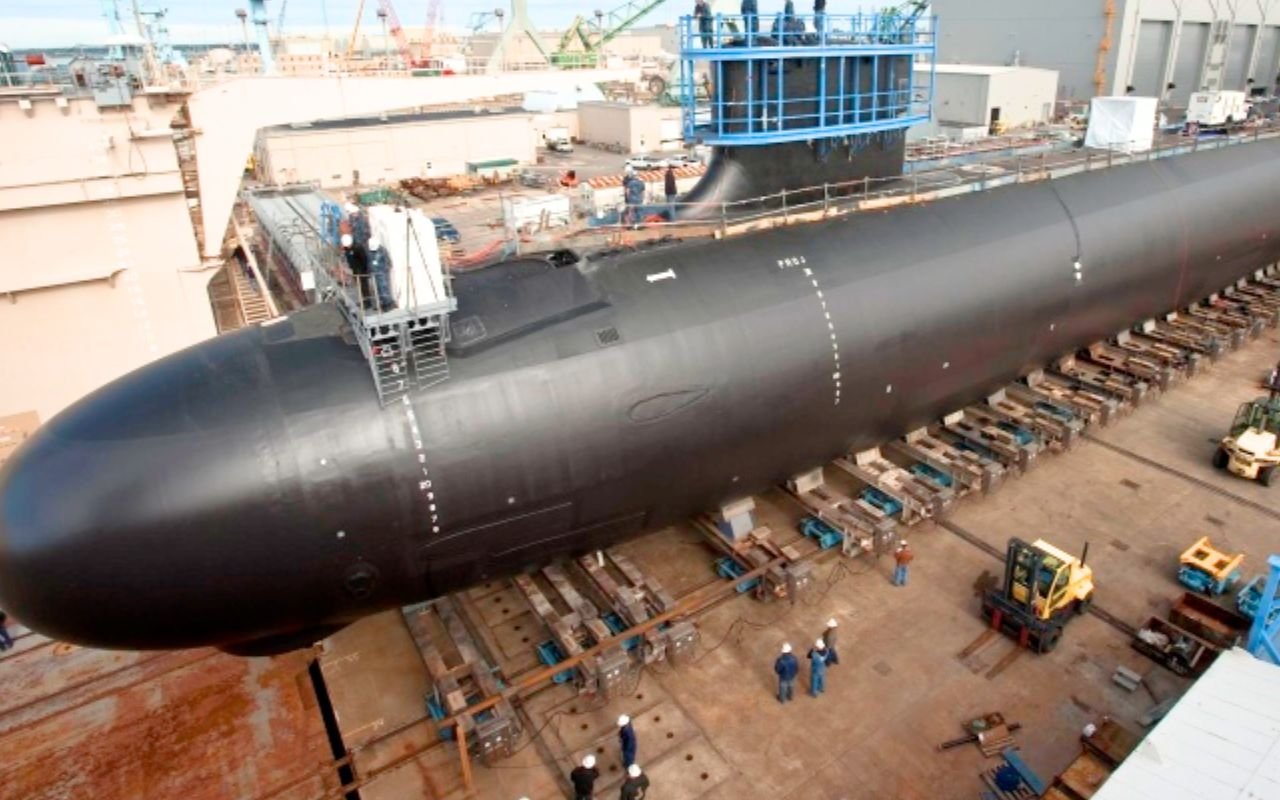
The US Navy has placed the USS Idaho into active service, adding another Virginia-class attack submarine to a fleet that Washington increasingly relies on for Pacific deterrence.
Idaho is the 26th Virginia-class boat, built over several years, from construction start in 2020 to launch in 2024, before the commissioning ceremony that makes it an operational unit. But the new hull also highlights a structural problem: the industrial pace behind the program is not matching the Navy’s long-term math. The service wants a steady flow of roughly 2 to 2.3 Virginia deliveries per year, yet projections point closer to 1.5, and senior officers have warned that 2024 production was about 1.13 submarines against a need of 2.0. That gap matters if the US aims for a larger force, including a target of 70 attack submarines by 2045, while China expands its own undersea capabilities.
USS Idaho commissioning underscores Virginia Block IV’s operational role
The commissioning of USS Idaho is not just a ceremonial milestone, it is the point when a submarine becomes usable for real tasking, from intelligence collection to strike missions. Idaho is part of Block IV, a configuration designed to raise availability by reducing the number of major maintenance periods over a boat’s service life. In practical terms, the Navy expects fewer long shipyard stays than earlier blocks, a detail that becomes crucial when hull numbers are tight.
Virginia-class submarines are built for a wide mission set: anti-submarine warfare, anti-surface warfare, deep strike, surveillance, reconnaissance, and support to special operations. The Block IV design includes 533 mm torpedo tubes and a weapons capacity described around 25 weapons, plus vertical launch capability through payload tubes. That mix is why the Navy keeps pushing these boats into the Pacific, where commanders want platforms that can shift roles quickly without waiting for a different class to arrive.
Idaho also lands in a year when the Navy has counted only two Virginia deliveries, including USS Massachusetts earlier in the year. Two deliveries might sound healthy to a casual observer, but the industrial baseline is what matters: the Navy’s planning assumes a consistent rhythm, not occasional bursts. If the fleet gets two boats one year and fewer the next, deployment plans, training pipelines, and maintenance schedules become harder to stabilize, especially when the Pacific is treated as the priority theater.
HII and Electric Boat struggle to sustain two Virginias per year
The Virginia program depends on two prime shipbuilders, HII Newport News and GDEB Electric Boat in Groton, and both have been under pressure to raise output. The Navy’s stated objective is an average of 2 to 2.3 Virginia-class submarines annually. Yet recent expectations have drifted closer to about 1.5 per year, a shortfall that compounds over time into several missing hulls, not just a minor scheduling issue.
Rear Adm. Jonathan E. Rucker put a number on the problem in 2025, noting that 2024 production was about 1.13 Virginia submarines against a need of 2.0. Congressional discussions have pointed to workforce and supply-chain constraints at shipyards and across the supplier base. In plain terms, even if the Navy has the budget authority and strategic urgency, the industrial system still has to find skilled labor, qualify parts, and keep complex nuclear construction moving without stoppages.
Another drag is that the same industrial ecosystem must also ramp up for the future Columbia-class ballistic missile submarines. That creates a collision of priorities: attack submarines are in demand today for presence and crisis response, while Columbia is treated as a strategic deterrent must-have. A shipyard manager described it to me like a household trying to renovate the kitchen while building an extension, the crews, tools, and subcontractors are finite, and every delay in one project tends to spill into the other.
The Navy’s 70-submarine 2045 goal collides with China and AUKUS commitments
The strategic target often cited inside Navy planning is a force of about 70 attack submarines by 2045, a number tied to the scale of the Indo-Pacific challenge. China’s undersea modernization has become a central driver of US posture, pushing more Virginia-class deployments into the Pacific and increasing the demand for ready boats. The problem is arithmetic: if deliveries remain below the desired annual rate for years, the fleet does not just grow more slowly, it risks shrinking as older submarines retire.
There is also the external commitment under AUKUS, with the United States expected to sell three to five Virginia-class submarines to Australia. That pledge has been described inside US defense circles as hard to square with current output, because every export hull is a hull not immediately available for US fleet counts unless production expands. Critics argue that Washington is trying to do two difficult things at once, deter China with more submarines while also using submarines as a pillar of alliance policy.
To address the bottlenecks, the industrial base has seen a major financial push, including an additional $15.4 billion tied to submarine manufacturing support connected to Columbia-related work at Electric Boat, with a new component production facility also cited in reporting. Money helps, but it does not instantly create certified welders, nuclear-qualified inspectors, or second- and third-tier suppliers that can deliver on schedule. The risk is not that the US stops building submarines, it is that the pace stays stuck below what strategy demands, while China keeps moving.
Sources
- Les États-Unis mettent en service l’USS Idaho mais leur industrie navale ne suit plus : les chantiers Virginia peinent à produire assez de sous-marins pour atteindre 70 unités face à la Chine d’ici 2045
- L’US Navy met en service son 26ème sous-marin nucléaire d’attaque de classe Virginia | Mer et Marine
- Chine vs États-Unis : l’émergence de sous-marins redoutables menace la suprématie navale américaine – Geo.fr
- Les États-Unis investissent 15 milliards pour renforcer la chaîne de fabrication de leurs sous-marins nucléaires
