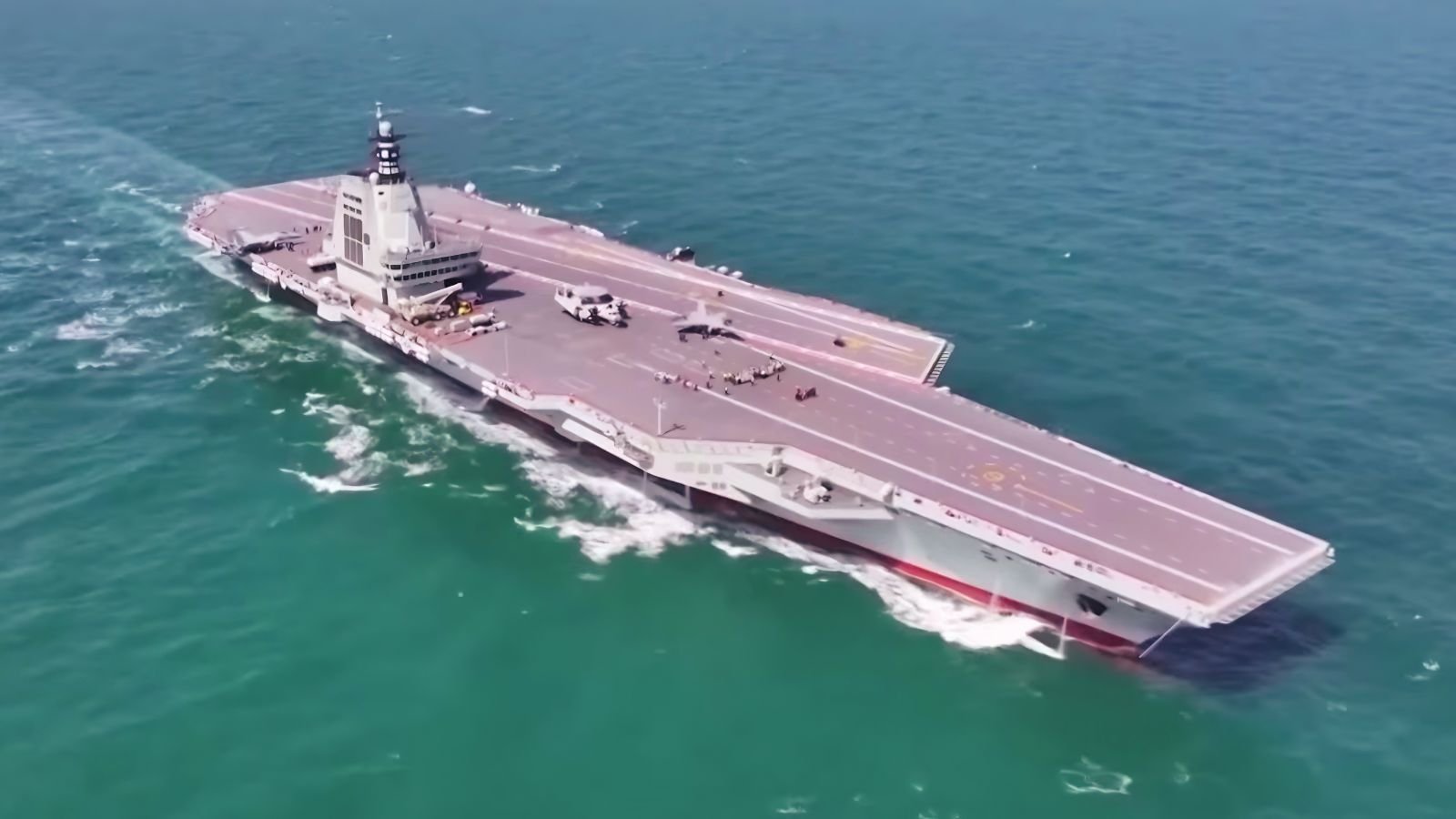
China is preparing a new benchmark in carrier aviation: a future nuclear-powered flattop, widely referred to as the Type 004, that could displace 110,000 to 120,000 tons and embark up to 105 aircraft.
That figure is notably higher than the roughly 75 aircraft typically associated with the U. S. Navy’s USS Gerald R. Ford class. The comparison matters because raw aircraft count is a blunt but influential proxy for operational tempo, flexibility, and staying power at sea. More jets, early-warning aircraft, and drones can translate into more patrols, more strike packages, and more resilience when aircraft break or require maintenance. The key question is what that extra capacity really buys in a fight, and what it demands in technology, crew training, and logistics.
Type 004 design aims at 105 aircraft on a 120,000-ton hull
A carrier’s air wing is limited by physical volume as much as ambition. A jump from about 100,000 tons to 120,000 tons is not a cosmetic change, it can mean more hangar space, more aviation fuel storage, more spare parts capacity, and wider margins for moving aircraft between the hangar and the flight deck. That is the practical foundation behind the reported 105-aircraft target for the Type 004.
In day-to-day operations, a larger embarked group can cover more mission types at once. A commander can keep combat air patrols up, launch anti-ship or land-attack sorties, and still retain aircraft for training, maintenance rotations, and contingency response. It also creates room for a more mixed fleet, including drones and airborne early-warning assets, without shrinking the number of fighters available.
There is a catch that gets lost in headline comparisons: maximum capacity and typical loadout are not the same. Even U. S. carriers can surge aircraft for specific missions, but they usually operate around a sustainable baseline that matches crew workload and maintenance cycles. Pushing toward a larger embarked number raises the burden on elevators, deck crews, and spare parts pipelines, meaning sortie generation depends on more than a big deck.
USS Gerald R. Ford relies on EMALS and nuclear power for sortie tempo
The USS Gerald R. Ford has been presented as the United States’ most advanced carrier design, built around nuclear propulsion and high electrical output to support modern systems. Its two A1B reactors are designed to produce far more electrical power than earlier classes, a core requirement for technologies that lean on electricity rather than steam-driven legacy equipment.
The most discussed example is EMALS, the electromagnetic catapult system, paired with advanced arresting gear. The intent is higher launch rates with reduced stress on aircraft, which matters when an air wing includes a mix of heavier fighters and specialized platforms. The Ford class is also associated with a typical air wing of around 75 aircraft, a figure that reflects a balance between capability and what can be sustained for long deployments.
Critically, the Ford comparison shows why aircraft count alone can mislead. A carrier that embarks fewer aircraft but launches them faster and recovers them more efficiently can still generate strong combat power. The U. S. Navy also plans for integrated operations with escorts, submarines, and land-based airpower, meaning the carrier is one node in a larger system, not a standalone air base.
Indo-Pacific planners weigh air wing size, logistics, and survivability tradeoffs
A Chinese carrier designed around 105 aircraft signals an intent to expand options in the Indo-Pacific, from persistent air cover to larger strike packages. In practical terms, a bigger embarked group can keep more aircraft in the air while others cycle through maintenance, which becomes important over weeks at sea. It also gives planners flexibility to include more drones without sacrificing fighter numbers.
But scaling up brings immediate constraints. A larger air wing increases demand for aviation fuel, munitions storage, spare engines, and deck crew endurance. It also raises the stakes for training and safety, because flight deck operations are inherently hazardous and the tempo of launches and recoveries drives accident risk. A carrier’s real output is shaped by the “boring” details: parts availability, maintenance capacity, and the ability to replenish at sea.
There is also the survivability question. A bigger, more capable carrier can become a higher-priority target in any confrontation involving long-range missiles, submarines, and surveillance networks. That pushes both sides toward layered defenses and dispersed operations. The headline difference between Type 004 and USS Gerald R. Ford is a useful data point, but the operational outcome will hinge on escort strength, intelligence, and whether either navy can sustain high-tempo flight operations under pressure.
Sources
- La Chine pourra embarquer 105 appareils sur son nouveau porte-avions atomique de 120 000 tonnes contre « seulement » 75 sur l’USS Gerald R.Ford
- La Chine imagine un porte-avions spatial volant de 120 000 tonnes …
- Voici le top 5 des porte-avions les plus massifs jamais construits par l’homme
- China’s Fujian vs America’s USS Gerald Ford: The Aircraft Carrier …
- Luanniao : un projet chinois de porte-avions spatial pesant 120 000 tonnes et capable de déployer 88 drones – Valeurs actuelles
