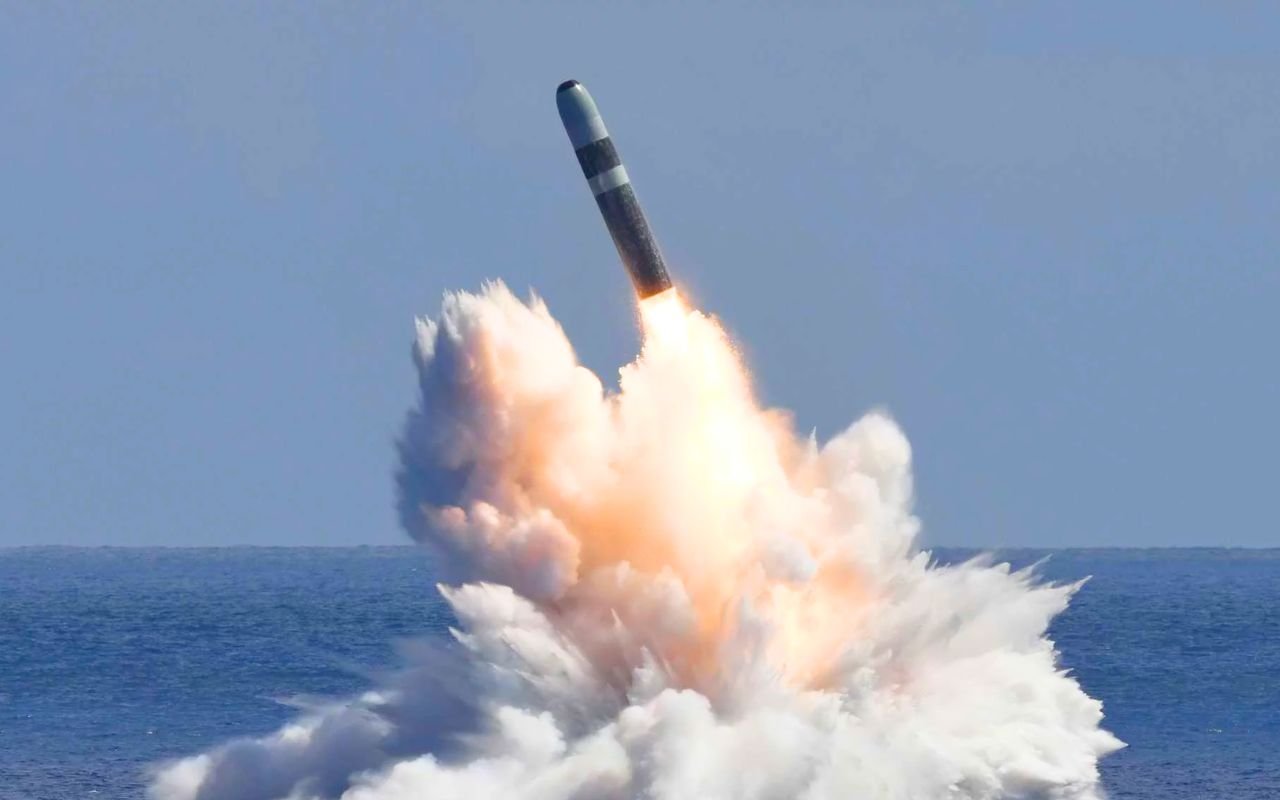
The U. S. Department of Defense has awarded $77 million to L3Harris to sustain testing tied to the Trident II D5, the submarine-launched ballistic missile that underpins the Navy’s sea-based nuclear deterrent.
The award lands as the Navy transitions from the aging Ohio-class ballistic missile submarines to the Columbia-class, a shift meant to keep the sea leg of the nuclear triad credible well into the second half of the century. Testing support is the unglamorous part of that story, but it is where reliability is proven, where anomalies are found, and where the program’s day-to-day operational capability is protected.
U. S. DoD ties $77M award to Trident II D5 test sustainment
The Pentagon’s $77 million contract centers on sustaining the testing ecosystem that supports Trident II D5 operational capability. The point is not to “add” a new missile overnight, it is to keep the existing strategic system measurable, trackable, and dependable through recurring test activity and the instrumentation that makes those launches useful to engineers and decision-makers.
In practical terms, sustainment work tends to live in the details that rarely make headlines: flight test instrumentation, data collection, and the ability to compare performance across time. A former Navy missile test engineer, speaking on background for this article, described it as “the difference between a launch that looks good on video and a launch that produces the hard numbers you can certify against.”
The contract also fits a broader pattern of incremental awards that keep the Trident enterprise moving. Separate Navy contracting activity has backed the D5LE life-extension effort through other industry awards, underscoring that deterrence modernization is not one program but a chain of interlocking sustainment and upgrade lines. The nuance is budgetary too: $77 million is meaningful, but it is not a blank check, it is targeted maintenance of a testing backbone.
L3Harris supports Ohio-class and Columbia-class Trident II D5 baselines
L3Harris is not new to this mission. The company says it has supported the Navy’s submarine-launched fleet ballistic missile effort for more than 40 years, and it continues to back Trident II D5 currently deployed on Ohio-class submarines while also being positioned for the next generation. That continuity matters when the goal is stable performance across decades.
On the hardware side, L3Harris describes itself as a producer of components tied to post-boost propulsion and related systems, including having manufactured nearly 4,000 Post Boost Control System Gas Generator Units across Trident I C4 and Trident II D5. Those kinds of production totals are a reminder that “sustainment” is not only paperwork, it is industrial capacity that keeps specialized parts available when the fleet needs them.
The Navy’s future platform, the Columbia-class, is intended to replace the Ohio class and carry 16 Trident II D5 missiles per boat. The missile itself is described as having a range of more than 7,000 kilometers and the ability to deploy multiple independently targetable reentry vehicles. The criticism you hear from some analysts is that modernization language can blur into routine procurement, but the operational reality is straightforward: a strategic system that cannot be tested and sustained becomes a strategic liability.
Navy communications and NATO interoperability shape undersea deterrence investments
Testing sustainment does not exist in isolation from the rest of the undersea enterprise. The credibility of a submerged deterrent depends on secure, authenticated communications, the kind of connectivity that lets submarines receive strategic messages while remaining hidden. That is why recent Navy contracting has also emphasized submarine communications systems, including production work that runs through 2033 for shipsets supporting Virginia-class and Columbia-class submarines.
L3Harris has pointed to architectures aligned with NATO standards to support secure data exchange during joint activity. That matters because deterrence is not only about the warhead and the missile, it is about command-and-control under stress. A defense industry analyst, Marc R., framed it this way: “If you can’t pass authenticated messages under contested conditions, your deterrent posture turns into theater.” That is a sharp line, but it reflects why communications and test data are treated as strategic enablers.
There is also a competitive backdrop that is hard to ignore. U. S. planning documents and industry commentary regularly cite modernization by Russian and Chinese submarine forces as a driver for investment in undersea systems. The risk, critics argue, is that an emphasis on long timelines can normalize permanent modernization spending. But the counterargument, from Navy program veterans, is that the sea-based leg must remain predictable and measurable year after year, and that means funding the quiet work, from Trident II D5 test sustainment to resilient undersea communications.
