
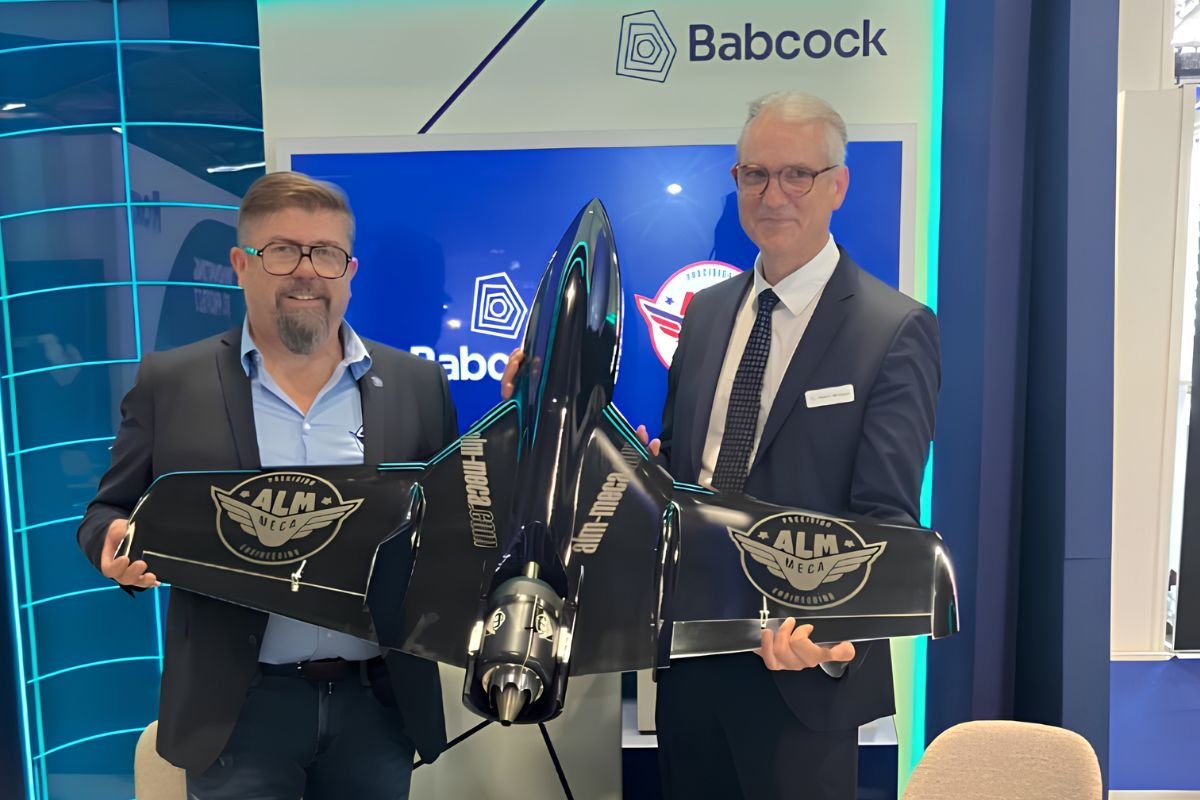
While Anduril was closing a nearly $2 billion counter-drone deal with Kuwait last month, the sharpest European answer to America’s drone-defense boom was taking shape in a machine shop of seventeen people in eastern France.
On June 16, 2026, at the Eurosatory defense show outside Paris, that shop — ALM Méca, based in the Alsatian village of Eschbach — signed a memorandum of understanding with Babcock France, the French arm of the British group Babcock International. The prize at the center of the deal is a jet-powered interceptor drone called Fury, a compact machine that hits 700 kilometers per hour (about 435 mph) to run down hostile drones. It is a small announcement with a large subtext: Europe wants counter-drone champions of its own, and it is hunting for them in unlikely places.
Related articles:
- New U.S. Counter-Drone Concept Challenges Airbus and Europe’s Lead
- Germany’s largest defense company teams up with Boeing to explore how to equip the country with a drone fleet based on the MQ-28 Ghost Bat
ALM Méca and Babcock France Join Forces to Industrialize the Fury Interceptor Drone
The problem everyone is suddenly racing to solve
The urgency is not abstract. Since 2022, cheap one-way attack drones have become weapons of attrition, saturating defenses and draining stocks of expensive surface-to-air missiles. The math is brutal: firing a Patriot interceptor that runs roughly $4 million at a drone that costs a few tens of thousands is a trade no military can sustain. Worse, the threat is getting faster — jet-powered variants of Iran’s Shahed and its Russian Geran cousins now fly far quicker than the propeller-driven originals, which forces interceptors to keep pace.
That is the gap the entire industry is now scrambling into, on both sides of the Atlantic. In the United States, it produced Anduril — and the story of how Anduril got here is worth telling, because it is the template Europe is quietly trying to copy.
US-based Kraus Hamdani unveils the record-breaking K1000ULE electric drone redefining ISR missions
How America built its answer
Anduril was founded in 2017 by Palmer Luckey — the young inventor who built the Oculus virtual-reality headset, sold it to Facebook for about $2 billion, and was pushed out soon after — alongside four co-founders drawn largely from the software contractor Palantir. Its founding bet was a direct challenge to the way weapons had been bought for half a century. Legacy primes like Lockheed Martin and Boeing develop hardware on government contract: the taxpayer funds the research, the contractor delivers the result, years later. Anduril inverted that. It raised private money, built the products it believed the military would need before anyone ordered them, and then sold the finished capability to the Pentagon — keeping ownership of its own designs and iterating at software speed.
The model worked, spectacularly. Backed by venture investors led by Peter Thiel’s Founders Fund, Anduril has raised well over $7 billion across successive rounds and reached a valuation near $60 billion after a spring 2026 raise. In March 2026 the U.S. Army handed it a ten-year enterprise contract worth up to $20 billion. A company that did not exist a decade ago is now closing on the scale of the giants it set out to displace. (In a small irony, Anduril fields a “Fury” of its own — an autonomous jet fighter for the Air Force, a far larger and unrelated machine.)
That is the scale, and the momentum, Europe is measuring itself against. And ALM Méca, at one-thousandth the size, followed the exact same playbook.
A jet interceptor built in under a year, on private money
ALM Méca is not the kind of company that usually shows up in this conversation. It made its name in precision machining for aerospace and defense — meticulous, near-artisanal metalwork — before it decided to design a full weapon system of its own. What makes the story unusual in France is how it happened: no structuring state program, no DGA framework, no prime contractor overhead. Founder Laurent Schaal poured somewhere between €3 and €4 million (roughly $3.4 to $4.5 million) of his own company’s money into it and built a flying interceptor in under a year — then went looking for a customer and the muscle to build it at scale. Self-fund, build first, sell later: it is the Anduril thesis in miniature.
The result is genuinely rare. Fury runs on a kerosene microturbine engineered in-house — a technology only a handful of firms anywhere can master, and, according to ALM Méca, no other French SME can produce at this level of performance. The microturbine is the whole game: it is what lets a machine this small accelerate hard enough to catch a jet-powered Shahed, and it is the piece competitors cannot simply buy off a shelf. At roughly 1.1 meters long and under six kilograms empty, Fury can pull maneuvers of around 20 G and, in the new V2 version, reach out to 120 kilometers (about 75 miles), up from 40. Its adviser Thierry Berthier, a researcher at the Saint-Cyr military academy, puts it plainly: there is no other product of this type in Europe.
Where Fury sits in the global pack
Fury plays in the same narrow segment as Anduril’s Roadrunner-M, which remains the reference. The gap in resources is stark — but the technical proposition holds up.
| Interceptor | Origin | Speed | Range | Status |
|---|---|---|---|---|
| ALM Méca Fury | France (Alsace) | 435 mph (700 km/h), microturbine | 25 mi (V1) / 75 mi (V2) | Flying demonstrator, ELISA contender |
| Anduril Roadrunner-M | United States | High subsonic (undisclosed), twin turbojet | Not disclosed | In service; $1.98B Kuwait sale (June 2026) |
| DELAIR ASPIK | France (Toulouse) | Undisclosed (electric) | Short to medium | DELAIR–CERBAIR partnership (June 2026) |
| Destinus Hornet Block 2 | Switzerland | High (microturbine) | 45+ mi | Integrated into Diehl’s Garmr MRS |
| TYTAN Technologies | Germany | Undisclosed | Short | Hensoldt partnership; 3,000 units/month target late 2026 |
| Fortem DroneHunter F700 | United States | Low (electric, net capture) | Very short | In service |
That a shop of seventeen can field something technically comparable to a company of several thousand, without massive subsidies or a state program behind it, is the part worth sitting with.
Why a British group, and what Babcock brings
The Babcock tie-up fills the one thing a garage-scale innovator never has: the ability to build at scale. Babcock France is no bit player — around 600 staff and €200 million (about $227 million) in revenue, woven into French defense for decades, handling maintenance for the French Navy’s helicopters and training Air Force crews. It supplies exactly what ALM Méca lacks: operational support, user training, maintenance, a logistics chain, and the capital to move from a few demonstrators to serial production. That the muscle came through the French subsidiary of a British group, rather than a French prime, is its own quiet commentary — one Paris will note, given that the government had earlier nudged national champions to step in.
Could Europe grow its own Anduril?
The near-term test is ELISA, a competition the French procurement agency launched in April 2026 with €18.7 million (about $21 million) to develop and industrialize drone interceptors — the agency admits current systems answer the threat only partially, in both volume and cost. A decision is expected around 2027. Fury will not have the field to itself: DELAIR and CERBAIR announced their own pairing the very same day, and MBDA is developing a Shahed-focused interceptor with Alta Ares.
And that crowded field is the whole ambiguity. Europe clearly does not lack talent in kinetic interceptors, nor even the appetite to bet privately — Schaal wagered his own company’s money on Fury exactly as Luckey’s circle wagered venture capital on Anduril. What Europe lacks is the machine that turns one founder’s gamble into a national champion: deep pools of private defense capital, a single large customer willing to buy fast from an unknown, and a culture that tolerates spectacular failure as the price of a breakout. Washington concentrated demand and money behind one name until it grew into a $60 billion company. Europe spreads a €18.7 million pot across a dozen promising shops of seventeen and lets a multi-year competition sort them out. One approach manufactures a giant. The other, for all its ingenuity, risks funding a great deal of brilliance that never reaches the scale to matter — and buying American in the end anyway.
Sources:
- Breaking Defense, US approves $2B sale of Anduril counter-drone systems to Kuwait (June 2026)
https://breakingdefense.com/2026/06/us-approves-2b-sale-of-anduril-counter-drone-systems-to-kuwait/
The $1.98 billion State Department approval, timing after the Kuwait airport strike, and Roadrunner-M’s role. - LinkedIn — Babcock France, Official announcement of the ALM Méca partnership (June 17, 2026)
https://www.linkedin.com/feed/update/urn:li:activity:7472680334350913536
The partners’ own announcement of the ALM Méca–Babcock France memorandum of understanding. - French National Assembly (Théo Bernhardt, MP for Bas-Rhin), Oral Question No. 305 — What support measures for ALM-MECA? (March 25, 2025)
https://questions.assemblee-nationale.fr/q17/17-305QOSD.htm
French institutional record of ALM Méca’s precarious finances in spring 2025 and the defense ministry’s response — including its approaches to Safran and Dassault and a first operational order.
