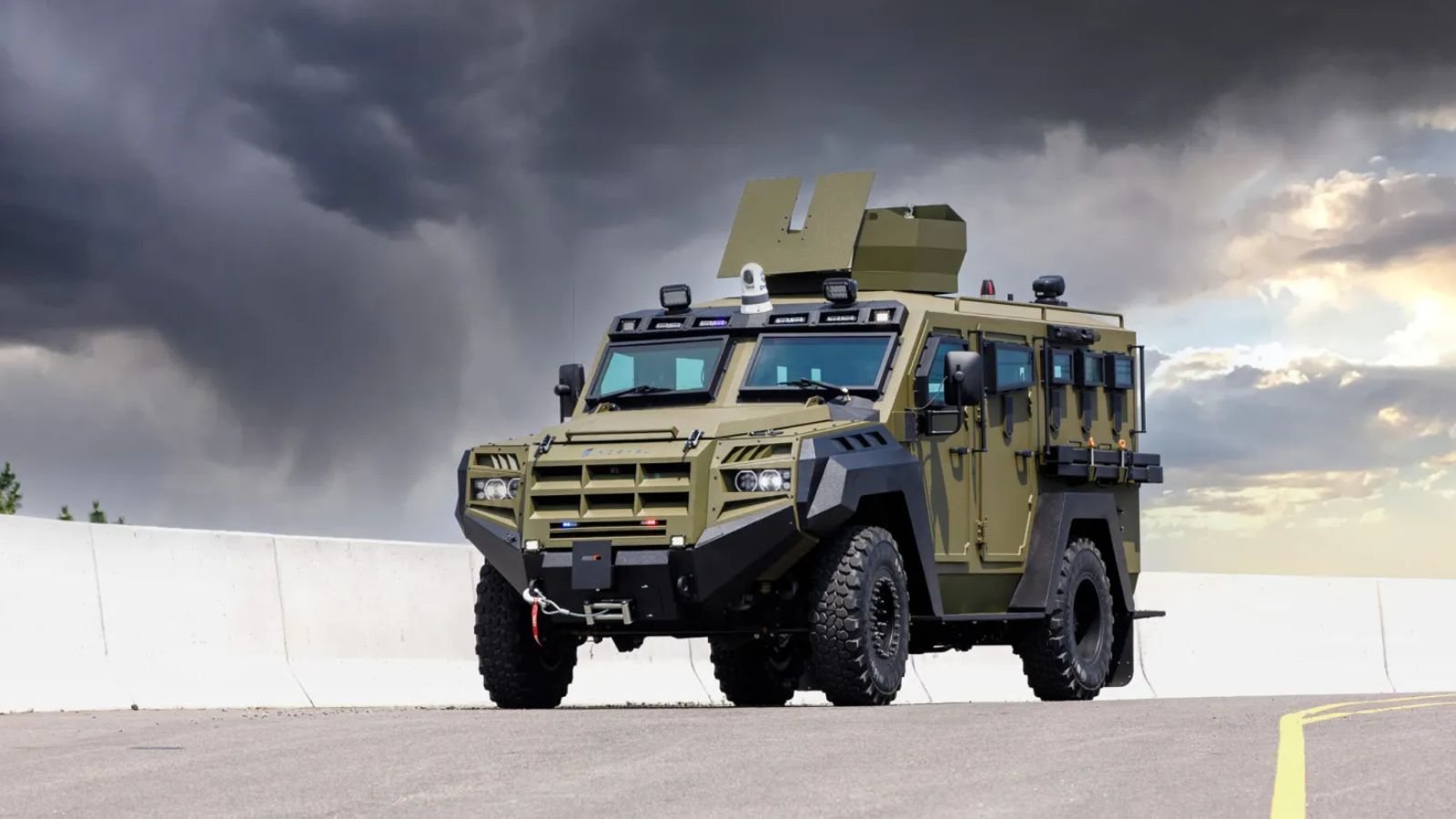
Strip off the armor plating and the V-shaped hull, and the vehicle the European Union just bought to shore up Moldova’s army is a Ford F-550 — the same heavy-duty pickup that tows trailers and hauls gravel across North America.
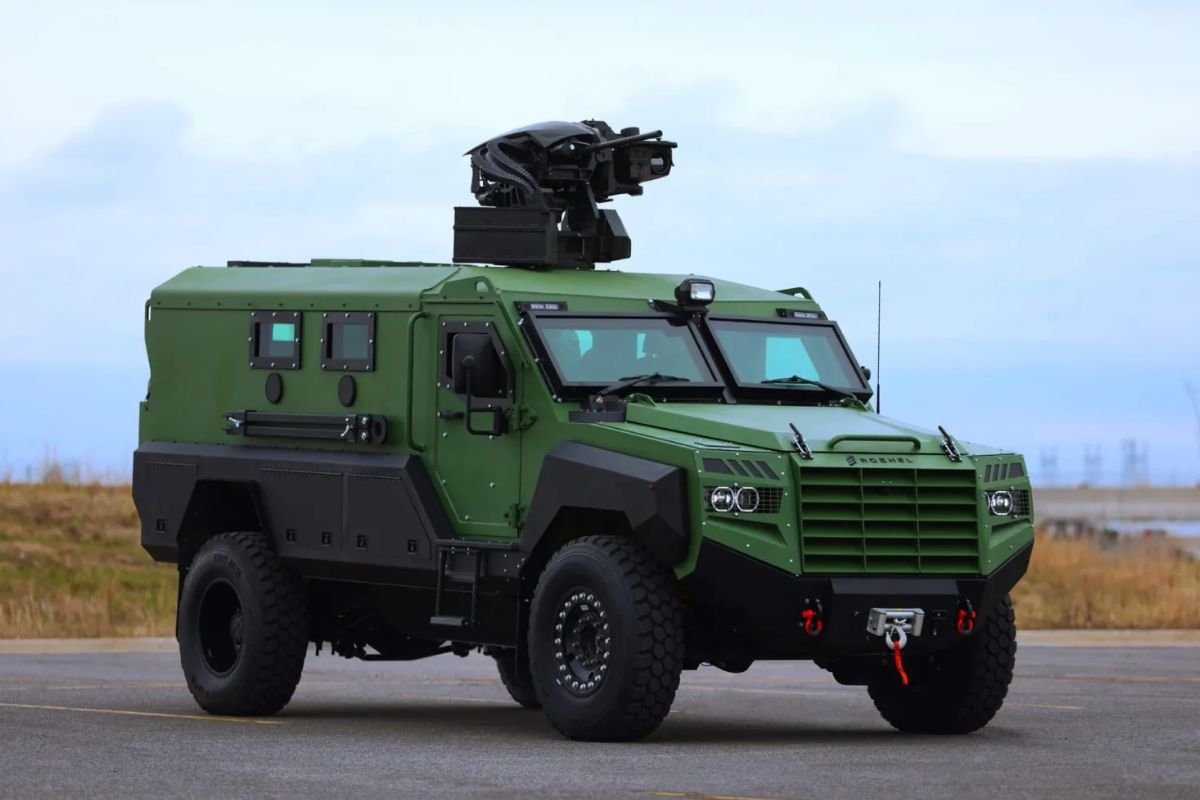
On June 30, 2026, Moldova’s Defense Ministry signed for more than 100 Senator armored personnel carriers from the Canadian manufacturer Roshel. The deal runs past €50 million ($57 million) and is paid for entirely by Brussels through the European Peace Facility. For a country of 2.4 million people, that is a serious order. For Roshel, it is one more entry in a growth story that quietly needles the way the West has spent decades buying its armored vehicles.
Related articles:
- Why France Is Vertically Integrating Its Armored Vehicle Supply Chain — Starting With KNDS Mobility
- British Army retires Land Rover fleet after decades of military service in 2026
From a Ford dealership to the front line
Roshel is not the sort of company that usually walks off with defense contracts. Based in Mississauga, Ontario, it threw out the traditional playbook. Rather than engineer an armored chassis from scratch — the slow, costly route legacy builders take with vehicles like Australia’s Bushmaster — Roshel begins with a Ford F-550, a commercial truck produced by the millions across North America. Onto that civilian frame it bolts armor certified to the CEN B7 standard, enough to stop sustained 7.62 mm fire, welds in a V-shaped hull to blunt mine and IED blasts, and fits a cabin for up to ten. Under the hood sits a 6.7-liter turbo-diesel good for roughly 330 horsepower and 553 lb-ft of torque.
The payoff is a vehicle that costs two to three times less than a purpose-built APC, leaves the factory faster, and — the genuinely clever part — can be repaired almost anywhere on earth, because Ford parts are never far away.
Ukraine was the proving ground
A cheap armored truck reads well on a spec sheet. Ukraine turned it into a résumé. Canada announced its first major Senator donation in January 2023, worth CA$90 million ($67.3 million) for 200 vehicles, and by May 2025 Roshel had handed Kyiv its 1,800th. The trucks ferried infantry along the front, joined Ukraine’s August 2024 push into Russia’s Kursk region, and were lost in real numbers: the open-source tracking project Oryx counted 176 Senators destroyed, damaged, or captured by December 2025. That attrition reads two ways at once — a sign of how many were deployed, and of how hard they were run.
The American footprint
This is where the story stops being a Canadian one. In December 2024, Roshel opened its first U.S. plant in Shelby Township, Michigan. Across 2025 it signed a string of Blanket Purchase Agreements with the State Department worth a combined $130.6 million for 330 vehicles, and launched a joint venture with the Czech firm OMNIPOL to build Senators on European soil — a move aimed squarely at shortening delivery times for European buyers like Moldova. The company says it has ramped toward a target of 1,000 vehicles a year. Mexico, Brazil, Haiti, and even Guam now field them. A truck that started on a Ford assembly line has become one of the most widely used Western armored platforms outside the marquee primes — with Washington among the paying customers.
Why Moldova, and why now
Moldova is the newest name on that list, and its predicament explains the order better than any sales pitch. Constitutionally neutral since 1994, it has no tanks, no combat aircraft, and no modern missile defense. Its army fields a little over 5,000 active troops on a defense budget near $109 million. On its eastern flank sits Transnistria, a self-declared breakaway sliver Chișinău has not governed since 1992, where roughly 1,500 Russian troops stand watch alongside local militia over the Cobasna depot — as much as 22,000 tons of decaying Soviet ammunition, two kilometers from Ukraine’s border. The temperature rose this spring: on April 16, 2026, Moldova barred the Russian group’s commander, Dmitry Zelenkov, and his deputies from entering the country.
Set against all that, 100 armored trucks will not win a war. What they do is close the most glaring gap in Moldova’s army — moving protected infantry quickly across its own ground, toward the Transnistrian line or the pro-Russian south.
| Indicator | Moldovan Army | Transnistria (separatist + Russian) | Ukraine (reference) |
|---|---|---|---|
| Active troops | 5,150–6,500 | ~7,500 (1,500 Russian + 5,000–6,000 local) | ~900,000 |
| Main battle tanks | None | ~24 T-64BV | 1,000+ (T-72, T-80, T-84, Leopard, Abrams) |
| Armored transports | A handful of BTRs + HMMWVs + 100 Senator (on order) | ~80 BTR + 15 BMP-1/2 | Several thousand |
| Combat aircraft | None | None | ~100 (MiG-29, Su-24/25/27, F-16, Mirage 2000-5) |
| Air defense | S-125 (obsolete) + Thales GM200 radar (2024) | Grad rocket launchers | Patriot, IRIS-T, NASAMS, SAMP/T, S-300 |
| Defense budget | ~$109 million (0.65% of GDP) | Funded by Moscow | ~$53 billion |
The formula the primes would rather ignore
None of this turns Roshel into a rival for the makers of high-end fighting vehicles. A Senator is no Bradley, and it was never trying to be. What it is, is a standing reminder that a large slice of the armored-vehicle business — troop transport, border security, convoy escort — does not require a bespoke, seven-figure platform. It wants something protected, available, and cheap enough to lose without wincing.
The State Department buys them. Ukraine runs them by the thousand. The European Union is now paying to park them in Moldova. Buried in that customer list is a question the traditional primes would rather leave unspoken: how much of their order book rests on vehicles a Ford dealership could nearly supply — and how long until a competitor decides to find out?
Sources:
- Defence Blog, Moldova to receive 100+ Canadian-made armored vehicles (June 2026)
https://defence-blog.com/moldova-to-receive-100-canadian-made-armored-vehicles/
Order details, Senator specifications, and Roshel’s U.S. manufacturing footprint and State Department contracts. - Logos Press, Moldova to Receive Over 100 Canadian-Made Senator Armored Vehicles (June 2026)
https://logos-pres.md/en/news/moldova-will-receive-more-than-100-canadian-made-armored-vehicles /
Ford F-550 chassis, grant value, minister’s statement, and the Ukraine delivery record. - True North Strategic Review, Moldova: The National Army will be modernized with over 100 new Roshel Senators (June 30, 2026)
https://www.truenorthstrategicreview.ca/p/moldova-the-national-army-will-be
Moldovan Defense Ministry press release and context on Roshel’s widening list of customers and partners. - Wikipedia, Russian military presence in Transnistria (2026)
https://en.wikipedia.org/wiki/Russian_military_presence_in_Transnistria
OGRF composition, the Cobasna depot, and the April 16, 2026 entry ban on commander Dmitry Zelenkov and his deputies.
Image : Featured image: Roshel’s primary ERV has been specifically designed to provide emergency response and rescue services.
